

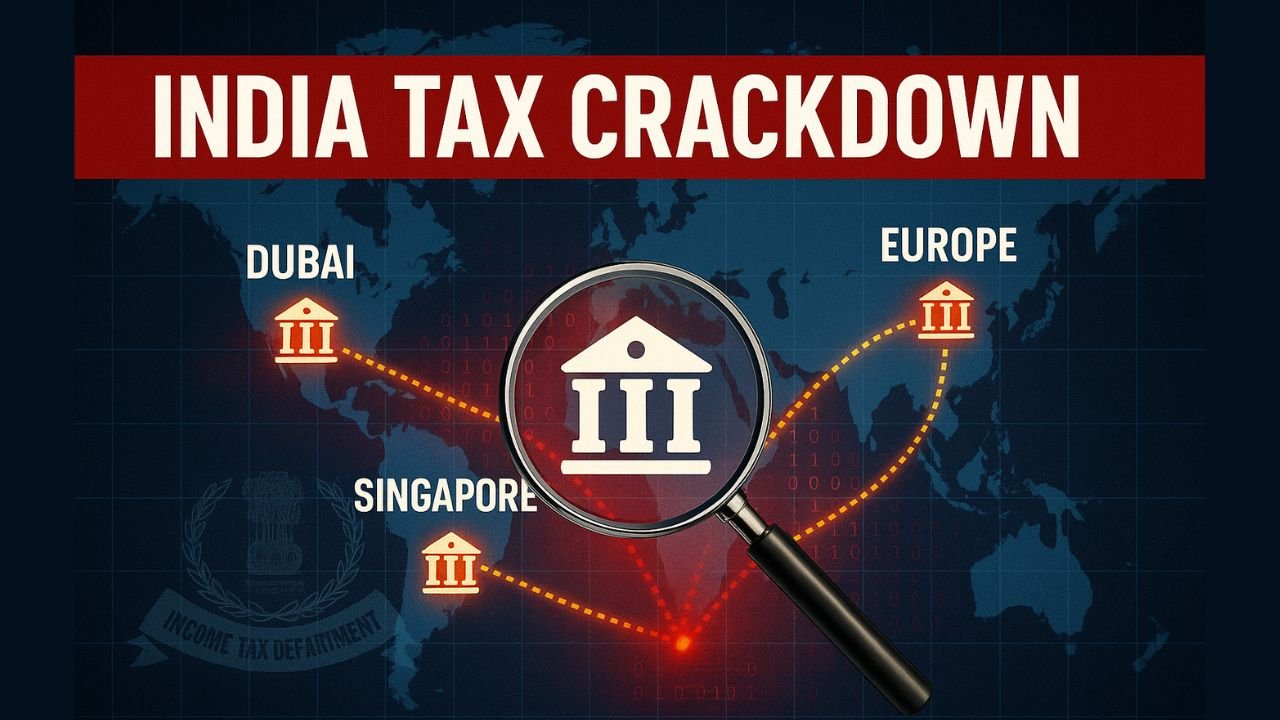

New Delhi. In a decisive move to combat black money and offshore tax evasion, the Income Tax Department has launched a major enforcement drive against undisclosed foreign assets owned by Indian taxpayers. According to officials familiar with the development, extensive data analytics conducted on financial activity reported for the assessment year 2024–25 has revealed thousands of cases where individuals appear to hold foreign bank accounts, property, or investments that were not declared in Income Tax Returns (ITR).
Sources say that in the first phase, the department has identified around 25,000 high-risk cases, signaling large-scale non-disclosure of offshore wealth. These cases are now under scrutiny for possible tax evasion and investment concealment.
Second Phase in Mid-December: NUDGE Campaign to Become More Aggressive
Officials have confirmed that the ongoing NUDGE campaign — designed to encourage taxpayers to voluntarily correct or update their filings — will be expanded significantly.
If individuals fail to comply even after receiving notifications:
- Scrutiny assessments will be initiated
- Detailed investigations will follow
- Penal and criminal proceedings may be launched
Large corporations and professional bodies have been instructed to sensitise employees—particularly those with overseas postings or stock options—about the mandatory disclosure of foreign income and assets.
The Central Board of Direct Taxes (CBDT) has directed ICAI, industry chambers and HR leadership of top corporates to ensure stronger compliance awareness.
The Law is Clear: 30% Tax + 300% Penalty for Hiding Wealth
Under the Black Money (Undisclosed Foreign Income and Assets) Act, 2015, failure to report offshore wealth attracts:
- 30% tax on the value of undisclosed asset/income
- Penalty up to 300% of the tax payable
- Additional fine up to ₹10 lakh
This rule applies to:
foreign bank accounts, overseas properties, shares, bonds, business ownerships and digital assets.
In simple terms, escaping tax liability on foreign income is now nearly impossible.
₹40,000 Crore Tax Demand Already Issued
By June 2025, the department has:
- Completed assessments in 1,080 cases
- Issued tax demands worth nearly ₹40,000 crore
Investigations and searches across major cities including Mumbai, Delhi and Pune have unearthed:
- Undeclared assets in Dubai and other tax-friendly nations
- Offshore corporate structures holding Indian-owned wealth
- Suspicious foreign account transactions
Officials estimate these concealed assets to be worth hundreds of crores.
CRS and FATCA Data Driving Most Detentions
India is leveraging global tax information networks —
- CRS (Common Reporting Standard)
- FATCA (Foreign Account Tax Compliance Act)
— to gather financial intelligence directly from foreign banks and investment platforms.
The department states:
“Concealing ownership of foreign accounts or assets is no longer feasible. Data trails always reach India.”
If taxpayers ignore warning notices under the NUDGE initiative:
- Their cases may be categorized as serious fraud
- They risk criminal prosecution
Who Is Under the Scanner?
Authorities are giving specific attention to:
- Foreign assets not reported in ITR
- Wealth hidden through family trusts or shell entities
- Individuals misusing NRI status for tax sheltering
- Deposits in overseas banks not declared to Indian authorities
Experts say stock-linked compensation for expatriate executives is also a major area of concern.
Goal: Transparent & Responsible Tax Culture in India
Tax analysts believe that stronger digital surveillance, automated data-matching algorithms, and global tax cooperation will ensure:
- Lower scope for tax evasion
- Higher probability of detection and penal action
The government, they say, is making its stance explicit:
“Comply with the law—or be ready to pay a steep price.”
Conclusion
The latest crackdown is seen as one of the most aggressive enforcement measures against offshore tax evasion in India’s history. Once flagged, taxpayers will have no choice but to pay:
- full tax dues
- maximum penalty
- and face legal consequences if fraud is established
The broader aim: to strengthen India’s financial integrity with fairness, transparency, and accountability in tax behavior.
