

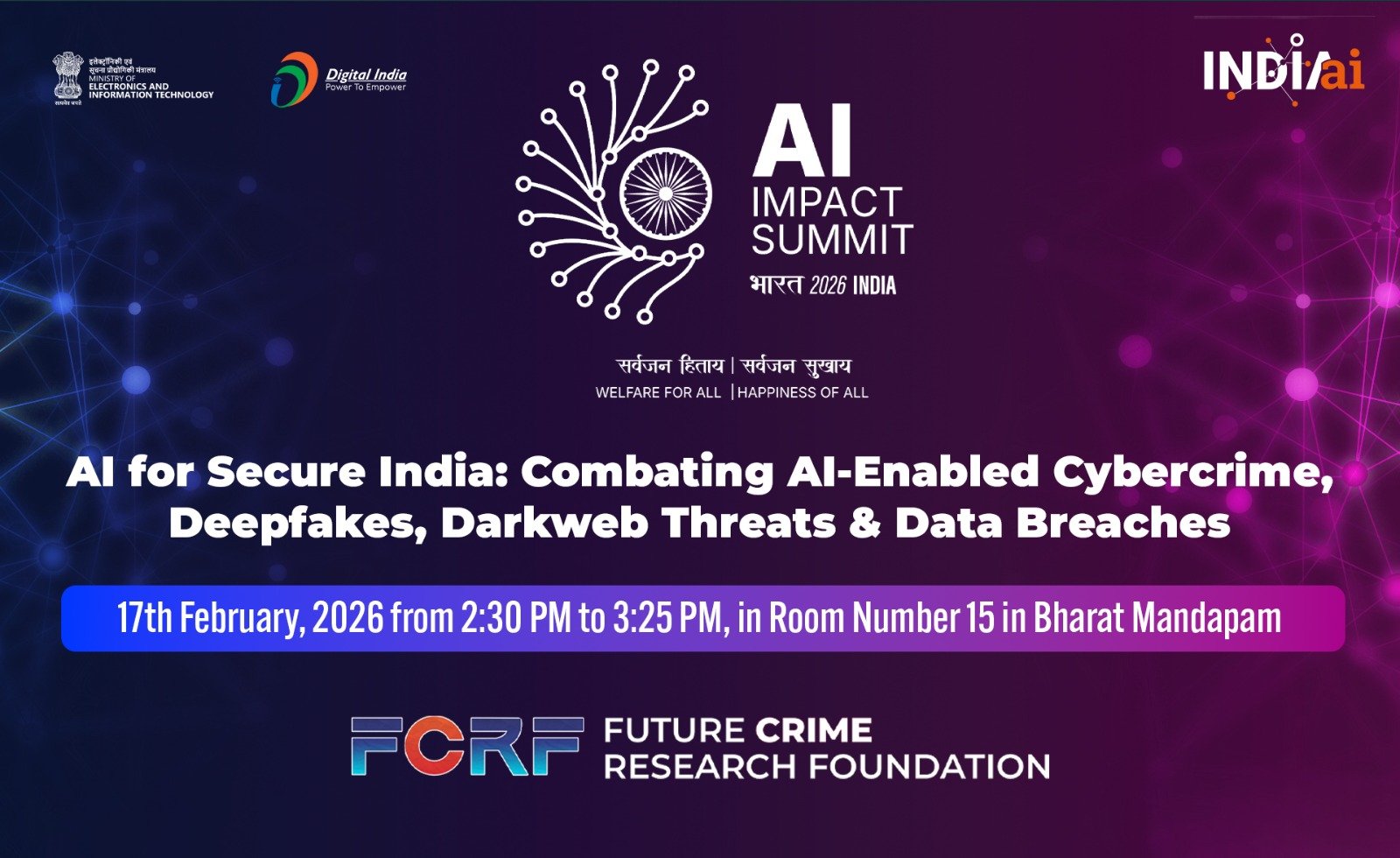

When the India-AI Impact Summit convenes in New Delhi from 16 to 20 February 2026, the event is expected to reflect both the promise and the unease surrounding artificial intelligence in India’s public life. Among its main summit sessions is a 55-minute discussion titled “AI for Secure India: Combating AI-Enabled Cybercrime, Deepfakes, Darkweb Threats & Data Breaches,” scheduled for 17 February 2026, from 2:30 PM to 3:25 PM, at Bharat Mandapam.
The session, part of the Summit’s main agenda, is designed to move beyond generic optimism about artificial intelligence. Instead, it will examine how the same technologies driving efficiency and innovation are being repurposed by criminal networks—fueling deepfake fraud, dark web marketplaces, large-scale data breaches, and increasingly automated cybercrime operations.
Organisers have positioned the session as a practical, policy-relevant conversation, aimed not only at technologists but also at lawyers, regulators, investigators, and institutional decision-makers navigating India’s fast-expanding digital ecosystem.
A Panel Bridging Law Enforcement, Law, Policy, and Industry
Moderating the discussion will be Prof. Triveni Singh, a former Indian Police Service officer and one of the country’s most widely recognised voices on cybercrime and digital investigations. Over nearly three decades in law enforcement, he has overseen complex cybercrime cases and advised agencies ranging from the CBI and NCRB to judicial academies and international cybercrime forums.
Joining him is Dr. Sapna Bansal, Director of Institutional Outreach and Inclusivity at Shri Ram College of Commerce, University of Delhi. With more than two decades in academia and public engagement, Dr. Bansal brings a perspective grounded in governance, education, and the societal impact of emerging technologies.
From the legal domain, Vivek Sood, Senior Advocate at the Supreme Court of India, is expected to address the constitutional and regulatory challenges posed by AI-driven technologies—from data protection and surveillance to accountability in algorithmic decision-making.
Industry insights will come from Tarun Wig, Co-Founder and CEO of Innefu Labs, whose firm works closely with law enforcement and critical infrastructure operators on AI-powered cybersecurity and intelligence solutions, and Rakesh Maheshwari, a former senior official at the Ministry of Electronics and Information Technology (MeitY) who played a key role in shaping India’s cyber law and data governance framework, including CERT-In coordination and enforcement under the IT Act.
Deepfakes, Dark Webs, and Data Breaches: Why the Moment Matters
The timing of the session reflects a broader unease within policy and enforcement circles. Over the past few years, India has witnessed a sharp rise in AI-assisted frauds—ranging from voice-cloned extortion calls and synthetic video impersonations to automated phishing campaigns and large-scale credential theft.
Experts note that these threats do not fit neatly within traditional categories of cybercrime. They cut across criminal law, data protection, platform regulation, and national security, often outpacing the legal and institutional frameworks meant to contain them.
By bringing together practitioners from enforcement, courts, academia, government, and industry, the session aims to situate AI-enabled cybercrime within this wider context—examining not only how such crimes are committed, but also how regulatory capacity, investigative methods, and public awareness must evolve in response.
An Open Invitation to Delegates
The organisers have extended an open invitation to delegates attending the India-AI Impact Summit 2026 to participate in the session, noting that seating will be limited to 100 participants at the venue.
All speakers and participants are required to complete official registration through the Summit portal. Delegates wishing to attend are encouraged to register at the earliest via the official link: https://impact.indiaai.gov.in/registration
As India’s engagement with artificial intelligence accelerates—across governance, markets, and daily life—the session promises a rare, grounded conversation about the risks unfolding alongside the rewards, and the institutional choices that may determine how securely the country navigates its AI-driven future.
