

Until recently, governance and compliance roles in India were largely reactive—activated after regulatory notices, audits, or enforcement actions. That approach is rapidly collapsing. Over the past few years, organisations have faced a convergence of regulatory pressures: stricter cyber incident reporting, heightened personal data protection obligations, sector-specific compliance mandates from financial regulators, and growing scrutiny of board-level risk accountability.
This has created a new professional reality. Companies are no longer looking for siloed legal or audit specialists. They want professionals who understand governance structures, risk mapping, regulatory alignment, and operational compliance as a single, integrated discipline. In short, they want GRC professionals.
It explains why senior lawyers, compliance heads, CISOs, auditors and government officers are increasingly enrolling in structured GRC certification programmes—not as résumé enhancements, but as career survival tools in a rapidly tightening compliance ecosystem.
The Rise of GRC as India’s “Meta-Compliance” Skillset
Governance, Risk and Compliance is no longer a theoretical framework borrowed from global consultancies. In India, it has become the connective tissue linking multiple regulatory regimes.
A data protection breach today is not just a privacy issue—it triggers cyber reporting obligations, board disclosures, reputational risk, sectoral penalties and potential criminal liability. Similarly, a financial compliance failure can cascade into enforcement action, governance lapses and leadership accountability.
GRC professionals are trained to see these interconnections. They are expected to anticipate regulatory risk, design internal controls, align organisational processes with evolving laws, and ensure that compliance is embedded into decision-making rather than appended as an afterthought.

This shift has driven demand for structured, India-centric GRC training—programmes that go beyond global frameworks and speak directly to Indian laws, regulators, enforcement practices and institutional realities.
Why FCRF Academy Has Become a Trusted Name in Compliance Training
Among the organisations benefiting from this shift is the Future Crime Research Foundation (FCRF), a Section-8, non-profit institution that has steadily built credibility in the compliance and cyber law training space.
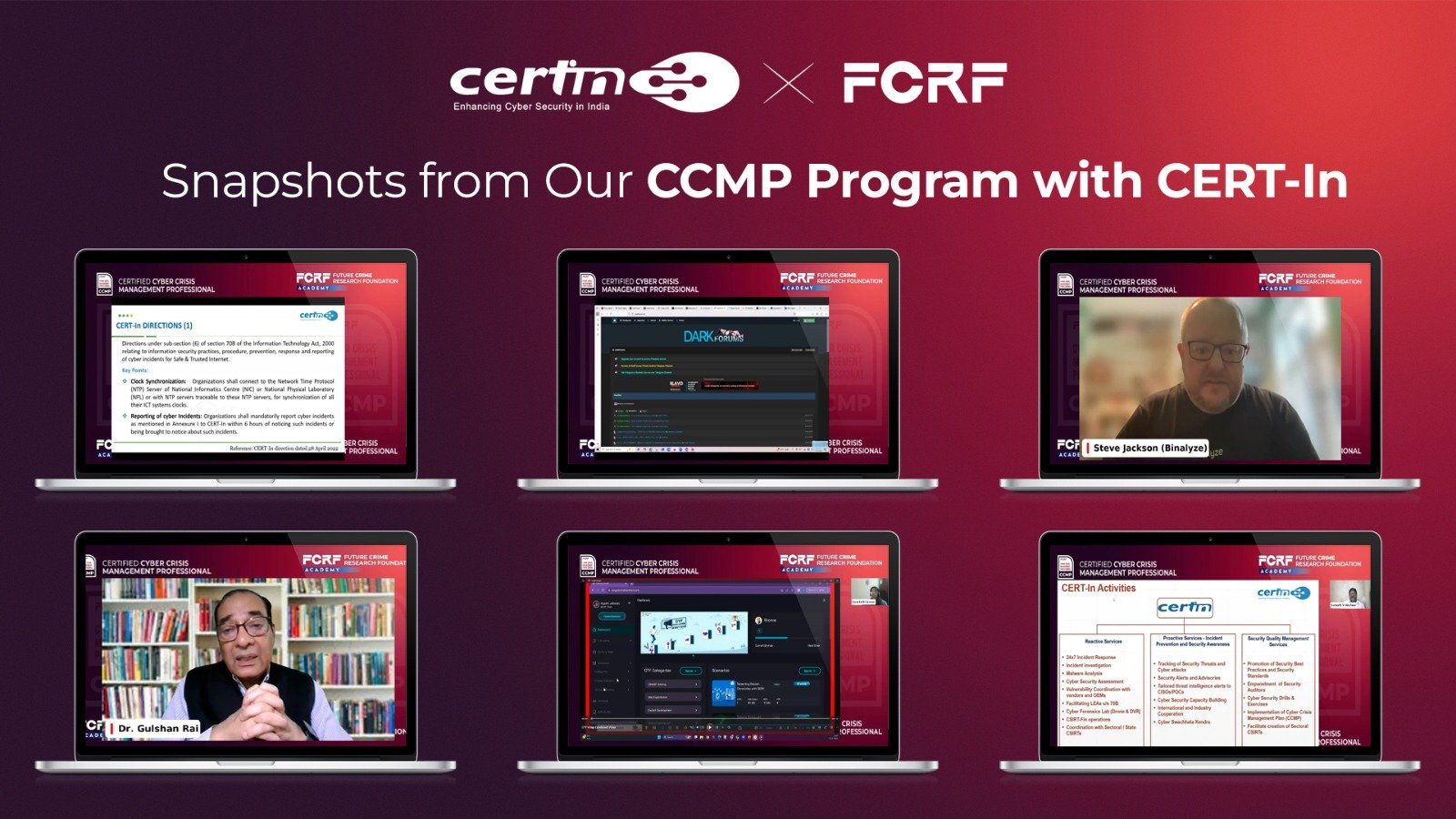
Unlike commercial training providers, FCRF’s credibility has been shaped by execution. Over the past few years, it has successfully delivered multiple national-level professional programmes, including cyber crisis management, cyber law practice, and data protection officer training. Several of these programmes have involved senior bureaucrats, law enforcement officers, judges, regulators, in-house counsel, and corporate compliance leaders.
FCRF’s track record matters in a sector crowded with short-term certifications. Its programmes have been built around Indian statutes, regulatory guidance, enforcement trends and real-world case studies—rather than imported templates with limited domestic relevance.
That history has now carried into its Certified Governance, Risk & Compliance Professional (GRCP) programme, which is being positioned not as an entry-level course, but as an advanced, practitioner-focused credential for working professionals.
Inside the GRCP Programme: Bridging Law, Risk and Practice
The GRCP programme reflects the reality that GRC cannot be taught in silos. Its curriculum is designed to move participants from foundational concepts of governance and risk, into sector-specific compliance obligations, digital and cyber risk, third-party risk management, and board-level accountability.
What distinguishes the programme is its emphasis on India’s regulatory stack—how different laws, regulators and enforcement agencies interact, overlap and sometimes collide. Participants are exposed to compliance expectations across sectors, the operationalisation of risk frameworks, and the practical challenges organisations face in aligning governance with fast-moving regulatory change.
The programme also draws strength from FCRF’s broader ecosystem. Having already trained thousands of professionals across its earlier certifications, the Foundation has developed a faculty base that includes senior practitioners, regulators, and subject-matter experts who bring enforcement-side perspectives into the classroom.
For many participants, the appeal lies in credibility. In compliance roles, credentials are scrutinised not just for content, but for the institution behind them. FCRF’s non-profit status, institutional partnerships, and record of delivering high-quality professional training have made its GRC programme a natural extension of its earlier work in cyber law and data protection.
A Credential for an Era of Continuous Scrutiny
As India moves deeper into an era of technology-driven regulation, compliance is no longer episodic—it is continuous. Regulators expect organisations to demonstrate preparedness, not just post-facto correction. Boards are being held accountable for governance failures. Senior management is expected to understand risk beyond financial metrics.
In that environment, GRC has emerged as a unifying professional discipline—one that sits at the intersection of law, technology, policy and organisational strategy. The surge in demand for GRC certifications reflects a broader recognition: compliance is no longer a support function, but a core leadership capability.
For professionals navigating this shift, structured and credible training has become essential. And for institutions like FCRF, the growing attention on its GRCP programme underscores how India’s compliance ecosystem itself is maturing—moving away from checklists, toward integrated governance and risk intelligence. Interested professionals can CLICK HERE to register now.
