
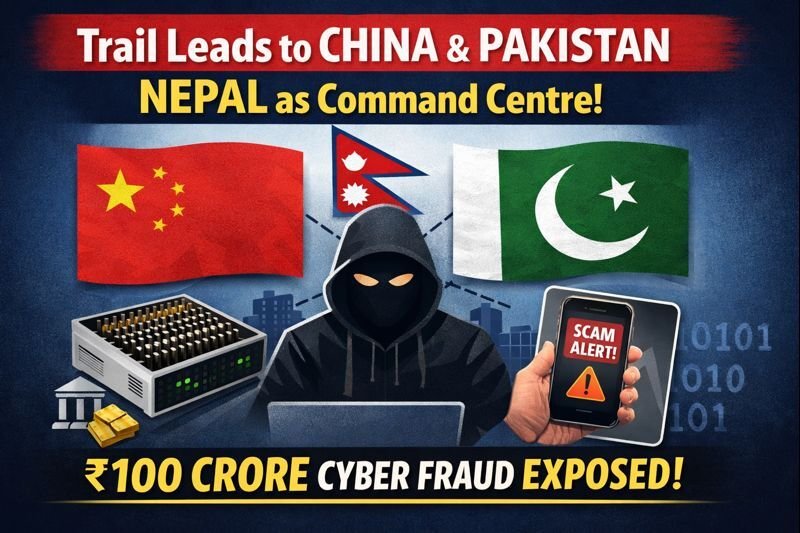
The Special Cell’s cyber unit of Delhi Police, IFSO, has busted a major international cyber fraud syndicate, exposing scams worth nearly ₹100 crore. Investigators say the network’s links ran across China, Pakistan, Nepal, Cambodia and Taiwan, with Nepal functioning as the operation’s command-and-control hub. So far, seven accused have been arrested, including a Taiwanese national identified as the technical mastermind behind the SIM-box network.
According to police, the syndicate used SIM box technology to convert international calls into Indian local numbers. The spoofed calls were then used to threaten victims nationwide with fabricated allegations of terrorism, money laundering and other serious offences. Victims were told they were under “digital arrest”, subjected to sustained psychological pressure, and coerced into transferring large sums to multiple bank accounts.
Certified Cyber Crime Investigator Course Launched by Centre for Police Technology
20,000 Numbers, Over 1,000 Complaints
Investigators said nearly 20,000 mobile numbers were active within the network. More than 1,000 complaints have already been recorded from different states. Preliminary estimates place the fraud at around ₹100 crore, though officials believe the actual figure could be higher as many victims are yet to come forward.
Routing via 2G to Evade Tracking
Senior IFSO officials said complaints surged from September after victims began receiving calls purportedly from the UP ATS and other agencies. Technical analysis revealed that calls were deliberately routed through 2G networks to evade precise location tracking. SIM boxes converted international traffic into local calls, making it extremely difficult to identify the caller’s origin or country.
Investigators also found that the same number appeared active across multiple cities simultaneously. This was achieved by overwriting and rotating IMEI numbers within SIM-box devices, effectively misleading call records and network tracing systems.
Raids Across Delhi, Punjab and Tamil Nadu
Based on technical leads, raids were conducted in Delhi’s Goyla Dairy, Qutub Vihar, Dinpur and Shahbad Dairy, resulting in the arrest of local SIM-box operators. Further investigation uncovered another setup in Mohali, Punjab. Police also detected preparations for a new SIM-box hub in Coimbatore, Tamil Nadu, which was dismantled in time.
Key Role of Taiwanese National
The probe revealed the role of I-Tsung Chen, a Taiwanese national who handled the supply, installation and technical configuration of SIM-box equipment. After monitoring encrypted communications, police arrested him at Delhi airport on December 21. Questioning indicated his links to an organised cybercrime network based in Taiwan.
Pakistani Handler, Nepal-Based Control
During interrogation, the arrested accused admitted they had previously worked in scam call centres operating out of Cambodia. A Pakistani handler allegedly recruited them and directed the establishment of SIM-box hubs in India. Investigators said the entire operation received real-time instructions from Nepal, where controllers coordinated tasks for Indian ground operators.
What Is a SIM Box—and Why It’s Dangerous
A SIM box is a device capable of hosting hundreds of SIM cards simultaneously, enabling international calls to be routed as local ones to bypass telecom charges and surveillance. Police said the seized SIM boxes were used for digital-arrest scams, phishing calls, fake loan offers and investment frauds, masking origins and complicating enforcement.
National Security Angle
Delhi Police said the case extends beyond financial fraud to cross-border organised crime with national security implications. Further arrests, asset seizures and coordination with international agencies are expected. Citizens have been urged to treat any call claiming a “digital arrest” or posing as an enforcement agency with suspicion and to immediately contact the cyber helpline or the nearest police station.
About the author – Ayesha Aayat is a law student and contributor covering cybercrime, online frauds, and digital safety concerns. Her writing aims to raise awareness about evolving cyber threats and legal responses.
