

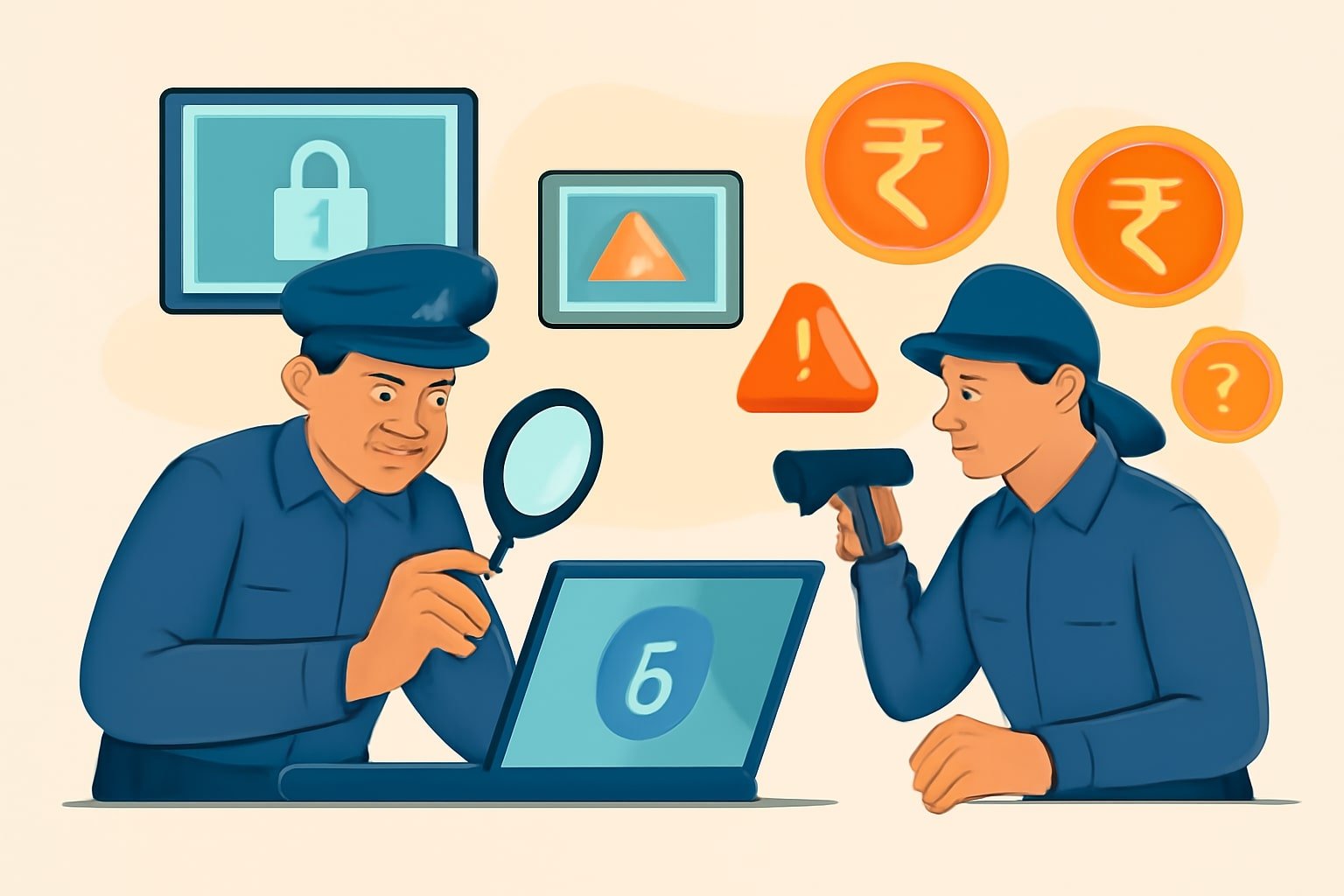
New Delhi | December 2025 The Delhi Police Crime Branch has dismantled a sophisticated multi-state cyber fraud syndicate allegedly linked to Chinese handlers, exposing a web of shell companies, forged identities and cryptocurrency-based money laundering.
The operation began after a senior citizen filed a complaint stating that he had been cheated of ₹33.10 lakh in an online investment scam. A detailed financial and technical probe revealed an elaborate system designed to siphon, layer and launder funds across India before routing them overseas through digital assets.
Shell Companies Used to Launder Victim Funds
Investigators found that a significant portion of the cheated amount was routed through a bogus company named BELCREST India Pvt Ltd, which existed only on paper.
Police said:
- ₹10.38 lakh from the complainant passed through BELCREST-linked accounts
- The firm had no genuine business operations
- It was created solely to act as a laundering channel
Technical analysis confirmed BELCREST as a central node in the syndicate’s financial network, used to pool and redistribute stolen funds.
First Arrest Leads to Collapse of Network Layer
The Crime Branch arrested Lakshay, a Delhi resident, on November 19. He allegedly:
- Opened BELCREST using forged credentials
- Provided bank kits and SIM cards to the syndicate
- Received ₹20,000 per month for facilitating account operations
Lakshay’s interrogation helped investigators identify Shubham, described as a key operator coordinating account usage and fund movement.
Weeks-Long Surveillance Ends in Key Arrest
A special team led by Inspector Ashok, SI Bhagyashri and HC Dinesh tracked Shubham across Delhi-NCR for weeks. Police said he frequently changed mobile numbers to avoid detection.
Shubham was arrested in Tilak Nagar on December 6.
From his possession, police recovered:
- One laptop
- Two mobile phones
- Five cheque books
- Six debit cards
USDT Currency Trail Points to Chinese-Controlled Entity
During questioning, Shubham allegedly disclosed the structure of the laundering operation. Investigators found that stolen funds were passed through multiple shell-company accounts, including:
- CSP24SEVEN Technologies
- Levin Fintech
- EKO India
- Rinova Pvt Ltd
- Money Wave Pvt Ltd
- Easy Mudra Pvt Ltd
- Lavi Software & Technology Pvt Ltd
The money was then converted into USDT (Tether cryptocurrency) and repeatedly sold to an entity identified as “Kool Pay,” believed to be controlled by Chinese operators.
Police described the mechanism as a “circular flow” system:
- Victim money enters first-layer accounts
- Routed into BELCREST
- Passed through dummy firms
- Converted into USDT
- Sent to Kool Pay
- Reintroduced to finance new scam operations
Evidence Destroyed After Co-Accused Arrest
Investigators said that after learning of Lakshay’s arrest, Shubham attempted to destroy evidence by:
-
Destroying BELCREST cheque books
-
Snapping SIM cards linked to the company
The mobile phone associated with the discarded SIM has now been recovered. Cyber forensic teams are analysing its digital footprints, wallet links and communication logs to trace foreign handlers.
Further Arrests Likely as Probe Expands
The Crime Branch confirmed that:
- Cryptocurrency transaction trails are under analysis
- Foreign coordination links are being examined
- Additional arrests are expected in coming days
Officials said the case exposes the industrial scale at which cyber fraud is now operating, combining domestic shell firms with cross-border crypto laundering networks.
Conclusion: A Growing Hybrid Threat
The bust highlights how modern cyber fraud has evolved into a hybrid crime model — blending traditional financial fraud, identity forgery and blockchain-based laundering.
Police officials warned that such syndicates often operate across jurisdictions, making early detection and inter-agency coordination critical.
“This is no longer just digital cheating — it is organised financial crime with international linkages,” a senior officer said.
Authorities have urged citizens to remain cautious of online investment schemes and to report suspected scams immediately, as delayed reporting significantly complicates fund recovery.
