

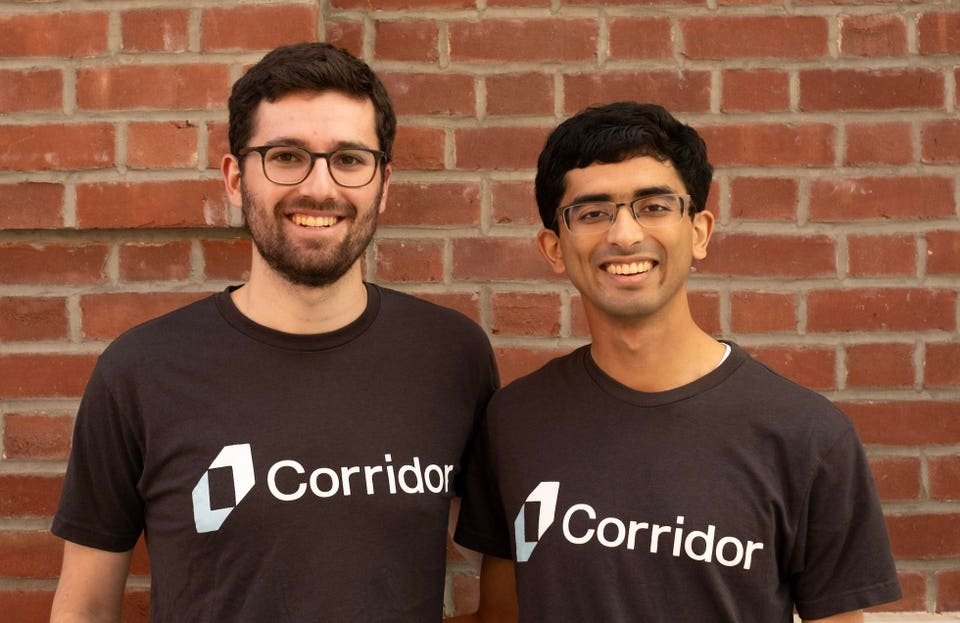

In the United States, two 26-year-old former government cybersecurity specialists, Jack Cable and Ashwin Ramaswami, have launched AI cyber startup Corridor, introducing a new way to prevent vulnerabilities in software coding. According to the company, Corridor recently raised $25 million (approximately ₹207 crore) in funding, bringing its total valuation to $200 million (around ₹1,660 crore).
AI as a Real-Time Security Layer in Coding
Corridor’s product is an AI-based system that monitors code being written by both human and AI operators. It issues immediate alerts whenever a security risk is detected, allowing developers to fix problems before the code goes live.
Jill Storm, VC at Felicis, said, “The pace of code creation has far outstripped the speed of security reviews. Corridor’s system offers a unique way to handle this in real-time.”
A recent Veracode report found that, while some premium AI models are improving in writing secure code, most AI systems still regularly introduce vulnerabilities. OpenAI’s GPT-5 model, for instance, exhibited a known security flaw in one out of every four coding tasks.
Cable and Ramaswami met at Stanford and later worked together at CISA. In 2020, Cable led the Secure By Design project, working with companies like Microsoft and Google to prevent known vulnerabilities from being coded into widely used software. After leaving DHS, both launched Corridor in early 2025.
FutureCrime Summit 2026 Calls for Speakers From Government, Industry and Academia
Funding Momentum and Market Expansion
Corridor’s current clients include AI coding providers and security companies, such as the AI customer service startup Pylon, valued at $365 million (about ₹3,030 crore), and Sublime Security, which has raised $240 million (around ₹1,992 crore) and is valued at $950 million (approximately ₹7,900 crore). Pylon engineer Aashish Kapur said Corridor allows his team to ship code without waiting for human review of security issues. Sublime’s CSO Andrew Becherer added that Corridor detected potentially critical vulnerabilities before they entered their product—something a human reviewer would struggle to identify.
Cable and Ramaswami claim their AI system identifies vulnerabilities more effectively than humans. Cable stated,
“AI can be highly effective in detecting and preventing flaws while ensuring code security. It surpasses human capabilities in both finding and mitigating risks.”
The new funding will be used to expand Corridor’s research and sales teams, recruit top talent, and strengthen security capabilities. Last year, the company appointed former Facebook CISO Alex Stamos and Joel Wallenstrom, former CEO of encrypted communication app Wickr, to key positions.
Rising Demand for AI-Led Cybersecurity Solutions
Corridor is part of a broader surge in AI-focused cybersecurity startups. Last year, security testing firm Tenzai secured $75 million (around ₹620 crore) in a seed round with a $330 million (approximately ₹2,742 crore) valuation. Irregular, which tests the safety of AI models at Anthropic and OpenAI, raised $80 million (around ₹656 crore).
Jake Storm remarked, “The volume of AI-generated code is exploding, but the security expertise per line of code has shrunk. Corridor’s proactive system ensures precise and timely security oversight.”
Corridor aims to make security a priority in AI-based software development and provide reliable solutions in the rapidly growing AI coding industry.
