

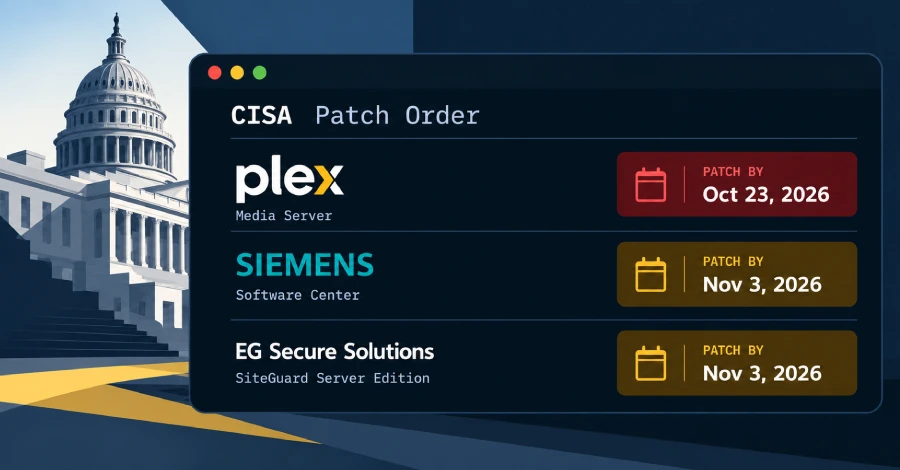

The US Cybersecurity and Infrastructure Security Agency has ordered federal civilian agencies to secure their systems against six actively exploited vulnerabilities affecting Plex Media Server, Siemens Software Center, and EG Secure Solutions SiteGuard Server Edition. Added to the Known Exploited Vulnerabilities catalogue on October 20, the flaws have been targeted by threat actors in real-world campaigns to deploy illicit cryptocurrency miners, install proxy malware, and execute unauthorized commands. The agency established two strict remediation targets, instructing federal bodies to mitigate the most critical exposures by October 23, 2026, while setting a secondary deadline of November 3, 2026, for the remaining security weaknesses.
Plex Flaws Chained to Deliver Malicious Payloads
Four of the newly catalogued security defects directly impact Plex Media Server, an application widely deployed to manage and stream personal digital media libraries. Identified under the tracking numbers CVE-2026-96652, CVE-2026-96654, CVE-2026-96655, and CVE-2026-96656, with severity ratings extending up to 8.6, the flaws collectively constitute an attack chain known as Plex2Shell. Discovered by security researcher Zach Main, the weaknesses involve server-side request forgery, improper URI scheme handling, and external control over file paths, which together allow an unauthenticated remote adversary to run arbitrary code on target hosts.
Exploitation activity identified by researcher boredhackerblog confirms that malicious actors are taking advantage of these vulnerabilities to compromise host devices for covert utility. Attackers have deployed cryptocurrency mining software that drains hardware performance to generate digital assets, as well as proxy malware designed to channel traffic through compromised hosts to obscure further hostile activity. Plex addressed these underlying security gaps in software version 1.43.3.10861, released on August 3, 2026, prompting security officials to advise immediate software audits across all internet-facing installations.
Siemens Application Compromised Through Deceptive Campaigns
Federal authorities also designated CVE-2026-110936, a high-severity flaw in Siemens Software Center carrying an 8.4 rating, as an active operational threat. The vulnerability stems from dynamic-link library sideloading, an architectural weakness wherein an authentic software process mistakenly executes an unauthorized external library. Threat actors have actively incorporated this mechanism into ClickFix campaigns linked to an infrastructure platform known as Romulus, tricking users into triggering system actions through falsified error dialogues and fraudulent procedural instructions.
By manipulating trusted software execution environments, attackers are able to run unauthorized operations on enterprise endpoints while bypassing routine system safeguards. The inclusion of the Siemens flaw within the federal registry highlights an immediate requirement for administrative teams to assess software dependencies, isolate vulnerable application components, and deploy vendor-supplied updates to prevent credential misuse and endpoint tampering.
Japanese Server Security Suite Hit by Command Injection
The directive further encompasses CVE-2026-106931, an 8.5-rated command injection flaw discovered in SiteGuard Server Edition, developed by Japanese cybersecurity firm EG Secure Solutions. The flaw permits remote operators to execute unauthorized system commands by manipulating application input parameters, potentially granting comprehensive control depending on the service execution rights assigned to the suite. While the developer has formally acknowledged ongoing in-the-wild exploitation of the flaw, specific technical details regarding the identity of the threat groups and their operational mechanisms have not been publicly disclosed.
To contain the risk of enterprise infiltration, CISA mandated that civilian federal departments patch CVE-2026-106931, alongside Plex vulnerabilities CVE-2026-96656 and CVE-2026-96654, by October 23, 2026. The remaining trio of vulnerabilities must be remediated by November 3, 2026. Although the binding directive formally governs civilian government networks, security authorities have urged private-sector network administrators to apply identical remediation schedules to shield commercial infrastructure from active compromise.
Follow for daily updates on cybercrime, corporate fraud, DFIR, hacking, investigations, and digital forensics
