
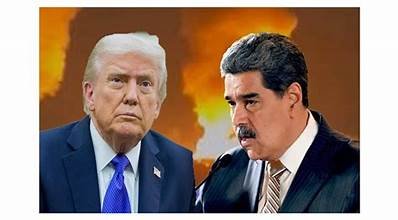
The large-scale US airstrikes in Venezuela and the subsequent capture of President Nicolás Maduro have triggered intense debate across global political and security circles. Accounts based on information from the US administration and international reporting indicate that the operation was far from spontaneous. Instead, it was the culmination of months of meticulous planning, covert intelligence gathering and repeated rehearsal runs. US President Donald Trump described the mission as “the most extraordinary operation” he had ever witnessed.
In the early hours of Saturday, explosions were reported in and around Caracas, fuelling speculation about a US role. Hours later, Trump confirmed on his social media platform that US forces had carried out a bold, coordinated operation that led to the detention of Maduro and his wife, Cilia Flores. The announcement sent shockwaves through Venezuela and beyond, while also raising questions about the legal basis and international legitimacy of the action.
CIA’s inside source and ‘pattern of life’ surveillance
People familiar with the matter say the backbone of the operation was a clandestine source inside the Venezuelan government linked to the Central Intelligence Agency (CIA). This source is said to have provided hour-by-hour intelligence on Maduro’s movements in the days and moments leading up to the operation.
Reports indicate that the CIA had deployed a small team to Venezuela as early as August 2025 to study Maduro’s daily routines, travel routes and security protocols—a detailed intelligence process known as building a ‘pattern of life’. This analysis helped planners anticipate where the Venezuelan leader would be at specific times and how his security apparatus functioned.
In parallel, a fleet of stealth drones maintained near-continuous aerial surveillance over Caracas and nearby areas. The real-time feeds from these platforms are believed to have given US planners a decisive operational advantage, allowing precise timing and accurate target confirmation.
Safe house replica and rehearsal runs
Sources further indicate that US special operations forces, including the Army’s Delta Force, constructed an exact replica of Maduro’s secure residence. Over several months, teams conducted repeated drills to practise breaching a heavily fortified compound, including cutting through reinforced steel doors and preparing for multiple contingencies.
Although Trump had authorised the mission four days earlier, military and intelligence advisers reportedly recommended delaying the operation until weather conditions and cloud cover were optimal for both air and ground components.
Operation in Caracas and unprecedented military build-up
When the operation began before dawn on Saturday, the Pentagon executed an unprecedented military build-up across the Caribbean region. According to available details, the deployment included an aircraft carrier, 11 warships, more than a dozen F-35 fighter jets, aerial refuelling tankers, electronic jamming aircraft, and over 15,000 US troops positioned across the wider theatre.
As the air campaign unfolded, heavily armed US special forces moved into Caracas. Social media footage showed helicopters flying low in tight formations over the city. Upon reaching Maduro’s safe house, US forces—alongside FBI agents—entered the premises. Trump later said the operation was completed in “a matter of seconds.”
Trump’s claim and international reaction
Trump later said he had witnessed many major military missions but had “never seen anything like this.” He also acknowledged that some US personnel were injured during the operation, though no fatalities were reported.
The developments have prompted reactions from Russia, China and several Latin American countries. International law experts are debating whether detaining the sitting president of a sovereign nation is compatible with established principles of international law and state sovereignty.
What lies ahead
Maduro’s detention, Venezuela’s immediate governance arrangements, and the future of US–Venezuela relations remain uncertain. What appears clear, however, is that the operation is likely to leave a lasting imprint on global diplomacy and modern military strategy in the years ahead.
About the author – Rehan Khan is a law student and legal journalist with a keen interest in cybercrime, digital fraud, and emerging technology laws. He writes on the intersection of law, cybersecurity, and online safety, focusing on developments that impact individuals and institutions in India.
