

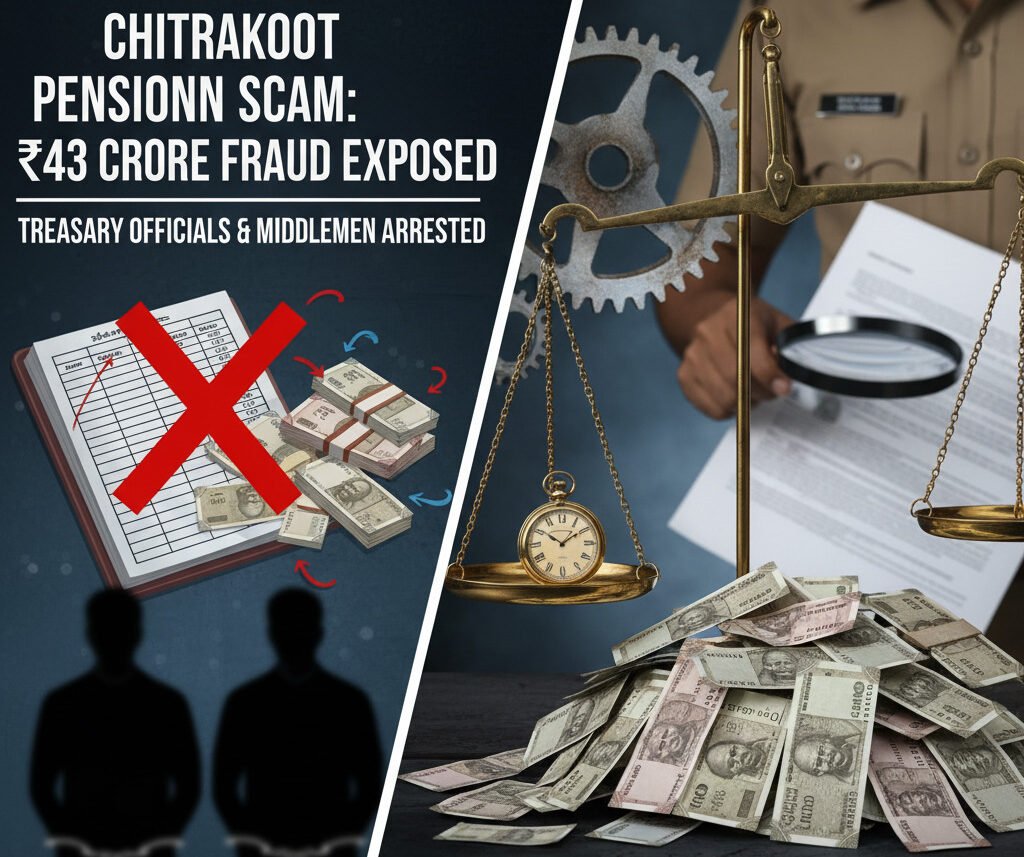

Chitrakoot – A ₹43.13-crore pension scam that has rocked the Chitrakoot Treasury has led to major administrative action.
Assistant Treasury Officer (ATO) Vikas Singh Sachan and accountant Ashok Verma—both currently in judicial custody—have been suspended by Treasury Director V.K. Singh, while two more middlemen have been arrested as the probe deepens.
To manage staff shortages in the wake of arrests, the Treasury Department has also redeployed officials Amit Kuril from Kanpur and Lokesh Kumar from Banda to Chitrakoot.
The ₹43-Crore Conspiracy: Pension Accounts Turned Into Pay Channels
The investigation revealed that treasury officials and brokers colluded to divert government funds into 93 pensioners’ bank accounts through unauthorized transactions.
On October 17, the Chief Treasury Officer filed an FIR against ATO Vikas Singh Sachan, accountants Sandeep Srivastava (since deceased) and Ashok Verma, retired ATO Avdhesh Pratap Singh, and 93 pensioners at Karvi police station.
A Special Investigation Team (SIT) led by Circle Officer Arvind Verma has since been probing the case.
So far, 32 individuals have been arrested, including 24 pensioners, six middlemen, and two treasury employees—a network that investigators say operated like a parallel payout system.
Middlemen’s Modus Operandi: Mother’s Pension Account Used as a Money Funnel
SIT findings expose a startling level of manipulation.
Broker Deepak Pandey, now behind bars, allegedly funneled scam money into his mother’s pension account, before distributing it among accomplices.
He also linked his personal bank account to a woman pensioner’s account to directly siphon treasury payments.
Another accused, Ranvijay Yadav, coordinated with pensioners and officials, earning commissions for every irregular transfer.
Investigators have so far recovered ₹3.19 crore, though officials believe the total trail may be much longer and more complex.
Verification Drive: Hundreds of Pensioners Under Scrutiny
After the fraud surfaced, the state government ordered a district-wide verification of all 5,000 pension and family pension accounts.
All pension payments have been temporarily halted, pending individual verification.
Officials said that about 100 pensioners are being verified each day, with each file, transaction record, and bank linkage being re-audited.
“This process will be crucial in uncovering every link in the chain,” a treasury officer said on condition of anonymity.
Administrative Overhaul: DM Orders Tight Monitoring
District Magistrate Pulkit Garg conducted a surprise inspection of the Treasury, Election, and Nazarat offices on Saturday.
He directed officials to:
“Maintain all records accurately and update them regularly. The functioning of government offices must be transparent and citizen-friendly.”
Garg added that the district administration would closely monitor the investigation and ensure that strict disciplinary action is taken against all responsible officials.
Systemic Lapses Exposed: Weak Oversight and Loose Accountability
Financial experts say the scam exposes deep structural weaknesses in India’s pension disbursement and treasury monitoring systems.
Lack of digital verification, manual record-keeping, and unchecked account linkages allowed the fraud to thrive.
“This is not just a corruption case—it’s a governance failure,” said a senior retired finance official.
“Without real-time auditing and centralized digital checks, treasury operations remain vulnerable to manipulation.”
Experts have recommended statewide digital audits, data analytics-based monitoring, and two-step verification protocols for pension transfers.
A Wake-Up Call for Treasury Reforms
The Chitrakoot treasury scam stands as both a cautionary tale and an opportunity for reform.
It underlines how administrative negligence and insider collusion can exploit systemic loopholes, putting public funds—and public trust—at risk.
If pursued transparently, this investigation could mark a turning point in how India secures and audits its financial governance systems—ensuring that no pensioner’s name is ever again misused for profit.
