

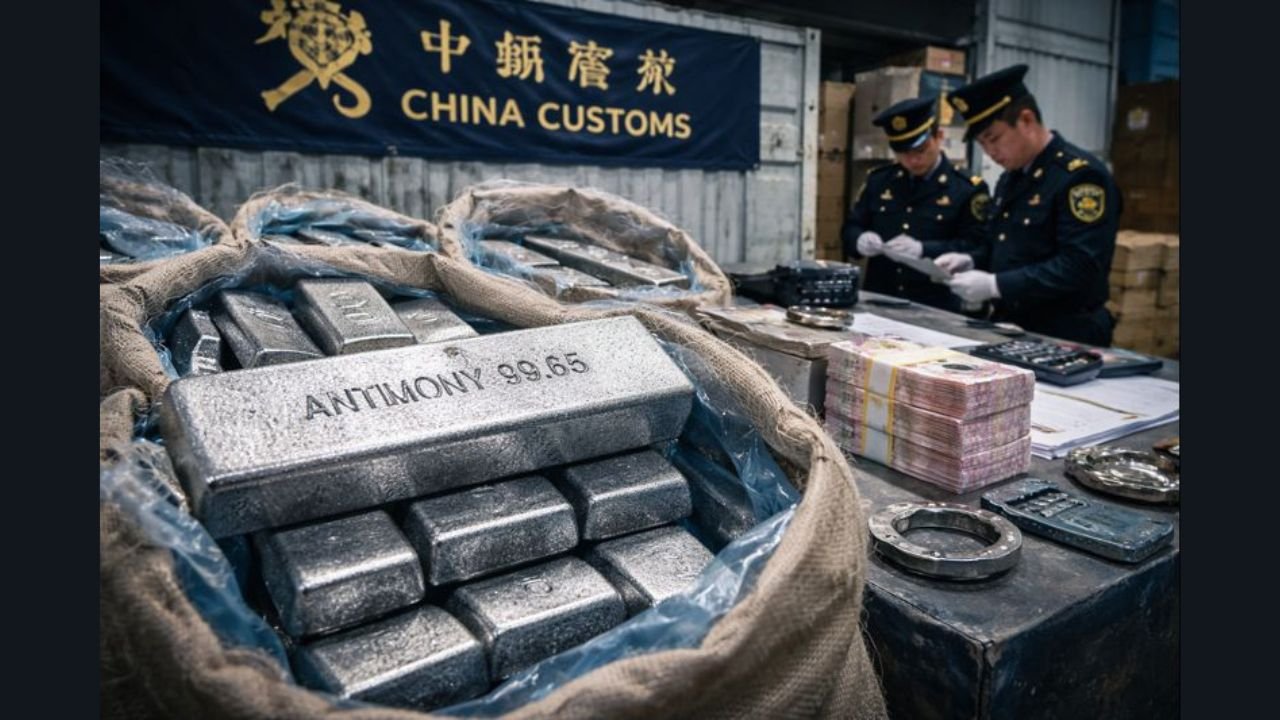

Beijing | In a strong signal of its growing enforcement against illegal trade in strategic resources, a Chinese court has sentenced 27 individuals to prison terms and financial penalties for smuggling antimony ingots out of the country without export licences. The verdict highlights Beijing’s determination to tighten oversight of minerals deemed vital to national security and advanced manufacturing.
The ruling was delivered on Tuesday by the Shenzhen Intermediate People’s Court, which said the defendants violated China’s export control regulations by shipping antimony overseas without the mandatory government approvals.
Main accused sentenced to 12 years in prison
According to the court’s statement, the principal defendant Wang Wubin was sentenced to 12 years in prison and fined 1 million yuan (approximately $142,000). Investigators found that Wang colluded with overseas smugglers and organised domestic accomplices to purchase antimony ingots and move them out of China through concealment, mislabelling and false customs declarations.
The illegal shipments took place during February and March this year, at a time when China’s export controls on antimony were already firmly in force.
Prison terms for remaining defendants
The remaining 26 defendants received prison sentences ranging from four months to five years, along with monetary fines. The court said penalties were determined based on the volume of metal smuggled and the degree of involvement of each accused.
In total, the case involved the attempted smuggling of more than 166 metric tonnes of antimony, of which over 96 tonnes were intercepted and seized by Chinese customs authorities, the court added.
Antimony’s strategic importance
China is the world’s largest producer of antimony, a metal widely used in:
- battery manufacturing,
- semiconductors and electronic chips,
- flame retardants,
- and defence-related applications.
Given its critical role in both civilian technology and military supply chains, Beijing has classified antimony as a strategic mineral. In September 2024, China formally added antimony to its export control list, making government licences mandatory for all overseas shipments.
Partial easing toward the US, controls remain
Last month, Chinese authorities announced a temporary suspension of restrictions on antimony, gallium and germanium exports to the United States. The decision followed high-level talks between President Xi Jinping and US President Donald Trump.
However, officials clarified that while the ban was eased, the metals remain subject to strict export licensing requirements, and unauthorised shipments continue to be treated as serious criminal offences.
Hong Kong seizure and global supply routes
The smuggling case is linked to broader regional developments. In April, Hong Kong authorities reported the seizure of a large consignment of antimony ingots, although no arrests were announced at the time.
Separately, Reuters reported in July that unusually large volumes of antimony had entered the United States via Thailand and Mexico after China curtailed direct shipments to the US last year, suggesting the emergence of alternative supply routes to bypass controls.
Clear warning to traders and intermediaries
Analysts say the ruling sends a clear warning to traders, intermediaries and logistics operators that Beijing is prepared to impose severe penalties for violations involving strategic resources. The case reflects China’s broader effort to safeguard control over minerals that play a central role in energy transition technologies, advanced manufacturing and defence systems.
The crackdown comes amid intensifying global competition for critical minerals, as governments increasingly link resource security to economic resilience and national defence. For China, maintaining tight control over such materials is now firmly embedded in its national security strategy.
