

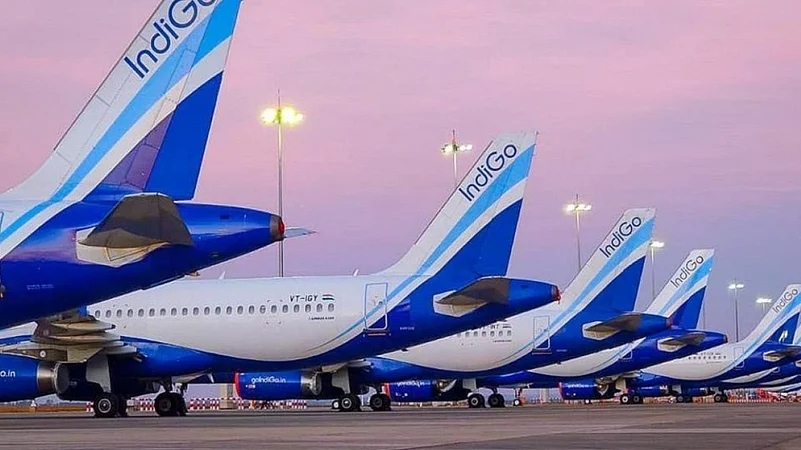
India’s competition watchdog has ordered a detailed investigation into IndiGo over allegations that the airline abused its dominant market position during widespread flight disruptions in December 2025, cancelling hundreds of services and subsequently charging sharply higher fares when passengers attempted to rebook.
In an order dated February 4, the Competition Commission of India (CCI) said a prima facie case had been established against InterGlobe Aviation Ltd for contravention of provisions of the Competition Act, 2002 that prohibit unfair or discriminatory conditions and practices by a dominant enterprise. The Commission has directed its Director General to complete the investigation within 90 days.
The case was initiated on a complaint filed by Bengaluru resident Kartikeya Rawal, who alleged that IndiGo cancelled a large number of flights in early December 2025 amid weather-related and operational disruptions, leaving passengers with limited alternatives. According to the complaint, Rawal’s return journey on the Delhi–Goa–Bengaluru sector scheduled for December 5 was cancelled just hours before departure, with no alternate arrangement offered.
When he attempted to rebook, fares on the same sector were found to be significantly higher than usual. Rawal ultimately flew two days later on another IndiGo service, paying ₹17,000, compared with his original ticket price of ₹7,173. The CCI noted that similar complaints were reported by passengers across multiple routes during the period.
Certified Cyber Crime Investigator Course Launched by Centre for Police Technology
The Commission observed that the episode was not isolated. Between December 3 and 5, 2025, a total of 2,507 flights were cancelled and 1,852 flights delayed nationwide, affecting over three lakh passengers. In the aftermath, the Ministry of Civil Aviation imposed a penalty of ₹22.2 crore on IndiGo for the disruptions, citing failure to adhere to passenger facilitation norms.
IndiGo contested the CCI’s jurisdiction, arguing that matters relating to airfare pricing, flight cancellations and passenger grievances fall exclusively under aviation law and are overseen by the Directorate General of Civil Aviation (DGCA). The airline also pointed to the Bharatiya Vayuyan Adhiniyam, 2024, and existing Aircraft Rules, contending that competition law should not apply to sector-specific issues.
Rejecting these submissions, the Commission held that sectoral regulation does not oust the application of competition law. Citing Supreme Court precedents, the CCI said aviation regulation and competition oversight operate in “distinct but complementary domains.” It also relied on the DGCA’s own position that the regulator does not possess economic regulatory powers over airfares or competition-related conduct.
In defining the relevant market as domestic air passenger transport services in India, the CCI noted that IndiGo enjoys a dominant position, with an estimated 60–63% market share by passenger numbers and seat capacity in recent financial years. The Commission highlighted that the airline operates exclusively on more than 330 domestic routes and is the only major Indian carrier to report sustained profitability in recent years.
According to the watchdog, large-scale cancellations by a dominant airline can create artificial scarcity, restrict consumer choice and enable excessive pricing during periods of peak demand or disruption. Such conduct, it said, has the potential to distort competition and harm passenger welfare, particularly when alternatives are limited.
The Commission clarified that its findings are preliminary and do not amount to a determination of guilt. The investigation will examine whether the cancellations and subsequent fare increases constituted abusive conduct under competition law. IndiGo has not yet issued a public response to the order.
The probe comes amid growing scrutiny of airline practices during disruption-heavy periods, with regulators and consumer groups calling for stronger safeguards to prevent price shocks and ensure fair treatment of passengers when operational failures cascade across the network.
About the author – Ayesha Aayat is a law student and contributor covering cybercrime, online frauds, and digital safety concerns. Her writing aims to raise awareness about evolving cyber threats and legal responses.
