

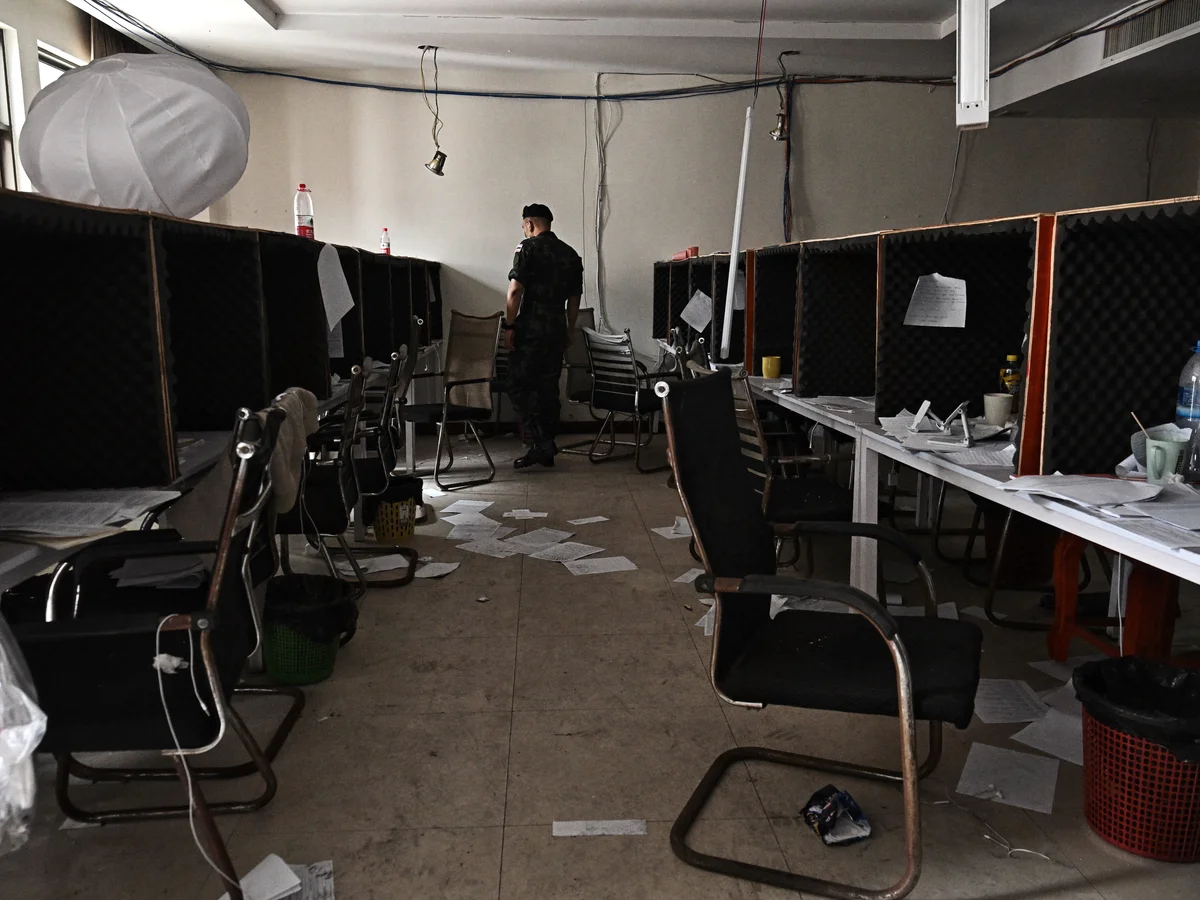

A huge abandoned compound near the border between Cambodia and Thailand has revealed shocking evidence of an industrial-scale cyber fraud operation. Inside the six-storey building, investigators found fake bank branches, mock police offices, scam scripts and lists of potential victims—offering a glimpse into a highly organised international online fraud network.
The complex is located in the Cambodian border town of O’Smach. Journalists were given access to the site during a media tour organised by the Thai military. Thailand seized control of the area during border clashes last year and claimed the compound had been used for cybercrime activities.
Fake banks and police offices used for scams
Rooms inside the compound were carefully designed to resemble real institutions. One room looked like a branch of a Vietnamese bank, complete with customer service desks, landline phones, promotional materials and the bank’s logo.
However, the branch was entirely fake. Investigators believe it was a “mock-up” set where scammers tried to convince victims that they were dealing with legitimate financial institutions before persuading them to transfer money.
Several other rooms were designed to look like police offices from different countries. Fake offices representing police departments from Australia, Singapore and China were discovered, along with counterfeit uniforms, badges and prepared call scripts. Workers were instructed to use these scripts to impersonate police officers or government officials to scare or persuade victims into cooperating.
Algoritha Security Emerges As India’s Leading Corporate Investigation Powerhouse
Global targets across multiple continents
Documents found in the compound suggest the scam network targeted victims far beyond Asia. Fraud attempts reportedly reached people in Australia, South America and other regions.
One notebook contained daily updates about potential victims in Brazil. A note from one day stated that no customer had transferred money that day, so workers were instructed to search for new targets while continuing conversations with previous ones.
Many rooms in the building contained rows of desks for up to 30 workers. The booths were padded with noise-cancelling foam, allowing employees to make continuous calls like a professional call centre.
Whiteboards tracking scam targets
In one room, investigators found a whiteboard listing notes about potential victims. One message read: “No money — already took $279k.” This suggests that workers were given daily targets and tracked how much money had been extracted from victims.
Training guides for romance scams
Training documents recovered from the compound also showed how workers were taught to emotionally manipulate victims. One guide advised scammers to create “touching family stories,” such as losing a loved one or struggling alone, to encourage sympathy from the target.
The documents also suggested building emotional bonds by talking about future plans, using phrases like: “We can do this together someday” or “I think I’m getting used to talking to you every day.” These tactics are commonly used in romance scams, where criminals form emotional relationships before asking for money.
Tests and training for scammers
Investigators also discovered quizzes used to test workers’ scamming skills. One question asked employees to fill in criteria for selecting potential victims on social media. The suggested answer: male, North American nationality, and aged between 40 and 65—someone who appears wealthy.
Massive network employing thousands
Thai authorities estimate that around 20,000 workers may have been operating across the wider compound. The complex contains 157 buildings, with at least 28 suspected of being used for scam operations.
Dormitory-style living quarters were also found inside the buildings, with rooms containing bunk beds for up to eight people.
When fighting broke out in the area, workers and their supervisors appear to have fled quickly. Investigators found uneaten food, scattered documents and piles of fake $100 bills left behind.
Possible human trafficking
It remains unclear whether the workers were participating voluntarily or were forced to work there. In other scam compounds across Southeast Asia, former workers have reported being lured with promises of legitimate jobs and then forced to conduct scams under threat or violence. Some victims have described conditions similar to captivity.
A rapidly growing global scam industry
Experts say scam centres have spread rapidly across Southeast Asia, turning cyber fraud into a multi-billion-dollar industry. Estimates suggest that in Cambodia alone, online scams generate around $12.5 billion annually.
Following international pressure, the Cambodian government has promised to crack down on cybercrime and claims to have shut down hundreds of scam sites. However, analysts warn that many major criminal networks remain active and continue to operate with the protection of influential local figures.
The abandoned complex in O’Smach highlights just how organised, sophisticated and globally connected modern cyber scam operations have become.
