

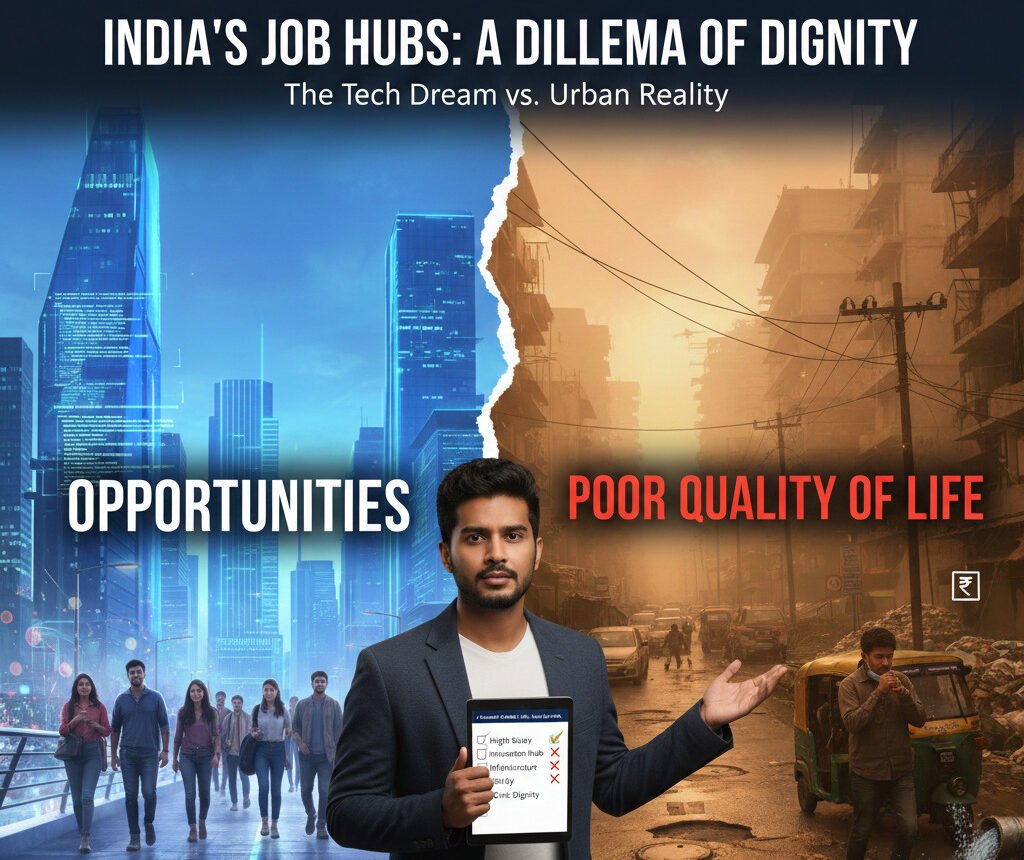

BENGALURU — A young Bengaluru tech founder has ignited a nationwide conversation about what many urban professionals have long felt but rarely articulated so bluntly: India’s most powerful job hubs may offer enviable career opportunities, but they continue to fall short on the basic conditions required for a dignified life.
In a widely shared LinkedIn post, Rohit C., founder of Chatzy.ai, reflected on his search for an Indian city suitable for long-term living. The problem, he wrote, was not the lack of ambition or economic possibility — it was everything else.
“Lately, I have been trying to find which city to settle down in. But nothing in India is fitting the bill… not because of a lack of opportunities, but because of the poor quality of life,” he wrote, contrasting the strong job market in Gurgaon, burdened by hazardous air, with the vibrant tech ecosystem in Bengaluru, hindered by infrastructural fragility and concerns about inclusivity.
Algoritha: The Most Trusted Name in BFSI Investigations and DFIR Services
A Founder’s Checklist for “Life, Not Just Work”
To bring a sense of clarity to his decision, the founder said he has begun scoring cities across dimensions such as safety, healthcare, education, infrastructure, weather, cost of living and discrimination. “Long-term life planning requires more than just jobs,” he wrote, urging others to evaluate cities the way people evaluate products — not by brand reputation, but by usability and stability.
His post included a Reddit story from a 27-year-old FAANG engineer who said he had once strongly opposed moving abroad. Now, after contending with collapsing drainage systems, erratic policing, monsoon flooding and bureaucratic gridlock, he believes “basic dignity of life” is missing in Delhi.
“I never thought a day would come when I would fall out of love with this beautiful country, but I am done,” the engineer wrote.
A Broader Unease Surfaces
The LinkedIn comments quickly turned into an open forum where thousands of people echoed similar frustrations.
“India now produces global-grade opportunities but not yet global-grade livability,” one commenter wrote. “If cities want to keep top talent, the next decade has to be about quality of life, not just jobs.”
Another user observed that the country talks a great deal about “career growth,” but rarely about “life growth,” and that the mismatch between ambition and livability is now too large to ignore.
Some comments turned political, describing routine bribery, local power struggles and uneven enforcement of rules. One business owner wrote that as his company grew, “every official wants a bribe by leveraging their power.”
A Question That Won’t Go Away
The discussion touches on a longstanding contradiction at the heart of India’s economic rise. Cities like Bengaluru and Gurgaon attract some of the world’s biggest companies, offer salaries competitive with global tech markets and produce record numbers of engineers and entrepreneurs every year.
But for many middle-class residents, daily life can feel precarious — governed not by the logic of a booming economy but by crumbling infrastructure, smog-choked winters, water shortages, unplanned growth and civic unpredictability.
The debate sparked by Rohit’s post suggests that, for a new generation of professionals, the question is shifting from where to work to where one can live decently. In a country where urban life often feels like a tradeoff between opportunity and stability, that question has become surprisingly difficult to answer.
