

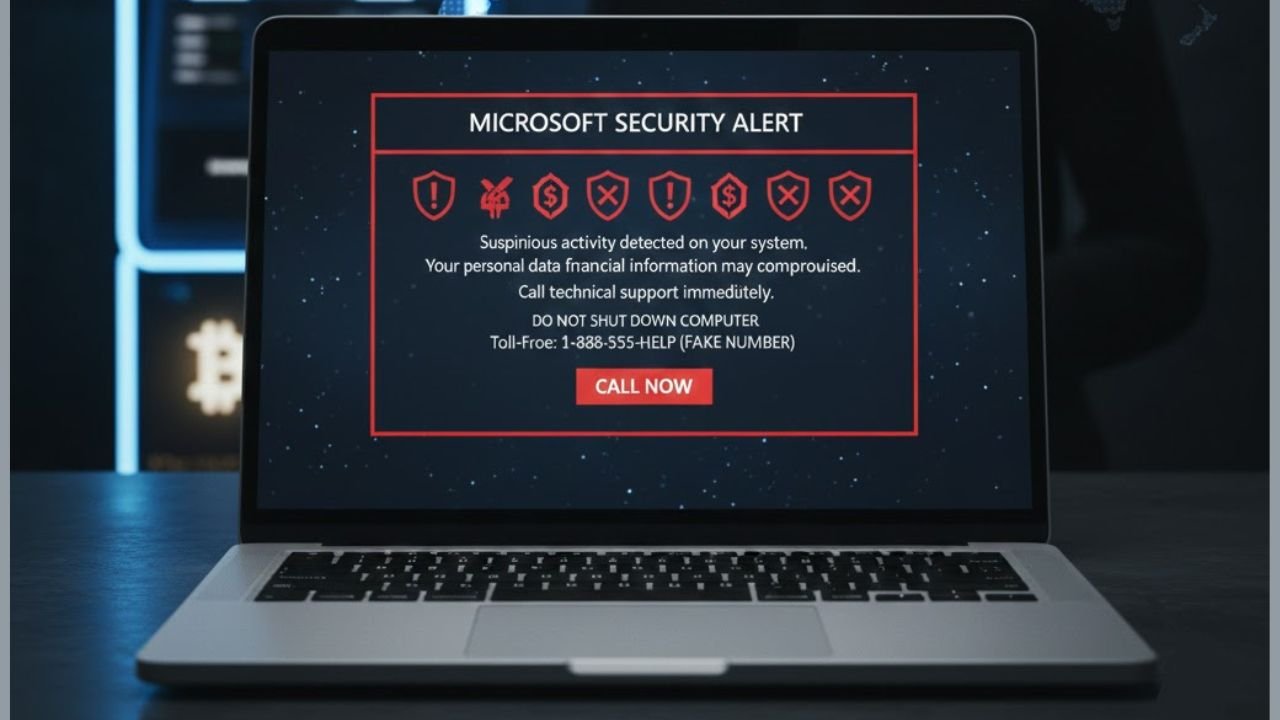

BENGALURU: A major international cyber fraud racket operating out of Bengaluru has been uncovered, with investigators revealing that over 150 American citizens were defrauded of a total of ₹13.5 crore between August and December. The accused, posing as Microsoft technical support executives, targeted foreign victims through sophisticated phishing and social engineering operations.
Officials said the scam involved Bengaluru-based tech employees working for a front company named Musk Communications, located in the city’s Whitefield area. Police raids last month led to the arrest of 21 people, while the alleged mastermind, identified as Ravi Chauhan, was detained in Ahmedabad.
Fake Microsoft Support, Bogus FTC Warnings Used to Extort Victims
According to the Bengaluru Police Cyber Crime Division, the gang contacted victims in the United States and the United Kingdom, claiming to represent Microsoft’s technical support wing. They falsely warned targets of supposed Federal Trade Commission (FTC) violations, alleging that their systems had been compromised or were linked to illegal activities.
Using the pretext of resolving these issues, the scammers demanded large payments in Bitcoin, guiding victims to deposit money into Bitcoin ATMs. Each victim lost an estimated $10,000 (₹11 lakh), authorities said.
“The accused created a high-pressure environment using fake legal threats and cyber warnings. Most victims were elderly and less familiar with digital security,” a senior IPS officer said.
85 Employees Recruited, Multi-Layered Setup in Bengaluru
Investigators found that the racket was professionally structured, with around 85 employees hired in Bengaluru to manage calls, process data, and impersonate foreign tech executives. The operation mimicked legitimate call centres, complete with U.S.-style accents, scripts, and email domains resembling Microsoft and FTC addresses.
The arrested employees were trained to extract personal and banking details from victims under the guise of troubleshooting software issues. Payments were then converted into cryptocurrency to obscure the financial trail.
Cyber investigators said the gang’s backend operations were connected to foreign wallets and crypto exchanges under probe by U.S. authorities.
Police Probe Expands to Financial Trail and International Links
Bengaluru Police confirmed that the probe has now expanded to trace Bitcoin transaction flows and identify international collaborators involved in routing the funds.
“We are working with Interpol and U.S. federal agencies to map the digital wallet movements. Several addresses are linked to overseas crypto exchanges under scrutiny,” said a senior cybercrime official.
Preliminary data suggest that at least ₹13.5 crore was transferred through Bitcoin ATMs in multiple tranches between August and November 2025. Investigators are also analysing data servers seized during raids to determine how the syndicate obtained contact lists of potential U.S. victims.
Bengaluru’s Growing Role in Global Cybercrime Operations
The case highlights Bengaluru’s emergence as a hub for global-scale cybercrime, where technically skilled individuals are being recruited for illicit offshore operations. Cyber experts warn that the city’s large IT workforce, combined with easy access to digital infrastructure, makes it vulnerable to fraud networks disguised as tech support companies.
Authorities have stepped up cyber monitoring across technology parks and shared office spaces, where such rackets often rent short-term premises under fake documentation.
“Several international fraud rings use India’s IT talent base to run global scams. We are tightening KYC verification for tech-based startups and co-working spaces,” the official added.
Victim Compensation and Legal Action Underway
The police said they are coordinating with U.S. law enforcement and cryptocurrency exchanges to assist victims and recover the stolen funds. Legal proceedings under India’s Information Technology Act and IPC sections on cheating and impersonation have been initiated.
Authorities are also considering invoking the Prevention of Money Laundering Act (PMLA) due to the scale of the financial transactions and the use of digital currencies.
Cybercrime officials advised citizens, both in India and abroad, to avoid responding to unsolicited tech-support calls, and to verify all communications directly with company websites or official customer service lines.
