

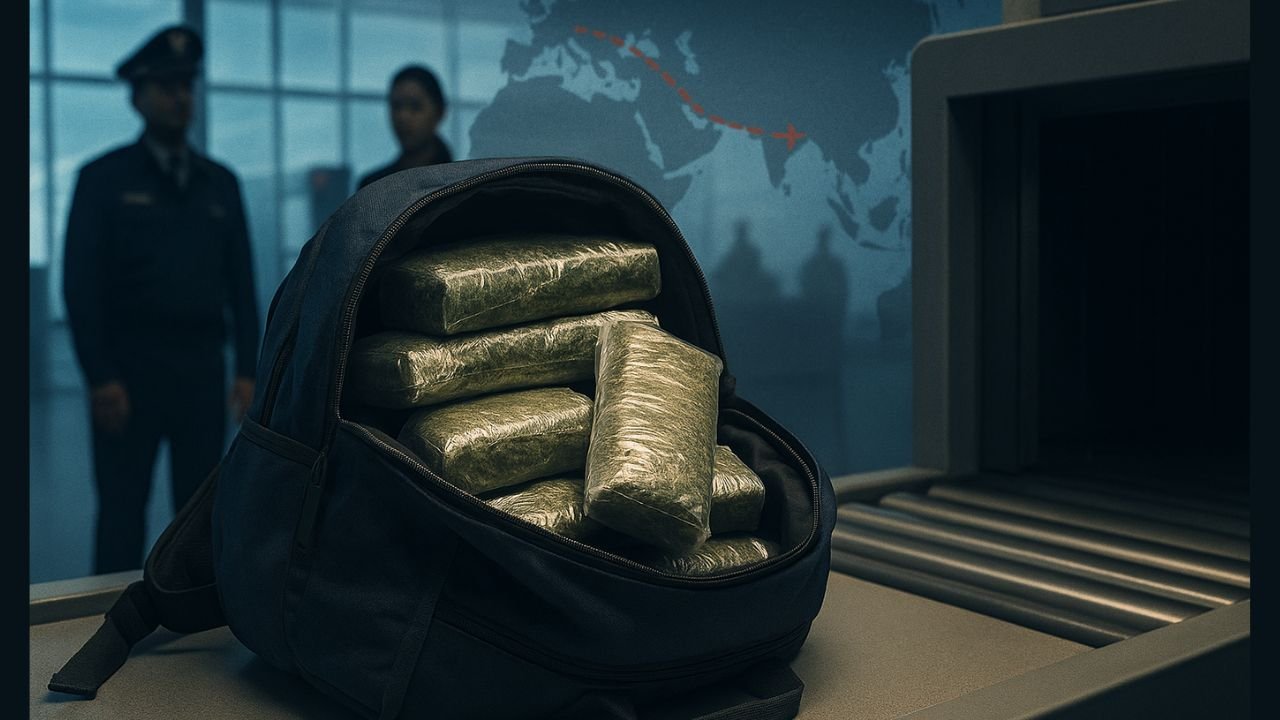

In a significant crackdown on cross-border narcotics trafficking, Bengaluru Police have arrested a couple allegedly acting as drug mules for an international smuggling syndicate. The duo reportedly transported 18 kilograms of high-grade hydroponic cannabis (hydro ganja) from Bangkok to India via Kempegowda International Airport (KIA), concealing the contraband inside their travel backpack. The seized consignment carries an estimated international market value of ₹18.6 crore.
The arrests were made on Sunday, November 30, 2025, after the couple reached the city and were waiting to hand over the consignment to a local handler. Acting on specific intelligence, the Mahalakshmi Layout Police intercepted them and recovered nine packets, each weighing approximately two kilograms. The narcotics were camouflaged as food-product packages, a method increasingly used by international drug cartels.
Linked to Overseas Drug Rings, Lured with “Free Trip” Offers
Investigations suggest that the couple had been recruited by a foreign drug syndicate that promised a free international trip, hotel stay in Bangkok, and additional monetary compensation in exchange for transporting the illicit cargo. Officers believe this is part of a growing pattern where global cartels exploit unsuspecting or financially vulnerable individuals by offering quick rewards.
The accused reportedly admitted that this was not their first assignment, though earlier deliveries allegedly involved smaller quantities. This, however, marks their first large-scale operation involving hydroponic cannabis—a highly potent variety cultivated in controlled environments and sold at a premium in the illicit market.
Serious Concerns Over Customs Lapses at Bengaluru Airport
The arrests have triggered concerns over the robustness of Customs screening at KIA.
According to police sources, the fact that 18 kg of narcotics passed through international baggage checks without detection raises red flags regarding surveillance gaps and possible systemic vulnerabilities.
City Police have formally flagged the issue to the airport’s Customs department.
The matter is particularly sensitive given the recent surge in high-value narcotics seizures across southern airports, reinforcing suspicions that global syndicates are using the region as an emerging hub for drug inflows.
Recent Seizures Indicate Expanding Drug Routes in South India
The Bengaluru case comes amid a series of major narcotics recoveries in the region. In recent weeks, enforcement agencies have seized:
- ₹53 crore worth of hydro ganja from airport-linked operations
- 67 kilograms of cannabis in 10 days in citywide raids
- Multiple consignments of MDMA and synthetic narcotics
The pattern indicates an aggressive expansion of drug networks using new routes, new mules, and sophisticated concealment techniques.
Need for Stronger Scanning, Profiling & Inter-Agency Coordination
Police officials assert that narcotics are increasingly disguised in food packets, sauce containers, dry fruits, and other common items, enabling smugglers to bypass lax checks.
The rising trend highlights the need to strengthen:
- Baggage scanning accuracy
- Passenger profiling mechanisms
- Coordination between Customs, airport security, and specialized narcotics units
With cartels relying on both physical couriers and digital coordination tools, technology-driven surveillance is becoming indispensable.
Couple in Custody; Focus Shifts to Overseas Network
The arrested couple has been remanded to judicial custody.
The next phase of the investigation will focus on:
- Identifying foreign handlers
- Tracing the local distributor network
- Mapping the financial and digital communication trail
- Reviewing travel patterns, call records, and CCTV surveillance
According to officers, decoding these links is crucial to dismantling the larger syndicate operating behind the scenes.
This case underscores the evolving strategies of international drug cartels and the increasing exploitation of Indian travellers and families as couriers. It also serves as a reminder to enforcement agencies that smuggling networks are becoming faster, smarter, and more technologically equipped—necessitating an equally agile and upgraded security framework at Indian airports.
