
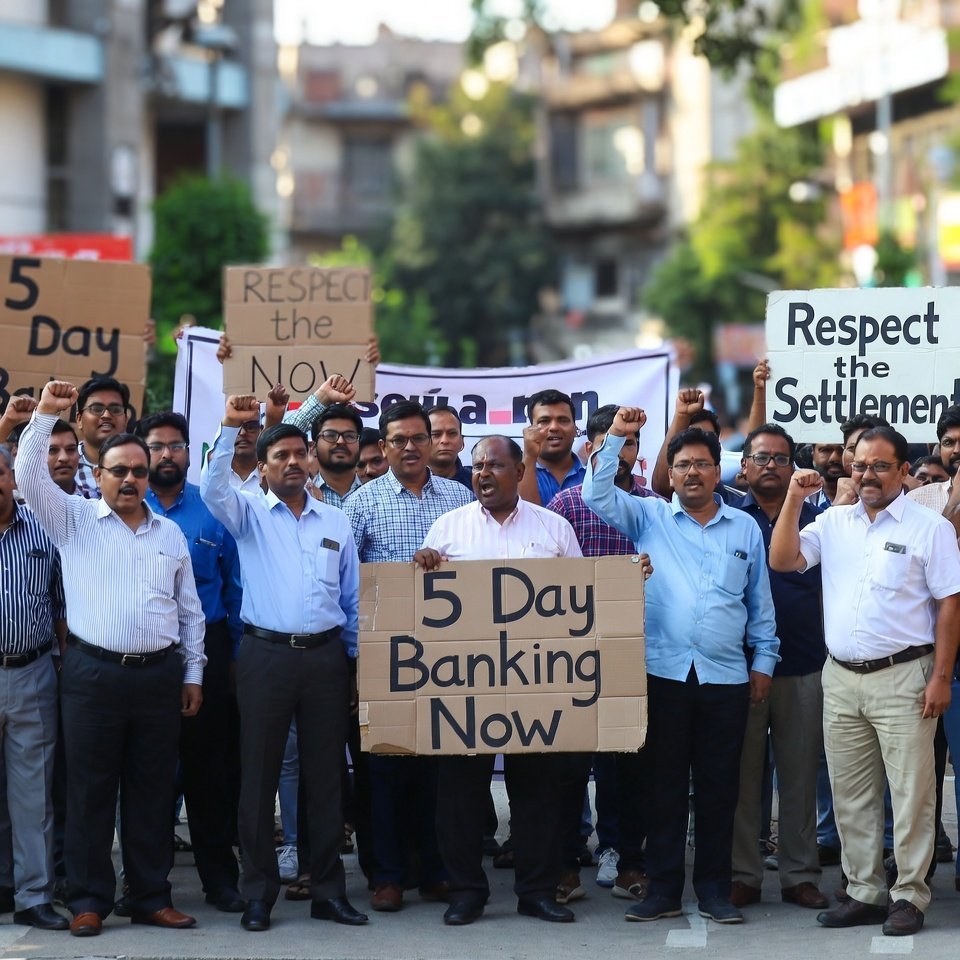

Bank employees’ unions under the umbrella of the United Forum of Bank Unions have announced a nationwide strike on January 27, 2026, pressing the government and banking authorities to implement a five-day work week. While the strike itself is scheduled for a single day, its timing could effectively stall operations at public sector banks for three consecutive days, as January 25 and 26 fall on holidays.
The unions argue that the demand is not new, nor radical. According to union leaders, the shift to a five-day schedule was agreed upon in principle during wage revision talks concluded in March 2024 between banks and employee representatives. What has followed since, they say, is silence from the government and implementing authorities.
In a public call circulated across bank branches and on social media, the unions framed the strike as a response to “a lack of response from the government” on an already negotiated issue, rather than a fresh escalation of demands.
Inside the Demand for a Five-Day Week
At the heart of the agitation is the claim that a five-day work week would not reduce productivity or man-hours. Union leaders say bank employees have already agreed to compensate by working an additional 40 minutes each weekday from Monday to Friday.
The argument draws comparisons with other institutions in India’s financial ecosystem. In statements accompanying the strike call, unions pointed out that bodies such as the Reserve Bank of India, the Life Insurance Corporation and the General Insurance Corporation already operate on a five-day schedule. Financial markets — including foreign exchange and stock exchanges — are also closed on Saturdays, as are central and state government offices.
“There is no rational basis for banks alone to function six days a week,” union representatives said, describing the current arrangement as an anomaly rather than a necessity.
The Role of Bank Unions and the Wage Pact
The strike call has been reiterated by the All India Bank Officers’ Confederation, one of the key constituents of UFBU. In a circular dated January 4, the confederation said the demand for five-day banking was explicitly acknowledged during wage settlement discussions with the Indian Banks’ Association last year.
UFBU, which represents nine major bank unions across public sector banks and some older private banks, has portrayed the strike as a continuation of a structured campaign rather than a sudden flashpoint. A coordinated social media effort under the hashtag #5DayBankingNow, union leaders said, generated more than 18 million impressions, signalling what they describe as widespread employee support.
Despite this, the unions claim there has been no formal notification or timeline from the government to operationalise the agreed framework.
What the Strike Could Mean for Customers
If the strike materialises as planned, customers of public sector banks could face delays in branch-based services, cheque clearances, and administrative processing. While digital banking channels are expected to remain operational, union leaders caution that backend disruptions could still affect transaction settlements and customer support.
Private sector banks and newer-generation lenders may remain largely unaffected, underscoring the widening operational divide within India’s banking system. For the unions, that contrast is central to their argument: as the sector modernises and workloads intensify, they say, working conditions have lagged behind structural reforms.
For now, the January 27 strike stands as both a protest and a test — of whether a long-negotiated promise will finally move from agreement to implementation, or whether India’s bank employees will once again find themselves pressing pause on business to be heard.
