
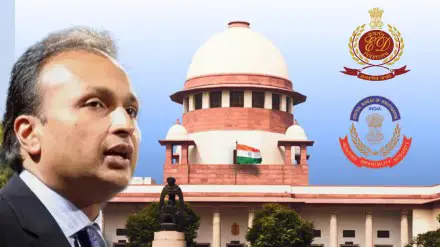
A major financial case linked to India’s corporate sector has come to light, with companies of the Reliance Anil Ambani Group (RAAG), led by Anil Ambani, facing investigation over an alleged bank fraud of approximately ₹73,000 crore. The Central Bureau of Investigation (CBI), in a status report submitted to the Supreme Court, stated that seven separate cases have been registered and the probe is actively underway.
After reviewing the report filed in February, the Supreme Court issued an order on March 23, noting that the cumulative financial losses in these cases amount to “several thousand crores,” totalling around ₹73,006 crore. The developments have raised serious concerns regarding the banking system and corporate governance standards in the country.
The CBI informed the court that the role of certain public officials is also under scrutiny. However, there has been no official response so far from the Reliance Group regarding these allegations. Investigating agencies are closely examining fund flows, loan approvals, and the circumstances leading to defaults in these cases.
FCRF Launches Premier CISO Certification Amid Rising Demand for Cybersecurity Leadership
ED’s Key Findings on ‘Project Help’ and IBC Misuse
Meanwhile, the Enforcement Directorate (ED) has also made key findings during its investigation. The agency told the court that it had seized documents referring to a purported “Project Help,” which suggests that insolvency proceedings under the Insolvency and Bankruptcy Code (IBC) may have been “deliberately” initiated using unrelated lenders.
Citing the ED report, the Supreme Court observed that funding for IBC acquisitions was arranged through a group of eight non-banking financial companies (NBFCs). According to the findings, claims worth approximately ₹2,983 crore were settled for just ₹26 crore, indicating potential large-scale financial irregularities.
The ED further informed the court that it has constituted a Special Investigation Team (SIT) to probe the matter and is currently examining eight cases linked to the Reliance Anil Ambani Group. The agency is investigating aspects such as fund diversion, loan restructuring, and possible misuse of insolvency mechanisms.
Supreme Court Mandates Collaborative, Time-Bound Probe
Taking a serious view of the matter, the Supreme Court stated that the preliminary facts “speak for themselves” and emphasised the need for senior officials of investigating agencies to work together to uncover any irregularities, illegal activities, or possible collusion. The court also highlighted the importance of examining the role of officials within financial institutions who may have facilitated undue benefits.
At the same time, the court clarified that it is not expressing any opinion on the merits of the allegations. It directed both the CBI and the ED to carry out the investigation in a “fair, transparent, and independent” manner and to take it to its logical conclusion within a stipulated timeframe.
The ED also informed the bench that it has not yet received certain crucial information from other investigating agencies related to the case. In response, the Supreme Court directed all agencies and financial institutions to extend full cooperation and ensure timely sharing of relevant information to aid the probe.
The case has surfaced at a time when concerns over banking frauds and corporate defaults are already high in India. Experts believe that a transparent and thorough investigation into such large-scale financial cases is essential not only to ensure accountability but also to maintain trust in the country’s financial system.
The Supreme Court has scheduled the next hearing in the matter for April 30. Further developments are expected in the coming weeks, which could have significant implications for India’s corporate and banking landscape.
