

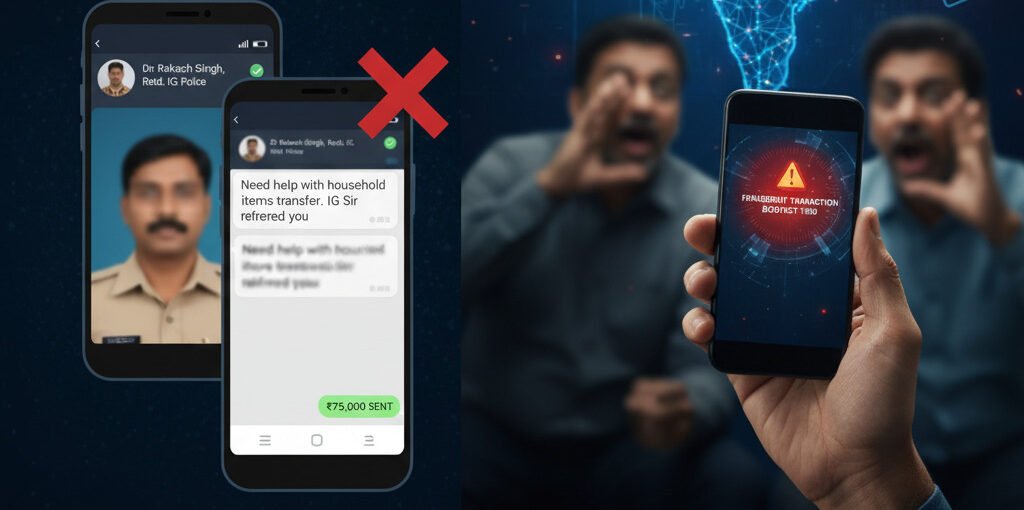

Cybercriminal posed as a retired IG on WhatsApp, tricking an ex-police officer into transferring money for “household items.” Quick action by the victim’s son helped block the funds before they were withdrawn.
Key Highlights
- Fraudsters created a fake WhatsApp ID using the name and photo of a retired Inspector General (IG) of Police.
- Retired Circle Officer (CO) transferred ₹75,000, believing he was assisting a fellow officer.
- Money was sent in three installments to different bank accounts.
- The victim’s son promptly reported the incident to the cyber helpline (1930), leading to the funds being blocked.
- A formal FIR has been registered by Kwarasi Police Station, and investigations are underway.
Aligarh – In yet another case underscoring the growing sophistication of cybercrime, fraudsters in Aligarh duped a retired Circle Officer (CO) of ₹75,000 by impersonating a retired Inspector General (IG) of Police on WhatsApp. The scammers used the fake identity to gain trust and persuaded the officer to transfer money for “domestic items” allegedly being sold before a transfer posting.
The victim, Lekhraj Singh, a retired CO residing in Gokulesh Puram Colony on Ramghat Road, received a WhatsApp call on September 16 from a number displaying the name and photograph of Dr. Rakesh Singh, a retired IG. Singh was in Noida Court at the time to appear as a witness, so he informed the caller that he would speak later in the day.
A few hours later, he received a text message stating that a CRPF officer named Santosh Kumar would contact him. When Santosh called, he told Singh that he had been transferred to Jammu and Kashmir and needed help selling household items before his departure.
“He said IG Sir had suggested that I help him dispose of his belongings.”
recalled Singh in his police statement.
Initially reluctant, Singh agreed after the caller insisted that “IG Sir himself” had referred him. After brief discussions at home, he transferred ₹75,000 in three transactions to different bank accounts.
Later, his son Amit Kumar checked the WhatsApp profile of the supposed IG and discovered that the account had been created only two months earlier. Realizing it was a fraud, Amit immediately contacted the National Cybercrime Helpline (1930) and reported the incident. Thanks to the swift response, the transferred money was blocked before withdrawal.
Inspector Narendra Kumar Sharma, in charge of Kwarasi Police Station, confirmed the case:
“An FIR has been registered, and we are tracing the money trail and technical details. The accused will be identified through digital forensics.”
Analysis: The New Face of Cyber Deception
This case highlights a growing cybercrime trend in India — impersonation of senior government officials to exploit public trust. Experts say that such scams often target retired officers and government employees who are likely to respond to messages appearing to be from known bureaucrats or police officials.
“Criminals are now using official designations and photographs to add legitimacy to fake accounts.”
said a senior cyber expert.
“The only safeguard is verification — always cross-check through direct contact or official channels before transferring funds.”
Authorities emphasize that the cyber helpline (1930) remains an effective tool for immediate redressal, provided victims report promptly.
As digital impersonation scams rise, law enforcement agencies are urging citizens — including retired officials — to remain vigilant and verify all online communications, even those appearing to come from trusted names.
