


New Delhi: The AI Impact Summit, one of the world’s largest gatherings on artificial intelligence policy and innovation, opened in the capital on Monday, bringing together a high-profile mix of political leaders, technology executives and researchers. French President Emmanuel Macron, OpenAI chief executive Sam Altman and Google chief executive Sundar Pichai are among the key figures participating in the five-day event at Bharat Mandapam.
A Diplomatic Stage for Artificial Intelligence
The summit is being positioned as a milestone for India’s ambitions to shape global conversations on AI governance while projecting itself as a hub for responsible and inclusive innovation. More than 100 countries are represented, with over 20 heads of state or government and senior ministers expected to take part alongside leading technology companies and academic institutions.
Unlike purely industry-focused technology conferences, the summit’s agenda extends beyond product innovation to address the societal impact of AI. Sessions will examine employment disruption, safety standards, data governance, ethical deployment, public infrastructure, and cross-border regulatory cooperation. India is expected to showcase its “AI for All” approach and its digital public infrastructure model as scalable frameworks for developing economies.
FCRF’s Security Lens: AI for Secure India
Amid the high-level discourse on compute and governance, cybersecurity remains a central concern — and it is here that the Future Crime Research Foundation (FCRF) emerges prominently as a Knowledge Partner.
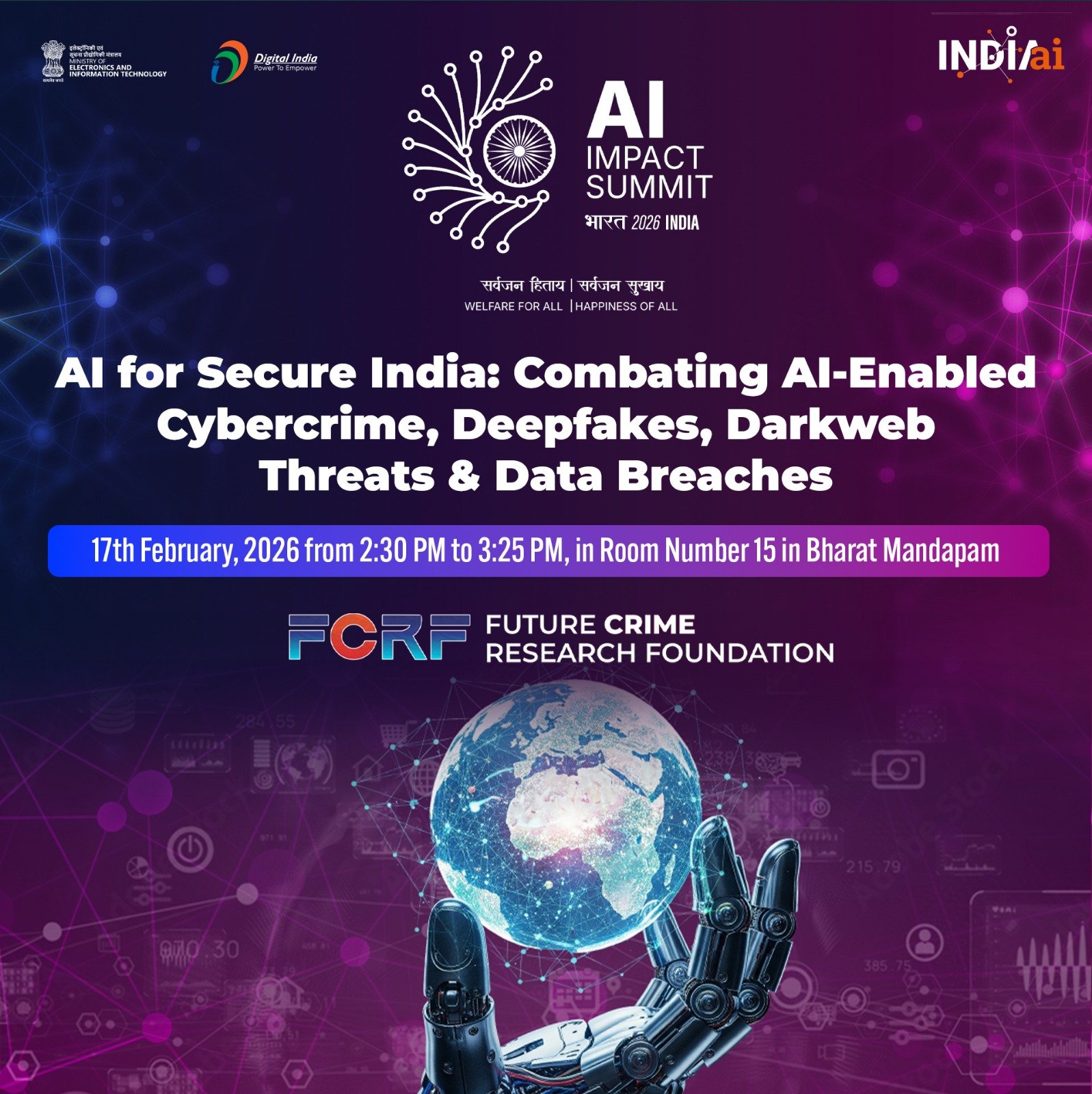
FCRF will host a dedicated session titled: “AI for Secure India: Combating AI-Enabled Cybercrime, Deepfakes, Darkweb Threats and Data Breaches.”
Date: 17 February 2026
Time: 2:30 PM – 3:30 PM
Venue: Bharat Mandapam, L1 Meeting Room No. 15
The session will be moderated by Prof. Triveni Singh, former IPS officer and Chief Mentor at FCRF, and will bring together a panel of legal, industry and cybersecurity experts, including:
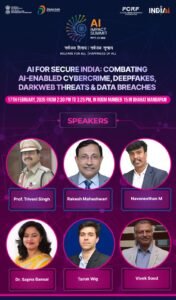
- Rakesh Maheshwari, Cyber Law & Data Governance Expert
- Senior Advocate Vivek Sood, Supreme Court of India
- Tarun Wig, Co-Founder & CEO, Innefu Labs
- Dr. Sapna Bansal, Shri Ram College of Commerce, University of Delhi
- Navneethan M., Senior Vice President & Chief Information Security Officer
The focus is unambiguous: artificial intelligence has become both a catalyst for economic acceleration and a multiplier of cyber risk. From AI-generated deepfakes and automated phishing ecosystems to dark web marketplaces leveraging machine learning, the threat landscape has grown more algorithmic and less predictable.
By placing this session within the summit’s core programming, FCRF reinforces a central message — that security must be embedded into AI systems from inception, not retrofitted after disruption.
Interested participants can register for the FCRF session through the following link: https://impact.indiaai.gov.in/registration
Investment, Industry and the AI Impact Expo
Running parallel to the policy discussions is the AI Impact Expo, where startups, research labs and global firms are demonstrating applications across healthcare, agriculture, education, climate modelling and financial inclusion. Officials said the exhibition is aimed at attracting investment, fostering partnerships and positioning India as a destination for AI development and deployment.
The presence of multiple world leaders has also lent the summit diplomatic weight. Macron’s visit is being viewed as a step toward deeper India-France cooperation in AI research, compute infrastructure and talent exchange. Delegations from Brazil and several other emerging economies are expected to push for technology access, funding mechanisms and shared standards that reflect Global South priorities.
Policy outcomes are likely to include a non-binding “New Delhi Declaration” outlining principles on safe, transparent and accountable AI. Discussions are expected to cover open AI ecosystems, model safety testing, data-sharing frameworks, and guardrails for high-risk applications. While the declaration will not create legal obligations, it could influence future regulatory approaches across multiple jurisdictions.
Global South Priorities and Workforce Transitions
A central theme of the summit is equitable access to AI capabilities. India is advocating the concept of “AI Commons” — shared models, datasets and tools for sectors such as agriculture, public health and education — to prevent concentration of technological power among a few countries or corporations.
Experts note that although India is not yet a leader in building large frontier models, its strengths lie in scale, data diversity, digital payments infrastructure and a rapidly expanding startup ecosystem. These advantages could allow it to lead in applied AI solutions, particularly for population-scale public services.
The labour market impact of automation is another major focus area. Industry leaders have warned of job displacement in routine digital services, while policymakers are emphasising reskilling, workforce transition and the creation of new AI-linked roles. Skill development initiatives and public-private training partnerships are expected to feature prominently in the discussions.
For India, the summit represents more than a technology showcase. It is being framed as a strategic platform to influence global AI norms, attract capital, deepen international partnerships and articulate a development-oriented model for emerging economies.
