

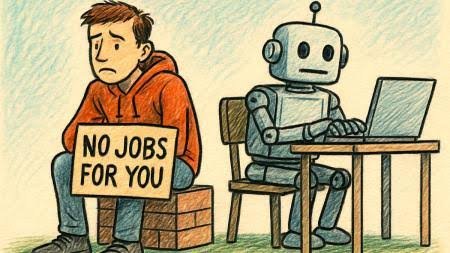

New Delhi: Artificial intelligence could affect more than half of entry-level jobs over the next one to five years, triggering one of the most dramatic transformations in the modern workforce, Anthropic chief executive Dario Amodei has warned.
In recent remarks and a widely discussed essay titled The Adolescence of Technology, Amodei said the pace of AI development is accelerating so rapidly that many traditional roles—particularly junior positions—may soon be reshaped or replaced. He compared the unfolding transition to the industrial revolution, arguing that while new technologies historically made human work faster and more productive, the current wave of automation could arrive far more abruptly.
An Industrial-Scale Shift, Compressed in Time
“AI systems are increasingly capable of performing tasks that once required human reasoning,” Amodei noted, adding that the speed of change could make it difficult for large sections of the workforce to adapt in time.
Certified Cyber Crime Investigator Course Launched by Centre for Police Technology
He cautioned that roughly 50% of entry-level roles could be impacted as AI tools evolve from writing single lines of code to generating entire software programs. Amodei also suggested that within a few years, advanced AI could handle substantial portions of software engineering work—an assertion that has intensified debate across the global tech industry.
Entry-Level Jobs Under Pressure
Industry observers say this marks a significant shift in how companies view automation, moving beyond routine tasks to complex, cognitive work. As AI becomes a mainstream alternative for many functions, workers may find it harder to transition laterally into similar roles, potentially widening skill gaps in the labour market.
Zoho Founder’s Warning on No-Code Futures
The warning was echoed by Zoho founder Sridhar Vembu, who has also raised concerns about the speed at which AI is redefining professional skills. Vembu recently pointed to an example of an individual building a functional Bhagavad Gita app without writing a single line of code—an illustration, he said, of how quickly no-code and AI-driven platforms are lowering barriers to software creation.
Vembu urged professionals, particularly those in technology, to begin exploring alternative career paths and to invest in continuous learning. He stressed that the traditional assumption of long-term stability in tech jobs may no longer hold as automation spreads deeper into white-collar work.
A Labour Market Facing Abrupt Disruption
Both leaders agreed that the coming years could bring unprecedented disruption to employment patterns. Amodei warned that the job market may experience large-scale shifts in a relatively short period, unlike previous technological transitions that unfolded over decades.
AI’s expanding capabilities already extend beyond basic automation, with systems increasingly handling complex analytical and creative tasks. Experts caution that this could lead not only to job losses but also to wage pressure, as some workers are pushed into lower-paying roles or forced to reskill mid-career.
At the same time, proponents argue that AI could unlock new industries and opportunities—provided governments, companies and educational institutions move quickly to prepare workers for emerging roles. Upskilling, they say, will be critical, with a growing emphasis on learning new tools, understanding AI systems and adapting to changing workplace demands.
Policy and Workforce Readiness in Focus
For policymakers, the warnings underscore the need for proactive labour strategies, including stronger social safety nets and investment in digital education. For employees, the message is increasingly clear: staying relevant will require continuous reinvention.
As AI development races ahead, the challenge now lies in ensuring that the benefits of automation are broadly shared—while minimising the social costs of a workforce in rapid transition.
