

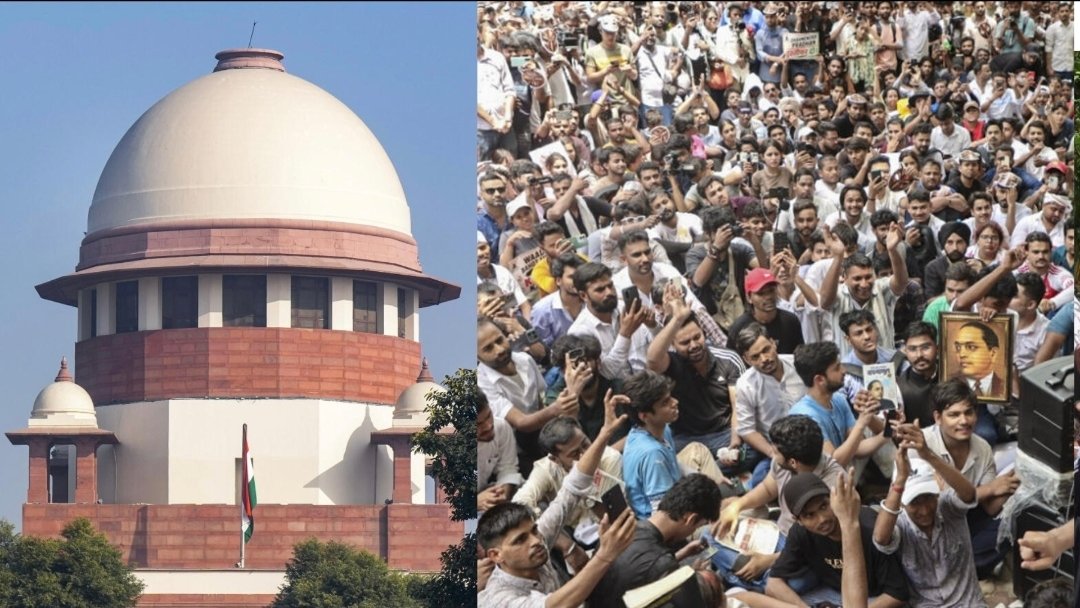
The Supreme Court ordered Delhi authorities to review barricades and restore Metro services, amid protests across Delhi.
What Did the Supreme Court Order?
The Supreme Court on Sunday, October 11, directed authorities to immediately review barricades across Delhi and remove those not justified by law-and-order or traffic requirements.
A two-judge bench comprising Justices Joymalya Bagchi and V Mohana also directed that Metro and railway services operate normally unless restrictions were necessary to maintain public order.
The interim directions came during an extraordinary Sunday hearing on petitions challenging restrictions imposed during Saturday’s protests against Chief Election Commissioner Gyanesh Kumar. The petitions raised concerns about the closure of Metro stations and the alleged illegal detention of peaceful protesters.
FCRF Launches CP-FRM to Build India’s Next Generation of Fraud Risk Professionals
What Did the Court Say About Protesters’ Rights?
The bench said citizens must be allowed to move freely across the national capital, subject to legitimate traffic requirements and lawful restrictions.
It directed authorities to ensure that people participating in peaceful, unarmed assemblies were not illegally detained outside areas where Section 163 of the Bharatiya Nagarik Suraksha Sanhita (BNSS) was in force. The judges emphasised that the right to protest must be exercised within the provisions of the Police Act.
The court also directed that lawyers and journalists should not face obstruction while performing their professional duties.
Why Were Restrictions Near the Supreme Court Questioned?
The bench ordered authorities to remove notices referring to Section 163 of the BNSS in and around the Supreme Court, if they had not already been removed. It said such restrictions should not create apprehensions about access to justice or prevent movement to and from the Supreme Court and other courts.
The judges also directed that internet facilities remain undisturbed in accordance with the law.
Why Did Metro Closures Draw Judicial Scrutiny?
The court examined the closure of 45 Delhi Metro stations during Saturday’s protests. During an earlier hearing on Friday, a bench comprising Chief Justice Surya Kant and Justices Bagchi and Mohana had directed the Centre to avoid a complete prohibition on Metro and train services entering Delhi on October 10.
However, several stations remained closed, prompting petitioner and advocate Shailendra Mani Tripathi to allege contempt of the court’s directions. The bench subsequently asked the Delhi Metro Rail Corporation (DMRC) to submit a map identifying closed and operational stations.
What Did the Government Tell the Court?
The bench noted that 57 stations had initially been proposed for closure, although 45 were eventually shut. It questioned how passengers could access the Metro network when intermediate stations remained closed despite stations at either end operating.
Solicitor General Tushar Mehta informed the court that all Metro stations had reopened by 10 pm on Saturday and that internet services had been restored. He assured the bench that Metro operations had returned to normal.
What Happens Next in the Case?
Mehta appeared alongside senior Delhi Police officials during the hearing concerning restrictions and alleged violations of citizens’ rights.
The matter will be heard again on Tuesday.
The protests form part of demands by the CJP and Opposition parties for Chief Election Commissioner Gyanesh Kumar’s resignation over alleged irregularities in the Special Intensive Revision (SIR) process.
The court’s interim directions address public movement, access to transport, peaceful assembly and access to justice while the proceedings continue.
Follow for daily updates on cybercrime, corporate fraud, DFIR, hacking, investigations, and digital forensics
