

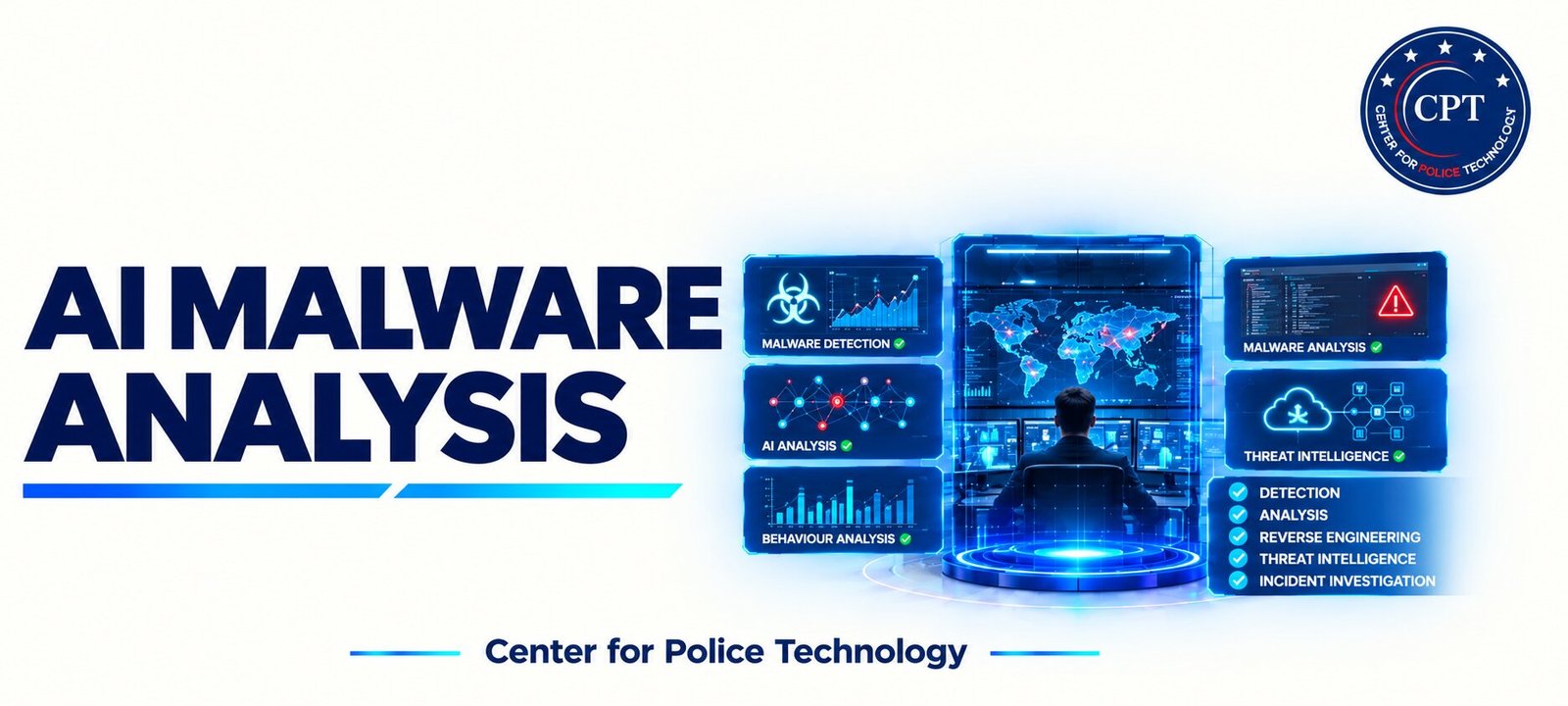
Centre for Police Technology Launches a 31-Day Cybersecurity Knowledge Series for Police, LEAs, Corporate Investigators, Digital Forensics, Fraud, Cyber Risk and Security Professionals
Malware is no longer limited to simple viruses that infect a computer and damage files.
Modern malicious software can steal credentials, encrypt entire networks, spy on users, establish hidden remote access, capture financial information, disable security controls and provide attackers with long-term access to critical systems.
For police, cybercrime units and digital forensic investigators, analysing such malware can become an important part of determining what happened, what the malicious program did, which systems were affected and what evidence it may contain.
Traditionally, malware analysis has required highly specialised analysts to manually examine suspicious files, scripts and computer code.
Artificial intelligence is beginning to change that process.
AI malware analysis uses machine learning, large language models and other AI techniques to help identify, classify and understand malicious software.
Google researchers have demonstrated the use of Gemini models to analyse decompiled and disassembled malware code and produce human-readable assessments. Microsoft Security Copilot can similarly assist security analysts in explaining suspicious scripts and command-line activity.
For investigators, however, the objective should not be:
- “Let AI decide whether a file is malware.”
- It should be:
- “Use AI to accelerate malware investigation while verifying conclusions against technical and forensic evidence.”
What Is AI Malware Analysis?
Malware analysis is the examination of suspicious software to understand what it is designed to do.
An investigator may want to determine:
- Is this file malicious?
- What happens when it runs?
- Does it steal passwords or information?
- Does it communicate with an external server?
- Does it create persistence on the infected computer?
- Is it connected to known malware?
Traditional malware analysis can involve examining program code, executing a sample inside a controlled environment and studying the changes it makes to a system.
AI can accelerate parts of this work.
Instead of requiring an analyst to manually understand thousands of lines of unfamiliar code, an AI model may help identify suspicious functions, explain scripts, recognise behavioural patterns and summarise what the program appears designed to accomplish.
AI malware analysis therefore does not represent one specific tool.
It represents the application of artificial intelligence to malware detection, classification, reverse engineering and investigation.
How Does AI Malware Analysis Work?
The investigation normally begins with a suspicious file, script or other digital artefact.
The first step should be preservation.
Investigators should retain the original evidence, calculate cryptographic hashes and conduct examination on appropriate forensic copies or within controlled environments.
The file can then undergo static analysis.
Static analysis examines a file without intentionally executing it. Investigators may examine its structure, strings, imported functions, embedded resources, instructions and other characteristics.
The second approach is dynamic analysis.
Here, malware is executed inside an isolated environment, commonly called a sandbox, where analysts observe what it does.
The system might monitor whether the malware creates files, changes registry entries, launches processes, contacts external servers or attempts to establish persistence.
AI adds another analytical layer.
A machine-learning model can compare characteristics of the sample against patterns learned from large collections of malicious and legitimate files.
Large language models can analyse code and explain its likely purpose in ordinary language.
Threat-intelligence systems can then compare discovered domains, IP addresses, file hashes and other indicators against previously known malicious infrastructure.
The process can therefore become:
Evidence Collection → Preservation → Static Analysis → Dynamic Analysis → AI-Assisted Code Analysis → Threat Intelligence Correlation → Analyst Verification → Reporting
AI accelerates interpretation.
It does not eliminate the need to preserve and examine the underlying evidence.
What Technologies Power AI Malware Analysis?
Several technologies work together.
Machine Learning
Machine-learning systems can identify patterns associated with malicious software.
Instead of relying exclusively on a known malware signature, models may examine characteristics such as file structure, API usage or behavioural patterns.
This can potentially help identify previously unseen variants.
Large Language Models
LLMs introduce a different capability.
They can examine programming languages, scripts, decompiled code and other technical material and explain what particular sections appear to do.
Google has demonstrated Gemini analysing malware code and generating readable reports describing malicious behaviour and indicators of compromise.
Microsoft Security Copilot similarly provides AI-assisted analysis of suspicious scripts and command-line activity.
Sandboxing
A sandbox provides an isolated environment in which suspicious software can be executed and observed.
AI can help interpret the large volume of behaviour generated during sandbox analysis.
Threat IntelligenceThreat-intelligence platforms provide context.
A suspicious program might communicate with an IP address.
The AI can potentially determine what the program is doing, while threat intelligence helps establish whether that address has previously been associated with malicious activity.
Decompilation and Reverse Engineering
Compiled software is difficult for humans to read directly.
Decompilers attempt to transform machine code into a more understandable representation.
AI can then help interpret this reconstructed code.
Google demonstrated a malware-analysis pipeline involving unpacking, decompilation and Gemini-based code analysis.
Which AI Malware Analysis Tools Are Important?
One important example is VirusTotal Code Insight, which uses AI to assist with analysing code and explaining potentially malicious behaviour.
Google has also explored Gemini models for malware analysis through its broader threat-intelligence ecosystem.
In one Google research exercise involving 1,000 Windows executables and DLLs, Gemini 1.5 Flash produced malware-analysis summaries after unpacking and decompilation, with the AI analysis stage averaging 12.72 seconds per file. Google stressed that accuracy challenges remained and described the work as part of a continuing development process.
Google subsequently demonstrated integration of Gemini with Code Interpreter and Google Threat Intelligence so the system could assist with deobfuscation and obtain additional context about indicators such as URLs, domains and IP addresses.
Microsoft Security Copilot provides another operational example. It can analyse suspicious scripts, explain potentially malicious behaviour and assist security analysts during incident investigation.
Traditional malware-analysis technologies remain important as well.
Sandboxes, disassemblers, decompilers, debuggers, memory-analysis tools, endpoint security platforms and threat-intelligence databases continue to provide the technical evidence on which investigations depend.
The important development is therefore not:
“AI replaces malware analysis tools.”
It is:
“AI increasingly works across those tools to help investigators understand their results.”
How Can AI Malware Analysis Support Police?
Cybercrime investigators routinely encounter suspicious digital material.
- A seized computer may contain an unknown executable.
- A phishing investigation may uncover a malicious attachment.
- A ransomware case may involve several malicious components.
- A financial-fraud investigation may reveal software designed to steal credentials.
AI-assisted analysis can help investigators rapidly determine which files deserve deeper examination.
It can also help translate highly technical malware behaviour into language that investigators and supervisory officers can understand.
For example, instead of presenting hundreds of lines of code, an analytical system might identify that the program appears to:
Collect browser credentials → Establish persistence → Contact an external server → Receive commands → Exfiltrate information
The investigator must still verify those findings.
But AI can significantly accelerate the process of reaching the relevant code and behaviour.
How Can It Support Cybercrime Investigation?
Malware rarely exists in isolation.
A sample may contain information about the wider criminal infrastructure behind an attack.
Investigators may discover:
- IP addresses
- Domains
- URLs
- File hashes
- Encryption keys
- Configuration information
- Command-and-control servers
- Cryptocurrency addresses
- Embedded usernames or identifiers
These artefacts may help investigators connect multiple attacks.
If malware recovered in different cases contains similar code, configuration patterns or infrastructure, investigators may have grounds to examine whether the incidents are connected.
AI can assist with identifying these similarities at scale.
However:
Technical similarity is an investigative lead, not automatic proof that the same offender committed both crimes.
What Role Can AI Play in Reverse Engineering?
Reverse engineering attempts to understand how software works without having access to its original source code.
This can be difficult and time-consuming.
Malware authors deliberately make the process harder through obfuscation, packing, encryption and anti-analysis techniques.
AI can help explain unfamiliar functions, identify suspicious code and summarise relationships between different parts of a program.
Google’s malware research has also explored using AI-assisted code execution to help deobfuscate strings and sections of suspicious code.
This could allow skilled analysts to spend less time interpreting routine code and more time investigating unusual or sophisticated behaviour.
But malware reverse engineering remains a specialist discipline.
An AI explanation should never automatically be treated as the definitive interpretation of malicious code.
Can AI Malware Analysis Produce Evidence?
AI analysis can contribute to an investigation, but investigators must distinguish between the original digital evidence and an AI-generated interpretation of that evidence.
Suppose an AI system reports:
“The sample contains credential-stealing functionality.”
The important question is:
“What technical evidence supports that conclusion?”
Investigators may need to identify relevant code, observed system behaviour, network activity, extracted configuration or other artefacts.
The forensic process should therefore follow:
Collection → Preservation → Hashing → Controlled Analysis → Technical Verification → Documentation → Chain of Custody → Reporting → Court Presentation
Where an AI system materially contributes to an important conclusion, investigators should consider documenting the tool used, relevant version information, input examined, output produced and subsequent human verification.
The underlying malware sample must remain preserved.
The central principle is:
AI can explain the evidence. It should not become a substitute for the evidence.
Can Criminals Use AI to Create Better Malware?
This is becoming an increasingly important concern.
AI can assist defenders in analysing malware, but similar technology can assist attackers.
CERT-In warned in its May 2026 guidance that AI-assisted offensive tooling may enable malware modification and obfuscation, adaptive payload generation, automated scripting and attempts to evade static detection. CERT-In also highlighted the possibility of increasingly automated multi-stage cyber operations.
Frontier AI can potentially reduce the technical effort required to analyse software, discover vulnerabilities or modify malicious code.
This creates an evolving contest:
AI-assisted attacker → AI-assisted defender
Malware may also increasingly attempt to change its behaviour according to its environment.
Defenders will therefore need analysis systems capable of understanding behaviour rather than relying exclusively on known signatures.
Can Malware Fool AI Analysis?
Yes.
Attackers already design malware to evade conventional security technologies.
AI creates additional targets.
A malicious sample could potentially be designed to manipulate features used by a machine-learning classifier or behave differently when it detects an analysis environment.
AI systems themselves can also face adversarial attacks.
NIST’s 2025 work on adversarial machine learning identifies attack categories including evasion, poisoning, privacy and misuse attacks affecting predictive and generative AI systems.
Generative AI introduces another problem.
It can hallucinate.
An AI system may provide a confident explanation of code that is incomplete or incorrect.
That is particularly dangerous in criminal investigation.
Confidence of language is not confidence of evidence.
What Are the Major Challenges?
The first challenge is accuracy.
AI can misclassify legitimate software as malware or fail to recognise malicious software.
The second is explainability.
An investigator should be able to understand why a particular conclusion was reached.
The third is data confidentiality.
Uploading suspicious files to an external service can potentially expose sensitive information. Police and forensic laboratories must therefore understand where samples are processed, retained and shared.
Another challenge is malware safety.
Suspicious programs must be handled inside properly isolated forensic or malware-analysis environments.
There is also vendor dependency.
Investigators should avoid situations where an important forensic conclusion can only be reproduced inside one proprietary AI platform.
Finally, AI models and malware both evolve rapidly.
A system that performs well against today’s malware may not perform equally well against tomorrow’s techniques.
What Is the India Perspective?
AI malware analysis sits within India’s broader cybersecurity, cybercrime investigation and electronic-evidence environment.
CERT-In plays an important national role in cybersecurity incident response and malware-related guidance.
India also operates the Cyber Swachhta Kendra, the Botnet Cleaning and Malware Analysis Centre, which supports detection of botnet infections and malware-related cyber hygiene.
CERT-In conducted a workshop in May 2026 specifically addressing malware attacks, including malware detection and analysis techniques, demonstrating the continuing operational importance of malware analysis in India’s cyber-defence ecosystem.
Where malware becomes evidence in a criminal investigation, the Bharatiya Sakshya Adhiniyam, 2023 and relevant procedures under the Bharatiya Nagarik Suraksha Sanhita, 2023 become important for electronic evidence and investigation.
Applicable provisions of the Information Technology Act and other legal frameworks may also become relevant depending on the offence.
AI does not change the fundamental requirement:
Digital evidence must remain capable of being authenticated and properly explained.
Are Law-Enforcement Agencies Already Using Automated Malware Analysis?
Automated malware analysis itself is well established in law enforcement.
Europol has operated the Europol Malware Analysis System (EMAS) to support EU Member States with automated malware analysis and cross-matching. Europol’s documentation describes a secure system through which malware samples can be submitted, analysed and compared to support investigations.
However, an important distinction is necessary.
Automated malware analysis is not automatically AI malware analysis.
Public evidence should support any claim that a particular police platform uses modern machine learning or generative AI before it is described as an AI-powered system.
Commercial cybersecurity organisations currently provide some of the clearest documented examples of generative AI being applied directly to malware and suspicious-code analysis.
For police agencies, this technology therefore represents a combination of existing operational malware-analysis practice and rapidly emerging AI capability.
What Can Indian Police Adopt?
Immediate: 0–1 Year
Cybercrime laboratories can begin with AI-assisted analysis of suspicious scripts, malware triage, threat-intelligence correlation and automated reporting.
AI should initially support trained analysts rather than make final forensic conclusions.
Medium Term: 1–3 Years
Police organisations could integrate AI with sandboxing, reverse-engineering tools, threat-intelligence platforms and digital-forensic workflows.
State cybercrime units could also build searchable repositories of malware indicators and behavioural patterns from investigated cases.
Long Term: 3–5+ Years
More advanced systems may use specialised AI agents to coordinate malware analysis across decompilers, sandboxes, memory-analysis systems and threat-intelligence platforms.
Such systems could potentially reconstruct malware behaviour and automatically identify connections between cases.
These capabilities should remain subject to human verification.
What Skills Will Police Investigators Need?
Investigators do not all need to become professional malware reverse engineers.
But cybercrime personnel should understand the fundamentals.
Important skills include:
- Malware fundamentals
- Understanding ransomware, trojans, spyware, loaders, stealers and other common malware categories.
- Static and dynamic analysis
- Knowing the difference between examining a file and observing it during controlled execution.
- Digital forensics
- Preserving evidence and maintaining integrity.
- Threat intelligence
- Understanding indicators of compromise and how they can connect incidents.
- AI literacy
- Recognising what AI analysis can and cannot reliably establish.
- Verification
Checking AI conclusions against code, behavioural evidence and forensic artefacts.
The future malware analyst may increasingly move from:
“Manually inspect every piece of code.”
towards:
“Direct, validate and deepen AI-assisted malware investigation.”
What Could AI Malware Analysis Look Like by 2030?
AI malware analysis is likely to become increasingly integrated with security operations, threat intelligence and digital forensics.
Instead of submitting a suspicious file and receiving only a detection result, investigators may receive a structured explanation of:
What the malware does → How it persists → What information it targets → Which infrastructure it contacts → Which known malware it resembles → Which indicators should be investigated
Specialised AI agents may eventually operate reverse-engineering tools, sandboxes and threat-intelligence systems together.
But the fundamental forensic question will remain unchanged:
“Can we demonstrate how this conclusion was reached?”
For law enforcement, that question matters more than how sophisticated the AI becomes.
Police Officer’s Quick Reference
5 Things Every Police Officer Should Know
- AI can accelerate malware detection, classification and reverse engineering.
- AI can explain suspicious code but can also make incorrect conclusions.
- Malware should be analysed in controlled environments.
- AI-generated findings must be verified against technical evidence.
- The original digital evidence must always be preserved.
5 Major Opportunities
Faster malware triage, easier code interpretation, improved threat-intelligence correlation, quicker identification of indicators and better investigation of large malware collections.
5 Major Risks
False classification, AI hallucination, evidence contamination, exposure of sensitive samples and adversarial manipulation of AI systems.
5 Actions Police Leadership Should Consider
Build malware-analysis capability, train cybercrime personnel, establish secure analysis environments, introduce AI as an analyst-support tool and develop clear procedures for documenting AI-assisted forensic work.
From Malware Detection to Machine-Assisted Investigation
Malware analysis has traditionally depended on scarce specialist expertise and time-consuming reverse engineering.
AI can change that equation.
It can help investigators understand suspicious code faster, connect malware with threat intelligence and identify the most important evidence within increasingly large volumes of malicious software.
But speed cannot replace forensic discipline.
The central principle is simple:
AI can accelerate malware analysis, but investigators must establish the evidence.
Preserve the original. Analyse safely. Verify the AI. Document the process.
Day 6 — AI Malware Analysis
31 Days | 31 Key Topics | October 2026
A Cybersecurity Awareness Month Knowledge Initiative
Created by Centre for Police Technology (CPT)
Follow Centre for Police Technology (CPT) for the complete 31-Day Cybersecurity Knowledge Series.
Follow for daily updates on cybercrime, corporate fraud, DFIR, hacking, investigations, and digital forensics
