
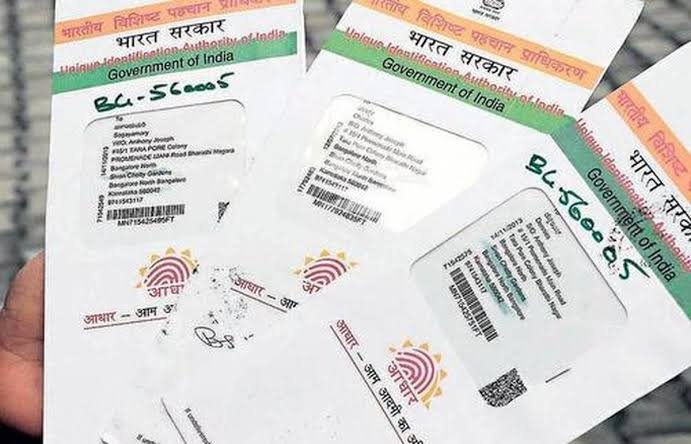

Police and security agencies have stepped up surveillance along the India-Nepal border in Bihar’s Sitamarhi district after alleged networks involved in preparing fake Aadhaar cards, residence certificates and other identity documents surfaced in the Parihar and Bela areas.
Several people have reportedly been arrested in separate cases linked to forged identity documents. Investigators are now examining whether cyber cafes and digital printing centres were being used to create documents for people seeking to establish false Indian identities.
The Sashastra Seema Bal has also increased checking at border posts, including Kanhwa under its 51st Battalion, where travellers’ identity documents are being subjected to physical and digital verification.
Fake documents allegedly offered to Nepali citizens
Police suspect that some forged Aadhaar cards and residence certificates were being prepared for Nepali citizens.
Investigators are examining whether those documents were later used to open bank accounts, obtain SIM cards, rent accommodation or seek employment in cities such as Delhi, Mumbai and industrial centres in Punjab and Haryana.
Those possibilities remain under investigation.
The existence of a forged Aadhaar document does not automatically mean it was successfully accepted by a bank, telecom company or government authority.
Investigators will have to establish where individual documents were used and whether they were backed by genuine Aadhaar records or were simply digitally altered cards.
Aadhaar card image and valid Aadhaar record are not the same thing
That distinction is critical.
A fake Aadhaar card can be made to look convincing on paper or as a PDF, but a genuine Aadhaar contains a secure QR code digitally signed by UIDAI.
UIDAI says the QR code includes identity details and the holder’s photograph and can be checked through its official Aadhaar QR Scanner or mAadhaar application.
A forged card whose QR code has been altered or copied may fail that verification.
UIDAI specifically says its secure QR system is designed to help detect Aadhaar fraud because the data is digitally signed and tamper-resistant.
This is why simply photocopying or visually inspecting an Aadhaar card is a weaker verification method than digitally validating it.
Aadhaar does not prove Indian citizenship
The Sitamarhi case also requires an important legal clarification.
Aadhaar is not a citizenship certificate.
UIDAI has explicitly stated that an Aadhaar number establishes identity and residency-related eligibility, but does not confer Indian citizenship or domicile.
Nepalese nationals can also be eligible for Aadhaar when they meet prescribed residency and documentation rules.
UIDAI’s current document list specifically provides Aadhaar enrolment requirements for nationals of Nepal and Bhutan, including accepted identity documents and residency conditions.
The alleged fraud in Sitamarhi therefore should not be described simply as “Nepalis obtaining Aadhaar”.
The real issue is whether individuals or intermediaries fabricated residence documents, altered Aadhaar records, impersonated other people or created entirely fake cards outside the official UIDAI process.
Earlier Parihar raid exposed document-making setup
The latest investigation follows an earlier case from Parihar in July.
Police raided a shop at Parwaha Chowk and arrested 35-year-old Gajendra Kumar after receiving information about alleged preparation of fake Aadhaar cards and other government documents.
Investigators seized two laptops, a Morpho fingerprint scanner, another fingerprint and identification device, a webcam and a photo printer.
Police said the accused could not produce valid authorisation for Aadhaar enrolment or update services.
A case was registered as Parihar Police Station Case No. 191/26, and police said they were examining whether other people were linked to the operation.
That earlier raid is significant because the equipment recovered was capable of supporting a document-production setup.
It does not by itself prove that every seized device was used to create forged Aadhaar cards, but the material gives investigators a digital trail to examine.
Cyber cafes and printing centres now under scrutiny
Following the emergence of multiple cases, police have increased monitoring of cyber cafes and digital printing businesses in Parihar and Bela.
Investigators are checking whether establishments offering legitimate printing, form-filling or online services were also producing forged identity documents.
Computers, printers and stored files can reveal much more than finished cards.
Investigators may be able to identify document templates, photographs, scanned signatures, lists of customers, altered certificates and digital files linked to previously generated IDs.
That could help police determine the number of documents produced and identify the people who obtained them.
SSB increases checks along open India-Nepal border
The India-Nepal border presents a particular enforcement challenge because citizens of both countries enjoy relatively open cross-border movement under longstanding bilateral arrangements.
That makes identity verification especially important when authorities suspect forged Indian documents are being used.
SSB Assistant Commandant Deepak Mishra told Hindustan that personnel are carrying out intensive verification of identity documents and allowing movement after physical and digital checks.
Security personnel are also monitoring suspicious activity at other checkpoints in the sector.
The purpose is not to treat ordinary cross-border movement as illegal, but to identify people allegedly relying on fraudulent Indian documentation.
Fake identity can unlock several other systems
The wider concern is what happens after a forged document is accepted somewhere else.
Aadhaar can be used for e-KYC in services including bank accounts and mobile connections when proper authentication requirements are followed.
If forged supporting documents help establish a false identity elsewhere, criminals may attempt to use that identity for bank accounts, SIM cards, employment or accommodation.
That can make later investigations difficult because one false identity may appear across several unrelated systems.
This is also why banks, telecom operators, landlords and other service providers should not depend solely on the appearance of a printed Aadhaar card.
Digital verification is much harder to counterfeit than a colour printout.
What this means for you: If you need to verify an Aadhaar document, do not rely only on the name, photograph or printed number. Use UIDAI’s official QR verification tools where appropriate and be cautious if someone provides only photocopies or edited digital images without verifiable credentials.
The420 Insight: The Sitamarhi case is not simply about forged cards at a border town. The real risk comes when one fake identity is accepted repeatedly by banks, telecom companies, employers and landlords. The strongest defence is therefore not better printing inspection, but digital verification at every point where identity is converted into access.
Follow for daily updates on cybercrime, corporate fraud, DFIR, hacking, investigations, and digital forensics
