
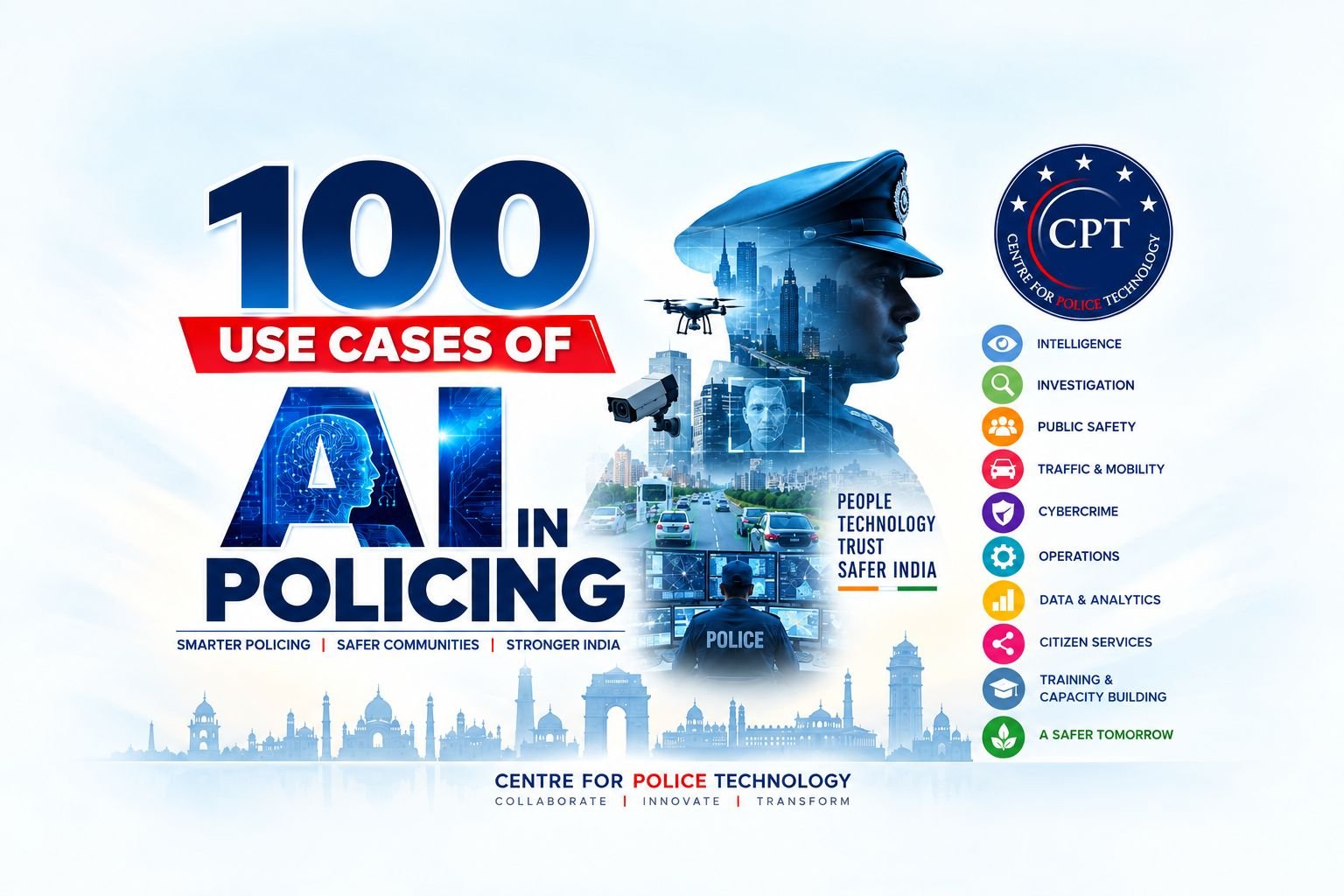
The Centre for Police Technology (CPT) invites students, researchers, academicians, AI developers, startups and technology innovators to associate with us and contribute to our mission of advancing responsible, ethical and practical AI applications in policing.
Participants may contribute through research, prototypes, datasets, proof-of-concepts, technology demonstrations, case studies and field-oriented solutions around the following 100 use cases.
Crime Analytics & Predictive Policing
1. Predictive Policing — AI analyses historical crime patterns and contextual data to anticipate potential hotspots and support proactive, intelligence-led deployment of police resources.
2. Crime Hotspot Mapping — AI identifies geographic concentrations of recurring crime, helping police commanders prioritise patrols, surveillance and preventive interventions in vulnerable locations.
3. Crime Pattern Recognition — Machine learning discovers recurring similarities across incidents, locations, victims and offenders that investigators may struggle to identify manually.
4. Crime Trend Forecasting — AI analyses historical and emerging crime data to forecast changing trends and help police prepare resources and preventive strategies.
5. Criminal Network Analysis — AI maps relationships among suspects, associates, communications and transactions, helping investigators understand complex organised criminal networks more efficiently.
6. Case Linkage Analysis — AI compares multiple cases to identify common offenders, methods, locations, vehicles, devices or behavioural patterns connecting seemingly unrelated crimes.
7. Cold Case Analysis — AI re-examines historical evidence and records using modern analytics to discover previously overlooked connections, suspects, patterns and investigative leads.
8. Repeat Offender Analysis — AI identifies patterns associated with repeat offenders, supporting investigation, lawful risk assessment and targeted crime-prevention strategies.
9. Modus Operandi Analysis — AI compares offender methods across cases, helping investigators recognise distinctive behavioural signatures and connect crimes potentially committed by common perpetrators.
10. Criminal Profiling — AI assists investigators by analysing behavioural and crime-pattern information to generate investigative hypotheses, subject to human judgement and evidentiary safeguards.
Surveillance & Recognition
11. Facial Recognition — AI can compare facial imagery against authorised databases to assist identification, subject to legal authority, accuracy testing and human verification.
12. Suspect Identification — AI combines available imagery, records and investigative data to help investigators narrow potential suspects while retaining human oversight.
13. Missing Person Identification — AI searches authorised image and video sources for potential matches, helping investigators locate missing persons more rapidly.
14. Wanted Person Detection — AI-assisted recognition can alert authorised officers to potential matches with wanted-person databases for subsequent human verification and action.
15. Victim Identification — AI can correlate photographs, biometric information and records to support identification of unknown victims during complex investigations and disasters.
16. Vehicle Recognition — Computer vision identifies vehicle type, colour, make and other visible characteristics to assist investigations and search operations.
17. Automatic Number Plate Recognition — AI-enabled ANPR reads vehicle registration plates and compares them with authorised databases to identify vehicles requiring police attention.
18. Stolen Vehicle Detection — AI correlates ANPR observations with stolen-vehicle databases, potentially alerting police when suspected stolen vehicles appear on monitored routes.
19. CCTV Video Analytics — AI rapidly searches large video collections for relevant people, vehicles, objects, movements and events, reducing investigators’ manual review workload.
20. Real-Time Surveillance Analytics — AI analyses authorised live video streams for defined events, enabling faster situational awareness while requiring appropriate privacy and oversight controls.
Public Safety & Threat Detection
21. Crowd Monitoring — AI estimates crowd movement and density, helping police manage major events, demonstrations, religious gatherings and other high-footfall situations safely.
22. Crowd Density Analysis — Computer vision estimates crowd concentration and identifies potentially dangerous congestion, enabling timely crowd-management and emergency interventions.
23. Suspicious Behaviour Detection — AI flags predefined unusual activity patterns for officer review rather than independently determining criminal intent or guilt.
24. Abandoned Object Detection — Computer vision detects unattended objects in monitored areas and alerts personnel for appropriate security assessment and response.
25. Weapon Detection — AI can flag visually apparent suspected weapons in authorised video feeds, enabling trained personnel to assess potential threats rapidly.
26. Gunshot Detection — AI analyses acoustic sensor information to identify possible gunfire and estimate location, enabling faster verification and emergency response.
27. Drone-Based Surveillance — AI processes authorised drone imagery to support search operations, disaster response, crowd management, traffic monitoring and situational awareness.
28. Satellite Imagery Analysis — AI analyses satellite imagery to support disaster assessment, border monitoring, terrain analysis and investigations involving large geographic areas.
29. Smart City Surveillance — AI integrates authorised sensor and camera information to improve situational awareness, incident detection and coordinated urban policing responses.
30. Disaster/Crisis Monitoring — AI analyses multiple information streams during emergencies to identify affected areas, emerging risks and priorities for police deployment.
Traffic Management & Road Safety
31. Traffic Violation Detection — Computer vision can identify defined violations such as red-light jumping or lane offences, subject to applicable traffic-enforcement procedures.
32. Intelligent Traffic Management — AI analyses traffic flows and incidents to support dynamic traffic management, congestion reduction and more effective police deployment.
33. Accident Detection — AI can recognise possible collisions through cameras and connected systems, helping emergency services receive earlier alerts and location information.
34. Road Safety Analytics — AI analyses crashes, violations and road conditions to identify dangerous locations and support evidence-based road-safety interventions.
35. Traffic Flow Prediction — AI forecasts congestion using historical and real-time information, allowing traffic police to prepare diversions and deploy personnel proactively.
36. Choke Point Analysis — AI identifies recurring congestion and mobility bottlenecks, supporting traffic planning, emergency-route management and major-event policing.
37. Smart Traffic Signals — AI can dynamically optimise signal timing according to traffic conditions while supporting priority movement for emergency vehicles where authorised.
38. Parking Violation Detection — Computer vision identifies vehicles parked in prohibited areas, helping authorities improve enforcement and maintain emergency access routes.
39. Highway Patrol Support — AI integrates traffic, vehicle and incident information to help highway patrol teams prioritise dangerous situations and deploy efficiently.
40. Traffic Incident Alerts — AI automatically detects unusual traffic disruptions and generates alerts, enabling control rooms to coordinate quicker verification and response.
Emergency Response & Police Operations
41. Emergency Response Optimisation — AI recommends suitable response resources using incident type, location, traffic and availability while keeping operational decisions with authorised officers.
42. Police Resource Deployment — AI analyses demand patterns and operational information to help commanders allocate personnel, vehicles and specialist resources more efficiently.
43. Patrol Route Optimisation — AI recommends patrol routes based on crime patterns, calls for service, traffic conditions and operational priorities.
44. Smart Beat Policing — AI provides beat officers with area-specific insights about incidents, recurring problems and patrol priorities to support preventive policing.
45. Police Workforce Planning — AI analyses workload, skills and demand patterns to assist scheduling, staffing and longer-term police workforce planning.
46. Emergency Call Prioritisation — AI assists control rooms by categorising incoming emergency information and highlighting potentially urgent calls for immediate human assessment.
47. Real-Time Incident Monitoring — AI integrates feeds from authorised operational systems to provide commanders with continuously updated situational awareness during major incidents.
48. Multi-Agency Coordination — AI can organise information from police and partner agencies into common operational views, improving coordination during complex emergencies.
49. Resource Allocation Modelling — AI simulates deployment scenarios to help commanders assess how different resource allocations could affect coverage and response capability.
50. Response Time Prediction — AI estimates likely police response times using location, traffic, resource availability and incident demand to improve deployment planning.
Complaint Management & Case Handling
51. AI-Assisted Complaint Classification — AI categorises citizen complaints by subject, seriousness and jurisdiction, helping route them efficiently to appropriate police units.
52. FIR Analysis — NLP can analyse FIR text to identify entities, offences, locations and recurring patterns, assisting investigators and supervisory officers.
53. Automated Complaint Routing — AI directs complaints to relevant units based on jurisdiction, subject and urgency while allowing human review where necessary.
54. Case Prioritisation — AI can highlight cases requiring urgent attention using transparent criteria, while final prioritisation remains an accountable human decision.
55. Investigation Decision Support — AI organises evidence, timelines and possible connections to help investigators evaluate leads without replacing professional judgement.
56. Citizen Grievance Analysis — AI analyses grievance patterns to identify recurring service problems, delayed cases and geographic areas requiring administrative attention.
57. Case Progress Monitoring — AI tracks investigation milestones, deadlines and pending actions, helping supervisors identify delays and improve case-management accountability.
58. Automated Generation of Summaries — Generative AI can summarise lengthy complaints, statements and case records, enabling officers to understand relevant information more quickly.
59. Case Recommender Systems — AI can surface similar previous cases, investigative approaches and relevant precedents to assist officers without automatically determining outcomes.
60. Legal Document Analysis — AI extracts relevant provisions, entities and issues from legal documents, supporting investigators in managing complex documentation efficiently.
Proposal for Conducting Cyber Crisis Drill, Tabletop Exercise (TTEx) & CCMP Readiness Exercise
Digital Forensics & Evidence Analysis
61. Digital Evidence Analysis — AI helps examine large digital datasets to identify potentially relevant communications, files, transactions and artefacts for investigator review.
62. Electronic Evidence Classification — AI automatically categorises electronic evidence by type and relevance, helping forensic teams organise large evidence collections efficiently.
63. Digital Evidence Search — Semantic AI search helps investigators locate relevant information across massive evidence repositories despite variations in terminology and wording.
64. Evidence Correlation — AI correlates evidence across devices, accounts, locations and cases, helping investigators identify relationships that manual analysis might overlook.
65. Evidence Timeline Reconstruction — AI combines timestamps and digital artefacts to create investigative timelines showing relevant sequences of events and activities.
66. Crime Scene Image Analysis — Computer vision assists examination of crime-scene imagery by detecting, classifying and organising visible objects for forensic review.
67. Fingerprint Matching — AI-enhanced algorithms accelerate comparison of fingerprint evidence against authorised databases while requiring qualified forensic confirmation of potential matches.
68. Biometric Identification — AI assists comparison of authorised biometric information such as faces, fingerprints or iris patterns while maintaining legal and procedural safeguards.
69. DNA Data Analysis — AI supports forensic specialists in analysing complex genetic datasets and prioritising potential associations, without replacing validated forensic interpretation.
70. Mobile/Computer/Cloud/IoT Forensics — AI helps forensic teams triage enormous datasets from devices, computers, cloud environments and connected systems to identify relevant evidence.
Cybercrime & Financial Intelligence
71. Cybercrime Detection — AI detects suspicious digital activity and patterns that may indicate cybercrime, enabling investigators to prioritise potential incidents for examination.
72. Cyber Threat Intelligence — AI processes large threat-data sources to identify malicious infrastructure, emerging campaigns, indicators and relationships relevant to law enforcement.
73. Malware Analysis — AI assists specialists in classifying malware, recognising behavioural similarities and identifying potentially related cyberattack campaigns.
74. Ransomware Investigation — AI correlates malware indicators, infrastructure, cryptocurrency activity and victim patterns to help investigators analyse ransomware operations and criminal ecosystems.
75. Phishing Detection — AI examines messages, domains and behavioural indicators to identify suspected phishing campaigns and support cybercrime investigations.
76. Online Scam Detection — AI identifies recurring patterns across fraudulent websites, messages, advertisements and accounts, helping police uncover coordinated online scam networks.
77. Social Media Intelligence — AI analyses lawfully accessible social-media information for investigative patterns, emerging threats and relevant connections while respecting applicable legal safeguards.
78. Open-Source Intelligence (OSINT) — AI collects, translates, categorises and correlates publicly available information, enabling investigators to transform large open datasets into actionable leads.
79. Dark Web Intelligence — AI helps authorised investigators identify relevant patterns and entities in lawfully accessed dark-web data during cybercrime and organised-crime investigations.
80. Cryptocurrency Investigation — AI assists blockchain analysis by identifying transaction patterns, clusters and relationships potentially relevant to fraud, laundering and cybercrime investigations.
Organised Crime, Financial Crime & Special Domains
81. Blockchain Transaction Analysis — AI analyses blockchain transaction graphs to identify clusters, fund movements and potentially relevant relationships for authorised financial investigations.
82. Financial Fraud Detection — AI identifies unusual transaction and behavioural patterns that may indicate fraud, helping investigators prioritise suspicious activity for further examination.
83. Money-Laundering Pattern Detection — AI detects complex movement of funds across accounts and transactions, supporting investigators in identifying potential laundering typologies and networks.
84. Terror Financing Detection — AI can identify suspicious financial relationships and transaction patterns for authorised counter-terrorism investigations, subject to strict legal safeguards.
85. Suspicious Transaction Analysis — AI prioritises unusual transactions and relationships from large financial datasets, helping investigators focus on potentially significant leads.
86. Organised Crime Network Mapping — AI builds relationship graphs connecting suspects, companies, communications, transactions and locations to expose structures within organised criminal groups.
87. Gang Network Analysis — AI analyses authorised intelligence to identify associations and patterns within suspected criminal networks while requiring human validation and lawful use.
88. Human Trafficking Detection — AI identifies patterns across advertisements, communications, travel and financial information that may help investigators detect trafficking networks and victims.
89. Drug Trafficking Intelligence — AI correlates seizure, communication, financial and geographic information to identify trafficking patterns, routes and potential organised networks.
90. Child Exploitation & Missing Children — AI can assist authorised investigators in detecting harmful material and matching missing children while applying stringent safeguarding and privacy controls.
Communication, Language & Content Intelligence
91. Voice Recognition — AI processes authorised audio evidence to identify linguistic and acoustic characteristics that may assist investigators, subject to forensic validation.
92. Speaker Identification — AI compares voice characteristics across authorised recordings to generate potential associations that trained forensic specialists can subsequently evaluate.
93. Speech-to-Text Transcription — AI converts recorded interviews, emergency calls and authorised audio evidence into searchable text, significantly reducing manual transcription workload.
94. Multilingual Translation — AI rapidly translates complaints, communications and investigative material across languages, helping police operate effectively in multilingual environments.
95. Natural Language Processing — NLP extracts names, locations, relationships, events and patterns from large collections of complaints, reports and investigative documents.
96. Police Document Summarisation — Generative AI creates concise summaries of lengthy police records, helping officers understand essential information while requiring verification against original documents.
97. Deepfake Detection — AI analyses digital media for signs of synthetic manipulation, helping investigators assess suspected deepfake images, audio and video.
98. Image & Video Authentication — AI assists forensic examination of digital media for manipulation indicators, metadata inconsistencies and other authenticity-related characteristics.
99. Audio Authentication — AI supports forensic experts by analysing recordings for edits, splicing, synthetic speech and other potential signs of manipulation.
100. AI-Generated Content Detection — AI tools can assist investigators in assessing whether suspicious text, imagery, audio or video may have been synthetically generated.
Join the CPT AI in Policing Mission
CPT welcomes collaborators interested in taking one or more of these 100 use cases from research to practical policing solutions. Students can undertake projects and dissertations; researchers can contribute studies, datasets and evaluation frameworks; startups and developers can demonstrate prototypes, PoCs and deployable technologies.
Particular emphasis is encouraged on Responsible AI, privacy, explainability, bias mitigation, cybersecurity, legal compliance, human oversight and measurable policing outcomes. AI should augment police capability—not replace lawful human judgement or accountability.
Interested students, researchers, academicians, startups and AI innovators may connect with Centre for Police Technology (CPT):
WhatsApp: 9696100100
Email: triveni@algoritha.in
Centre for Police Technology (CPT)
Technology • Research • Innovation • Collaboration for Smarter Policing
Follow for daily updates on cybercrime, corporate fraud, DFIR, hacking, investigations, and digital forensics
