
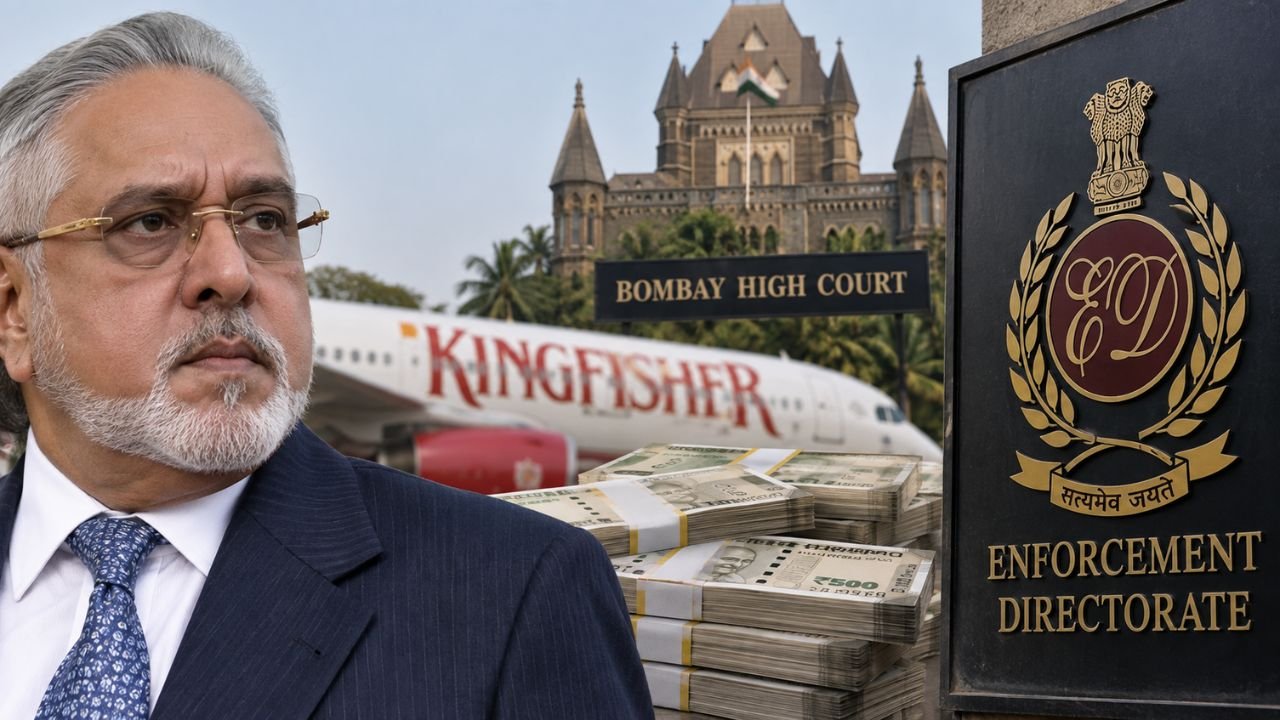

Mumbai. The Enforcement Directorate has told the Bombay High Court that the recovery of a substantial amount by banks from properties belonging to businessman Vijay Mallya does not automatically bring the money laundering case against him to an end. The agency said recovery of bank dues and criminal proceedings for money laundering are separate legal processes. The restoration of properties to legitimate claimants does not, by itself, extinguish allegations of money laundering.
According to an affidavit filed by the ED before the court, movable and immovable properties worth around ₹14,131.6 crore linked to Mallya had been handed over to the consortium of banks led by the State Bank of India as of August 2021. The restoration of these properties was intended to help compensate banks and other legitimate claimants for their financial losses. The agency said the action was carried out under the statutory framework of the PMLA and has no automatic impact on the pending criminal proceedings.
Proposal for Conducting Cyber Crisis Drill, Tabletop Exercise (TTEx) & CCMP Readiness Exercise
The case relates to Mallya’s petition challenging an order of the special court that allowed properties attached by the Enforcement Directorate to be used for recovery of bank dues. The High Court is also examining the legal relationship between recovery from the attached properties and the criminal proceedings pending against Mallya.
According to the ED, Mallya is accused of allegedly siphoning off at least ₹3,500 crore from loans of around ₹9,000 crore sanctioned by banks for the now-defunct Kingfisher Airlines. The agency provisionally attached several properties linked to Mallya in 2016 under the PMLA. In 2019, the special court allowed the State Bank of India and other lender banks to use the attached properties for recovery of their dues. The assets included shares linked to United Breweries Holdings Ltd.
Mallya challenged the special court’s order before the High Court in 2020. Senior Advocate Amit Desai, appearing for Mallya, argued that since a substantial portion of the banks’ liabilities had been recovered and the process of recovering dues from the properties had progressed, the proceedings challenging restoration of the assets had effectively become redundant. The defence also argued that the dispute was essentially commercial in nature and should be brought to a close.
The ED rejected the argument as misconceived and legally unsustainable. The agency said money laundering proceedings are not limited to recovery of outstanding bank dues. They concern allegations relating to proceeds of crime arising from scheduled offences and the subsequent laundering of those proceeds. Therefore, recovery of money by banks or a reduction in their outstanding liabilities does not mean that the alleged ingredients of the money laundering offence cease to exist.
The agency also told the court that the PMLA provides for restoration of properties to legitimate claimants who have suffered financial losses linked to the alleged offence. The purpose of this mechanism is to deal with the property rights and losses of legitimate claimants, whereas criminal proceedings determine whether the accused committed an offence of money laundering.
The ED argued that the amount recovered and the determination of the banks’ outstanding liabilities may be relevant in debt-recovery proceedings, but they do not determine whether the legal ingredients of the alleged money laundering offence against Mallya are satisfied. According to the agency, the two proceedings have different objectives and operate on separate legal foundations.
Action against Mallya followed the failure to repay large loans extended to Kingfisher Airlines, after which banks initiated legal proceedings to recover their money. The Enforcement Directorate subsequently initiated proceedings under the PMLA and attached properties in connection with the alleged money laundering.
The central issue before the High Court is whether the recovery of substantial amounts by banks through the attached properties has any legal effect on the pending criminal proceedings against Mallya. The ED has maintained that restoration of properties and recovery of bank dues must be considered separately from the allegations of money laundering.
The agency’s position is that the restoration of properties worth more than ₹14,131 crore and the recovery made by banks from those assets cannot, by themselves, provide a legal basis for terminating the criminal money laundering proceedings against Vijay Mallya.
Follow for daily updates on cybercrime, corporate fraud, DFIR, hacking, investigations, and digital forensics
