
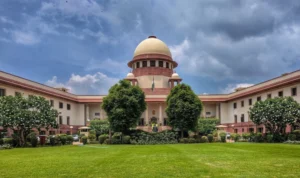
The Supreme Court has held that a bank can invoke the Securitisation and Reconstruction of Financial Assets and Enforcement of Security Interest Act, 2002, or SARFAESI Act, to recover loans acquired from a non-banking financial company, even if the NBFC was not covered by the Act when the loans were originally sanctioned.
A bench of Justices Sanjay Kumar and Sanjeev Sachdeva delivered the ruling on September 2 in appeals arising from disputes involving loans originally advanced by City Financial Consumer Finance Limited (CFCFL).
The judgment set aside the Bombay High Court decision that had restrained Kotak Mahindra Bank from using the SARFAESI Act to recover the acquired loans.
Algoritha Security Launches ‘Make in India’ Cyber Lab for Educational Institutions
Why did the Supreme Court examine the status of CFCFL?
The dispute involved loan accounts originally granted by CFCFL, an NBFC that did not fall within the definition of a notified “financial institution” under Section 2(1)(m) of the SARFAESI Act when the loans were sanctioned.
CFCFL was subsequently notified as a financial institution under the Act on August 27, 2018. Between 2012 and 2013, Kotak Mahindra Bank, which qualified as a “bank” under Section 2(1)(c) of the SARFAESI Act, acquired three sets of loan accounts from CFCFL. The loans were secured by mortgage of property.
After acquiring the accounts, Kotak Mahindra Bank initiated proceedings under the SARFAESI Act to recover the outstanding amounts.
Could Kotak Mahindra Bank invoke SARFAESI after acquiring the loans?
The borrowers challenged the bank’s action, arguing that the loans had been granted at a time when CFCFL did not fall within the statutory definition of a financial institution under the Act.
Their contention was that the loans could not subsequently come within the SARFAESI framework merely because they had been transferred to a bank. They also argued that the bank could not rely on CFCFL’s later notification as a financial institution to invoke the Act.
The Bombay High Court’s Division Bench had upheld the decisions of the DRT and DRAT, holding that the bank could not use SARFAESI to recover loans acquired from CFCFL. Kotak Mahindra Bank challenged that decision before the Supreme Court.
What did the Supreme Court rule on SARFAESI recovery?
The Supreme Court rejected the borrowers’ contention and allowed the bank to proceed under the SARFAESI framework.
The court observed that accepting the borrowers’ argument would mean that persons who obtained financial assistance from NBFCs outside the scope of Section 2(1)(m) could default on such loans with recovery then having to depend on ordinary civil proceedings.
The court noted that civil recovery proceedings could be more time-consuming, while the SARFAESI framework provides comparatively quicker recovery mechanisms. It held that allowing such a distinction could have wider implications for the functioning of the financial system.
The bench further observed that once a non-performing loan is acquired by a bank to which the SARFAESI Act applies, the loan account obtains the legal characteristics of a “secured debt” under the Act.
Does the original lender’s status affect SARFAESI proceedings?
The Supreme Court clarified that it made no difference whether both the original lender and the acquiring institution fell within the SARFAESI Act when the loan was initially granted, or whether only the loan-acquiring bank came within its scope.
The court referred to its earlier decisions in M.D. Frozen Foods Exports Private Limited v Hero Fincorp Limited (2017) and Indian Housing Finance Limited v Deccan Chronicle Holdings Limited (2018).
Relying on those precedents, the court noted that once a bank acquires a non-performing loan covered by the statutory framework, the identity of the original lender does not prevent the bank from taking recovery action under SARFAESI.
What is the significance of CFCFL’s later notification?
The court also considered the fact that CFCFL was notified as a financial institution under the SARFAESI Act on August 27, 2018, after the loans in question had been sanctioned and transferred.
It held that the ability of a bank to recover loans under SARFAESI could not be defeated merely because the original lender was not covered by the Act at the time the loans were sanctioned.
The judgment therefore rejected the argument that the original status of CFCFL prevented Kotak Mahindra Bank from invoking SARFAESI after acquiring the loan accounts.
What did the Supreme Court ultimately order?
The Supreme Court allowed the appeals and set aside the contrary decision of the Bombay High Court.
It directed that the securitisation applications filed by the borrowers before the Debt Recovery Tribunal be dismissed.
Case Title: Kotak Mahindra Bank Limited vs Trupti Sanjay Mehta and Ors.
About the author — Ayesha Aayat writes on cybercrime, digital safety, and emerging online threats. Her work focuses on public awareness, legal clarity, and technology-driven risks.
