
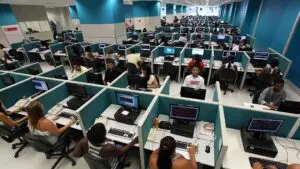
Gurugram Police have busted an alleged cyber fraud gang that operated a fake Apple customer service center and targeted US citizens. The Cyber Crime West police raided a rented house in Palam Vihar and arrested 11 people allegedly involved in the operation.
According to police, the accused posed as Apple customer service representatives, contacted US citizens and claimed that their devices had been infected with viruses or were facing serious technical problems.
Police recovered nine laptops, 20 mobile phones, two headphone-microphone sets, two cars, one motorcycle and one scooter from the premises.
Preliminary investigation indicates that the alleged call center had been operating from the rented property for around two to three months. Callers were reportedly hired on a commission basis, while the overall operation was allegedly being controlled by another person.
Algoritha Security Launches ‘Make in India’ Cyber Lab for Educational Institutions
Fake call center operating from Palam Vihar
Police received information that an unauthorized call center was being operated from Plot No. 1208 in J Block, Palam Vihar. Acting on the information, a police team raided the premises. The suspects were allegedly found using laptops, mobile phones and headset-microphone equipment to communicate with foreign nationals in English.
According to investigators, the accused used X-Lite Dialler and Apple FaceTime to contact US citizens. All 11 suspects were taken into custody during the raid. Those arrested have been identified as Pritpal Singh, Mohammad Rizan Ansari, Chaitanya Goyal, Manish, Shahrukh Ansari, Sanjeev Pandey, Shivam, Aditya, Deepak Trivedi, Varun Gautam and Neeraj. Police said Pritpal Singh allegedly worked as the team leader at the call center.
Posed as Apple employees
During questioning, the accused allegedly disclosed that they contacted US citizens while pretending to be employees of Apple customer support. Victims were told that their phones or other devices had been infected with a virus or were experiencing a serious technical problem.
The callers then allegedly directed victims to contact a fake virtual toll-free number, where they were guided through a purported troubleshooting process. Investigators suspect that the method was designed to create panic among victims and convince them to make large payments.
Fake FTC notices used to create fear
The investigation has also revealed that the accused allegedly used fake letters or notices purportedly issued by the US Federal Trade Commission (FTC). Victims were allegedly made to believe that suspicious activity involving their devices could lead to serious consequences and that immediate action was required.
The accused then allegedly demanded between $10,000 and $20,000 from victims in the name of resolving the technical issue or preventing purported legal action. The amount is roughly equivalent to ₹8.3 lakh to ₹16.6 lakh per victim based on the conversion used in the report.
Police said the alleged fraud proceeds were transferred to foreign bank accounts. The accused also allegedly obtained money through gift vouchers and gift cards, making it more difficult to trace the funds directly to the operators.
Police investigating wider network
A case has been registered at the Cyber Crime West police station under relevant provisions of the Bharatiya Nyaya Sanhita and the Information Technology Act. Police are now investigating the alleged mastermind behind the call center, the network that provided access to foreign victims and the bank accounts used to receive and move the suspected fraud proceeds.
Renowned cyber crime expert and former IPS officer Prof. Triveni Singh said that unsolicited technical-support calls that create fear about viruses, hacking, legal action or account security and then demand immediate payment should be treated as a major warning sign. He advised people to independently verify customer-support calls through the company’s official website or other verified channels rather than relying on numbers or links provided during an unsolicited call.
Police are conducting digital forensic examinations of the seized laptops and mobile phones and are also examining foreign bank accounts and transaction records. Investigators are expected to determine the scale of the alleged international operation, the total amount involved and the possible involvement of additional suspects.
