

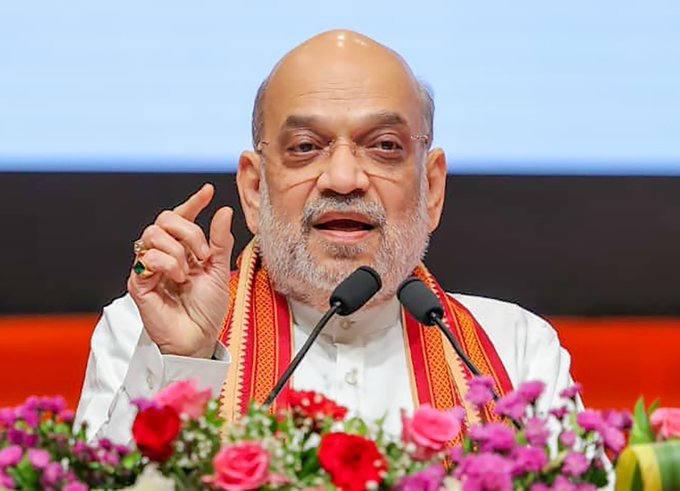
Union Home Minister Amit Shah on Monday directed police chiefs and security agencies to take strict measures against infiltration and accelerate the identification and deportation of illegal migrants. He also stressed greater use of artificial intelligence (AI) to analyse intelligence inputs and identify emerging national security threats. Shah was addressing the inaugural session of the two-day National Security Strategies Conference 2026 (NSSC) in New Delhi.
The Home Minister called for AI-based analysis of information available through the Multi Agency Centre (MAC) platform. The objective is to identify patterns linked to different national security challenges and develop standard operating procedures (SOPs) for an effective response. The approach is expected to improve the use of intelligence and enable faster coordination and action among security agencies.
More than 850 officials and experts attend conference
The National Security Strategies Conference was held in a hybrid format, with more than 850 participants from across the country. Union Home Secretary Govind Mohan, Intelligence Bureau Director Mahesh Dixit and heads of the Central Armed Police Forces attended the conference in Delhi.
Directors General of Police from States and Union Territories, young police officers working at the operational level and experts from specialised fields participated virtually. The conference aims to bring together the experience of officers working at the grassroots level with senior officials and domain experts to develop practical solutions to major national security challenges.
Illegal migration and intelligence coordination in focus
The detection and deportation of illegal migrants was among the key issues discussed on the first day. Shah directed police chiefs and security agencies to strengthen mechanisms to identify individuals staying in India without valid legal documents and ensure that deportation proceedings are carried out effectively and in accordance with the law.
The conference also discussed improving the use of intelligence received through the MAC platform. Shah emphasised that intelligence gathering should be followed by effective integration, analysis and operational utilisation.
AI-based systems can help analyse large volumes of information from multiple sources and identify patterns that may indicate potential security threats. The focus is expected to be on converting intelligence inputs into actionable information and developing coordinated responses.
According to the Ministry of Home Affairs, discussions also covered counter-terrorism, narcotics control, cybercrime, radicalisation and challenges linked to proxy warfare by Pakistan.
Strategy to counter terrorism and radicalisation
Shah stressed the need to strengthen training for implementation of the Ministry of Home Affairs’ PRAHAAR scheme as part of efforts to counter terrorism and radicalisation.
The conference also discussed ways to expedite trials in cases involving fugitives. Shah emphasised efforts to bring fugitives back to India and the use of legal provisions permitting trials in absentia where applicable.
He also called for a comprehensive and integrated approach to investigations under the Unlawful Activities (Prevention) Act (UAPA), with greater coordination among agencies involved in national security cases.
Cybercrime and proxy warfare on agenda
Cybercrime and the need for a policy framework to address evolving digital threats were also among the key subjects discussed at the conference. Officials examined the need to strengthen security mechanisms against increasingly sophisticated cyber threats and improve coordination between agencies.
Proxy warfare and the challenges arising from it were also discussed as part of the broader national security framework. The emphasis was on strengthening intelligence sharing, coordination and operational preparedness to deal with evolving forms of threats.
Shah’s focus on AI-based intelligence analysis comes at a time when security agencies are dealing with increasingly complex threats involving digital platforms, cyber networks and large volumes of data. AI-based analysis could help agencies connect information from different sources and identify suspicious activities or emerging threat patterns more quickly.
Emerging threats to be discussed on second day
The second day of the conference will focus on threats emerging from sub-aerial systems and measures to counter them. Discussions will also cover the security of the blue economy and the protection of critical maritime interests.
The National Security Strategies Conference has been organised annually in a hybrid format since 2021 following directions from Prime Minister Narendra Modi. Its objective is to bring together operational experience from the grassroots level, senior security leadership and specialised expertise to formulate effective strategies for national security.
With illegal migration, terrorism, radicalisation, cybercrime and emerging technological threats forming a major part of the discussions, AI-based intelligence analysis and coordinated SOPs are likely to become increasingly important components of the security agencies’ operational strategy.
