

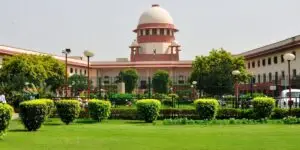
The Supreme Court has taken note of concerns over police organisations allegedly publishing social media content that reveals the identities of accused persons or depicts them in humiliating and degrading situations. The court on Tuesday sought responses from the Centre, all state governments, Union Territories and social media platforms Meta and X on a public interest litigation seeking restrictions on such posts.
A bench comprising Chief Justice Surya Kant and Justices Joymalya Bagchi and V Mohana issued notices after hearing submissions from senior advocate Gopal Sankaranarayanan, appearing for petitioner Hemendra Patel. The petition was filed through advocate-on-record Shrutanjay Bhardwaj.
The petition alleges that police departments sometimes publish photographs and videos on their official social media accounts in which the faces and identities of accused persons are clearly visible. It also refers to material allegedly showing accused persons in handcuffs, tied with ropes, beaten with sticks, forced to kneel or dragged by police personnel. Some photographs and videos are also alleged to show accused persons being pulled down staircases.
The petitioner has sought directions to states and Union Territories to immediately remove such content from official police social media accounts. The plea also seeks clear guidelines governing the use of social media by police organisations so that material revealing the identity of accused persons or depicting them in an inhuman or degrading manner is not published.
The petition has also sought directions for Meta-owned Facebook and Instagram and X to formulate appropriate policies and user guidelines to prevent the circulation of such content. The plea argues that social media platforms should have mechanisms to address posts that expose the identity of accused persons or portray them as being subjected to degrading treatment.
The issue before the court involves the balance between public communication by law enforcement agencies and the legal rights and dignity of accused persons. Publication of photographs or videos before allegations are established in court can potentially affect the reputation of an accused and raise concerns about the principle of a fair legal process. The responses sought by the Supreme Court will indicate how the Centre, states and social media platforms view the issue.
Separately, the Centre has also conveyed concerns to Meta over content related to child sexual abuse. According to government sources, the company has been told that there can be no legal protection for violations of Indian law involving child sexual abuse material. The government has also emphasised that content monitoring and removal mechanisms should take India’s languages, culture and social circumstances into account.
Officials have maintained that the objective is not to suppress legitimate expression but to prevent the misuse of social media from causing harm to society. The government has also pointed to the legal restrictions applicable to freedom of expression in India and the increasing debate over accountability of digital platforms in dealing with unlawful content.
According to the figures cited in the context of government monitoring, agencies between March and July issued around 1.95 lakh content-blocking orders to Instagram, Facebook and YouTube. Instagram received approximately one lakh orders, followed by Facebook with around 80,000 and YouTube with nearly 15,000. Together, the two Meta-owned platforms accounted for about 90 per cent of the orders issued to the three platforms.
The Supreme Court’s intervention comes amid growing scrutiny of how law enforcement agencies use social media to publicise arrests and investigations. While such communication can help inform the public about police action, the petition raises questions over whether official platforms should publish identifiable images of accused persons in circumstances that may compromise their dignity.
The notices issued by the Supreme Court now require the Centre, state governments, Union Territories and the concerned social media companies to respond to the issues raised in the petition. The proceedings could eventually lead to clearer standards governing the publication and circulation of photographs and videos involving accused persons on official police social media accounts.
