

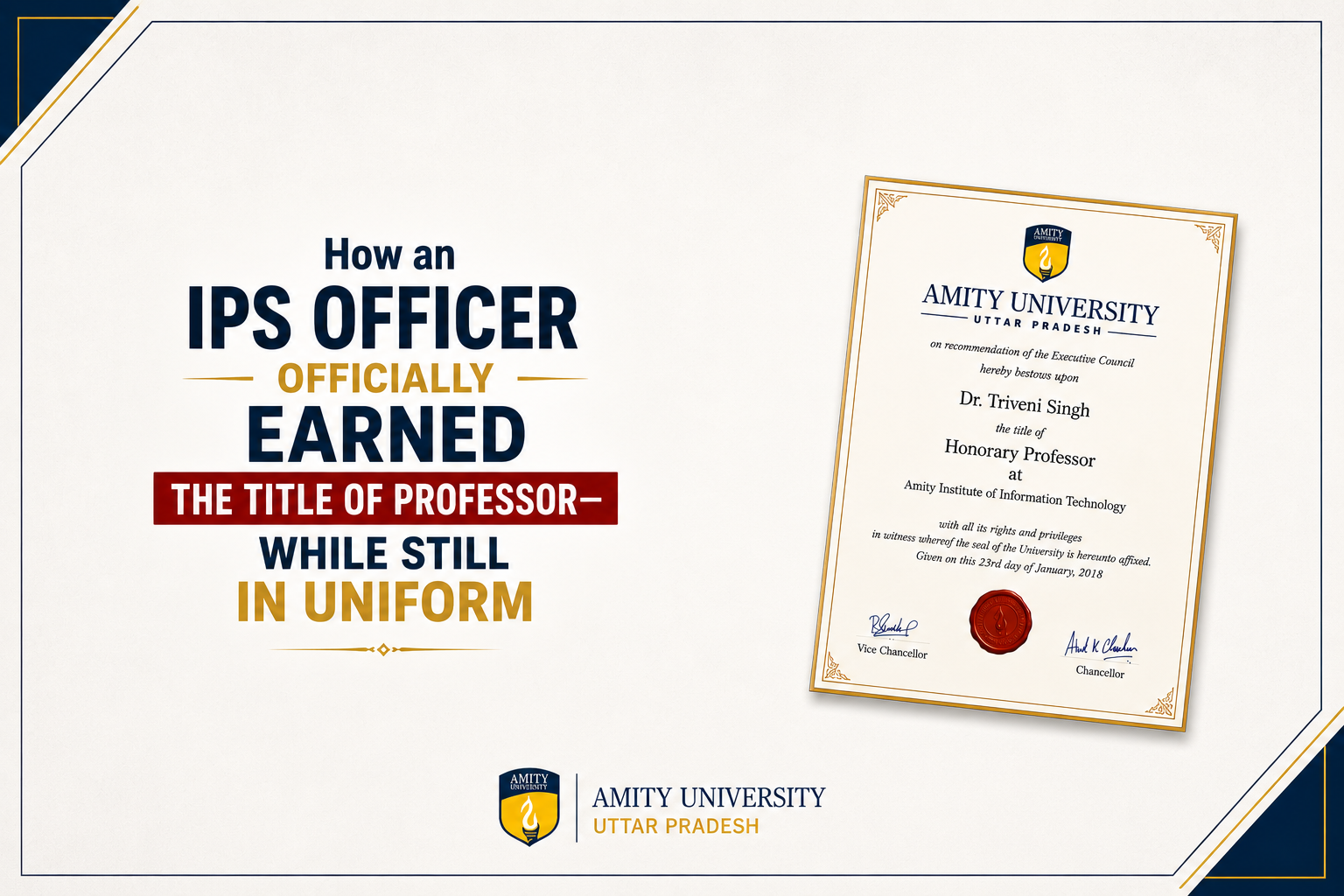
New Delhi: From investigating conventional crime to becoming one of Asia’s best-known cybercrime investigators, Prof. Triveni Singh’s journey is also an unusual story of how an academic title earned through professional contribution had to be formally defended within the police establishment itself.
For more than three decades, Prof. Triveni Singh, former Indian Police Service (IPS) officer, has occupied an unusual space at the intersection of policing, technology, academia and cybercrime investigation. Known variously in professional and media circles as “Cyber Cop,” “Cyber Singham” and “Cyber Cop of Asia,” Singh built his reputation by investigating complex cyber-enabled financial crimes at a time when cyber policing in India was still developing as a specialised discipline. Cybertech Global in Tel Aviv describes him as one of Asia’s respected cybercrime and law-enforcement leaders and refers to him as the “Cyber Cop of Asia.” (cybertechisrael)
Yet one of the most distinctive chapters of his career was not about catching a cybercriminal. It was about securing official recognition of an academic distinction while he was still serving in police uniform.
From Police Officer to Doctorate—and Professor
Singh’s academic journey ran parallel to his policing career. He completed an MBA in Finance from IGNOU and subsequently earned a Ph.D. in Financial Cyber Crime Management from Amity University, studying there between 2009 and 2012. His professional profile also records specialised qualifications in ethical hacking, computer hacking forensic investigation, forensic accounting and fraud examination, and cybercrime investigation.This combination was unusual: Singh was not approaching cybercrime purely as a police investigator. He was studying its financial architecture, technology, investigative methodology and behavioural patterns academically while simultaneously dealing with real cases on the ground.
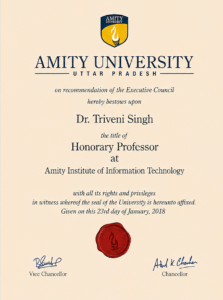
His work eventually received academic recognition from Amity University Uttar Pradesh, which conferred upon Dr. Triveni Singh the title of Honorary Professor at the Amity Institute of Information Technology. The certificate supplied with this account records that the title was bestowed on the recommendation of the University’s Executive Council and is dated 23 January 2018.
But recognition by a university did not automatically translate into recognition within police records.
When the DGP’s Office Did Not Accept the Title
The documents accompanying Singh’s account reveal an extraordinary bureaucratic trail.
In 2016, while Singh was serving as an Additional Superintendent of Police, the issue concerned recognition of his doctoral qualification. A Government of Uttar Pradesh communication dated 28 March 2016, addressed to the Director General of Police/Police Headquarters, recorded the government’s permission for the abbreviation denoting his doctorate to be mentioned against his name in his service records and personal correspondence.
The issue later arose again over the academic title “Professor.”
According to Singh’s account, permission to use the title was initially resisted within the police hierarchy. Rather than abandoning the matter, he represented his case to the Government of Uttar Pradesh.A subsequent UP Government communication dated 4 January 2018, addressed to the Director General of Police, Administration, refers to Singh—then Additional Superintendent of Police, STF Lucknow—and records the government’s permission for the honorary title of Professor, conferred by Amity University, to be entered/recognised in his service records.
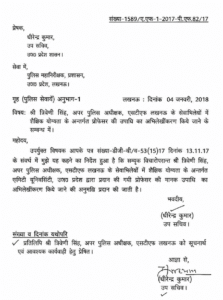
The significance went beyond a prefix before a name. It represented formal governmental recognition that a serving police officer’s serious academic achievement and professional contribution could coexist with his official identity.
Singh had, in effect, become a professor without taking off the uniform.
A Title Questioned Again
The controversy, according to Singh, did not entirely end there. He says that several years later another senior police leadership raised questions about his entitlement to use the academic title despite the earlier university conferment and government correspondence. Singh attributes that episode to a wider professional disagreement. According to his account, he had declined to support/sign a proposed contract because he believed its terms were not in the interest of public money. He maintains that questioning his professorial credentials followed that disagreement and amounted to improper institutional pressure.
These assertions about the motive behind the later questioning are Singh’s account and are not established by the government orders supplied here. What the documents themselves establish is narrower but important: his doctoral qualification and subsequently his honorary professorial title were subjects of formal correspondence between the Uttar Pradesh Government and the police establishment, with government communications permitting their recognition.For Singh, the episode became another test of a principle that had shaped much of his policing career: professional disagreement should not require surrendering either one’s credentials or one’s considered judgment.
Building a Reputation as India’s “Cyber Singham”
Long before cybercrime became an everyday national concern, Singh had begun specialising in technology-enabled crime and financial fraud. His professional profile records service in policing from 23 October 1994 to 30 November 2023 and states that he supervised 18 cyber police stations in Uttar Pradesh, led teams numbering more than 4,000 personnel across assignments, and worked on over 100 major cybercrime cases involving thousands of crores of rupees and hundreds of accused persons.
His assignments extended beyond cybercrime. His profile records experience in Vigilance, Economic Offences, Anti-Corruption, Jail and Rural Development, alongside district policing and cybercrime leadership.He also served as State Cyber Nodal Officer for Uttar Pradesh Police, was a member of the Uttar Pradesh Cyber Security Policy Draft Committee, and participated in the National Cyber Crime Training Course Design Committee of NCRB under the Ministry of Home Affairs.
The nickname “Cyber Singham” gradually became associated with him because of his work against cybercriminal networks. Mainstream reporting has continued to use the description; for example, while reporting his warnings about “digital arrest” scams, The Economic Times referred to Singh as the “Cyber Singham.” (The Economic Times)
Another description—“Cyber Cop”—has followed him for years. His international Cybertech profile now goes further, calling him the “Cyber Cop of Asia.” (cybertechisrael)
When Real Investigations Inspired “Cyber Singham” on Screen
Perhaps one of the most unusual forms of recognition came through popular culture.
Singh’s investigations and public persona inspired the cybercrime series “Cyber Singham.” Cybertech Global’s official profile specifically notes that his work and public impact inspired the series, bringing real-world cybercrime challenges into mainstream awareness. (cybertechisrael).The production company behind the project similarly describes “Cyber Singham – Part 2” as being based on real cybercrime stories and inspired by Prof. Triveni Singh, noting his reputation as the “Cyber Singham” of India. (Varchaswaa Media)
That transition—from police case files to a screen portrayal inspired by real cybercrime investigations—illustrates the public reach his work eventually achieved.
Investigator, Teacher and Trainer
The title “Professor” also came to reflect what Singh was already doing in practice: teaching investigators how cybercrime works.
His profile records extensive training and speaking engagements involving institutions such as the CBI, National Police Academy, NCRB, BIRD, RBI, SBI, State Judicial Academies and BFSI and cybersecurity forums.His recognitions include the Police Medal for Gallantry by the President of India, the India Cyber Cop Award 2012 by DSCI, commendation discs from the Uttar Pradesh DGP, a Certificate of Honour from the Director, CBI, and a Law Enforcement Award at the Visa Security Summit in Seoul. His profile also records authorship of books based on real cybercrime investigations and numerous case studies.
After leaving the IPS, Singh continued working in cybercrime, fraud-risk management, capacity building and policy. His profile records that he served as Advisor – Cyber and Fraud Risk at PwC India from January 2024 to January 2025.
From Cyber Policing to the FutureCrime Movement
The next phase of Singh’s career has been centred on building institutions rather than merely investigating individual cases.
He serves as Chairperson and Chief Mentor of the Future Crime Research Foundation (FCRF), focusing on cybercrime research, training, policy, digital forensics and collaboration between law enforcement, government, industry and academia. Cybertech Global also identifies him in these leadership roles. (cybertechisrael).FCRF has expanded into a platform for cybercrime research and capacity building. In 2025, for example, FCRF entered into an MoU with NIELIT to strengthen cybercrime research, training and policy initiatives, including work in AI-driven fraud, digital forensics, cyber law and law-enforcement capacity building. (The Times of India)
At the centre of this ecosystem is the FutureCrime Summit, an international platform conceived and driven with Singh playing a central intellectual and hosting role. His own professional profile records his strategic guidance to earlier editions of the Summit, while the 2026 edition at Bharat Mandapam, New Delhi, on 6–7 August 2026 brought together stakeholders working across cybercrime, digital fraud, online scams, digital forensics and technology law. (LinkedIn)
The role is a natural extension of his career: connecting the police officer investigating yesterday’s crime with researchers, technologists, regulators and investigators preparing for tomorrow’s.
The Larger Meaning of the Journey
Prof. Triveni Singh’s story is therefore about more than the unusual journey of an IPS officer acquiring the title of Professor while remaining in uniform.
It is about the convergence of policing and scholarship.
At a time when cybercrime began challenging traditional investigative methods, Singh pursued advanced academic study rather than treating field experience as sufficient. When the legitimacy of adding academic credentials to his official identity became an administrative issue, he pursued the matter through governmental channels. The documents supplied with his story show that the Government of Uttar Pradesh ultimately issued formal communications permitting recognition first of his doctoral qualification and later of his honorary professorial title.
His subsequent career made that title more than ceremonial.
From cyber police stations and financial-fraud investigations to classrooms, training programmes and international cybersecurity forums; from being called “Cyber Cop” and “Cyber Singham” to being introduced internationally as the “Cyber Cop of Asia”, Singh’s career represents an uncommon bridge between operational policing and academic knowledge. (cybertechisrael).His professional profile summarises a police career ending in November 2023, but the work clearly did not end with the uniform. Today, through FCRF and the FutureCrime Summit, his focus has shifted from investigating individual cybercriminals to helping build an ecosystem capable of anticipating future crime itself.
Perhaps that is the most fitting explanation of how an IPS officer became a professor while still wearing the uniform.
The uniform gave him the cases. The cases gave him the questions. Research helped him search for the answers. And teaching allowed those answers to travel far beyond a single police station or investigation.
