

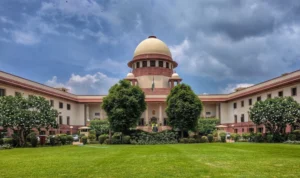
The Supreme Court has issued a series of significant directions to expedite the Central Bureau of Investigation (CBI) probe into the alleged home loan subvention fraud and builder-bank nexus. The Court directed the Directors General of Police (DGPs) of Uttar Pradesh, Rajasthan, Tamil Nadu, Maharashtra, Haryana, Punjab, and Karnataka to provide additional police officers to the CBI within 10 days to strengthen the ongoing investigation. It also directed State Bank of India (SBI), UCO Bank, HDFC, ICICI, Sammaan Capital, and other financial institutions to process pending requests for prosecution sanctions under Section 19 of the Prevention of Corruption Act, 1988, within two weeks.
The directions were issued by a Bench comprising Chief Justice of India Surya Kant, Justice Joymalya Bagchi, and Justice V. Mohana while hearing petitions alleging systemic irregularities in home loan subvention schemes and the alleged nexus between builders, banks, housing finance companies, and government authorities.
During the hearing, the Court considered the CBI’s fifth supplementary status report. According to the report, the agency has so far registered 50 FIRs in connection with the alleged fraud. Investigations have been completed in 18 cases, 17 charge sheets have been filed, and a closure report has been submitted in one case. The Court was also informed that cognisance has already been taken by the trial court in three of the cases where charge sheets have been filed.
The CBI informed the Court that investigations in five cases had revealed the alleged involvement of officials from various banks and financial institutions. These officials have been booked under the Prevention of Corruption Act, but prosecution cannot proceed until the competent authorities grant the mandatory sanction under Section 19 of the Act. The Court noted that 34 prosecution sanctions are currently pending before different banks and financial institutions.
The agency further submitted that the growing workload of the investigation requires additional police personnel from Uttar Pradesh, Rajasthan, Tamil Nadu, Maharashtra, Haryana, Punjab, and Karnataka. According to the CBI, despite repeated requests by the CBI Director, the concerned states had neither provided the required officers nor responded to the agency’s communications. Taking note of the delay, the Supreme Court directed the respective DGPs to nominate and depute suitable officers within 10 days, warning that any failure or delay would invite serious consideration by the Court.
The Supreme Court also directed the competent authorities of the concerned banks and financial institutions to accord prosecution sanctions against officers whose alleged involvement has been established prima facie during the investigation. The Court ordered that the entire exercise be completed within two weeks, failing which the concerned authorities would be required to explain the delay before the Supreme Court.
The Bench further instructed the CBI to share relevant information with the Enforcement Directorate (ED) in cases involving suspected proceeds of crime. It also directed the agency to examine representations, documentary evidence, and other materials submitted by Amicus Curiae Rajiv Jain. The Court specifically ordered a thorough investigation into issues highlighted by the Amicus in his comments on three charge sheets as well as six separate representations alleging offences by builders, banks, and housing authorities.
These representations include allegations involving Ozone Group projects in Karnataka, Maharashtra, and Tamil Nadu, the Vivansaa project in Bengaluru, Rudra Buildwell Construction Private Limited in Greater Noida, and the Omaxe Group in Chandigarh. The Court has directed the CBI to submit a separate status report on these investigations. It has also asked the agency to examine tripartite agreements in cases where the lessee and the builder were different entities and determine whether banks or housing finance companies created mortgage arrangements without including the actual lessee, resulting in wrongful losses.
The proceedings stem from complaints filed by thousands of homebuyers who alleged that builders failed to complete housing projects or hand over possession despite receiving loan funds directly from banks under subvention schemes. According to the petitioners, banks subsequently demanded EMIs from homebuyers even though possession had not been delivered. The Supreme Court is expected to review the CBI’s progress report and compliance by the concerned agencies during the next hearing.
Follow for daily updates on cybercrime, corporate fraud, DFIR, hacking, investigations, and digital forensics
