

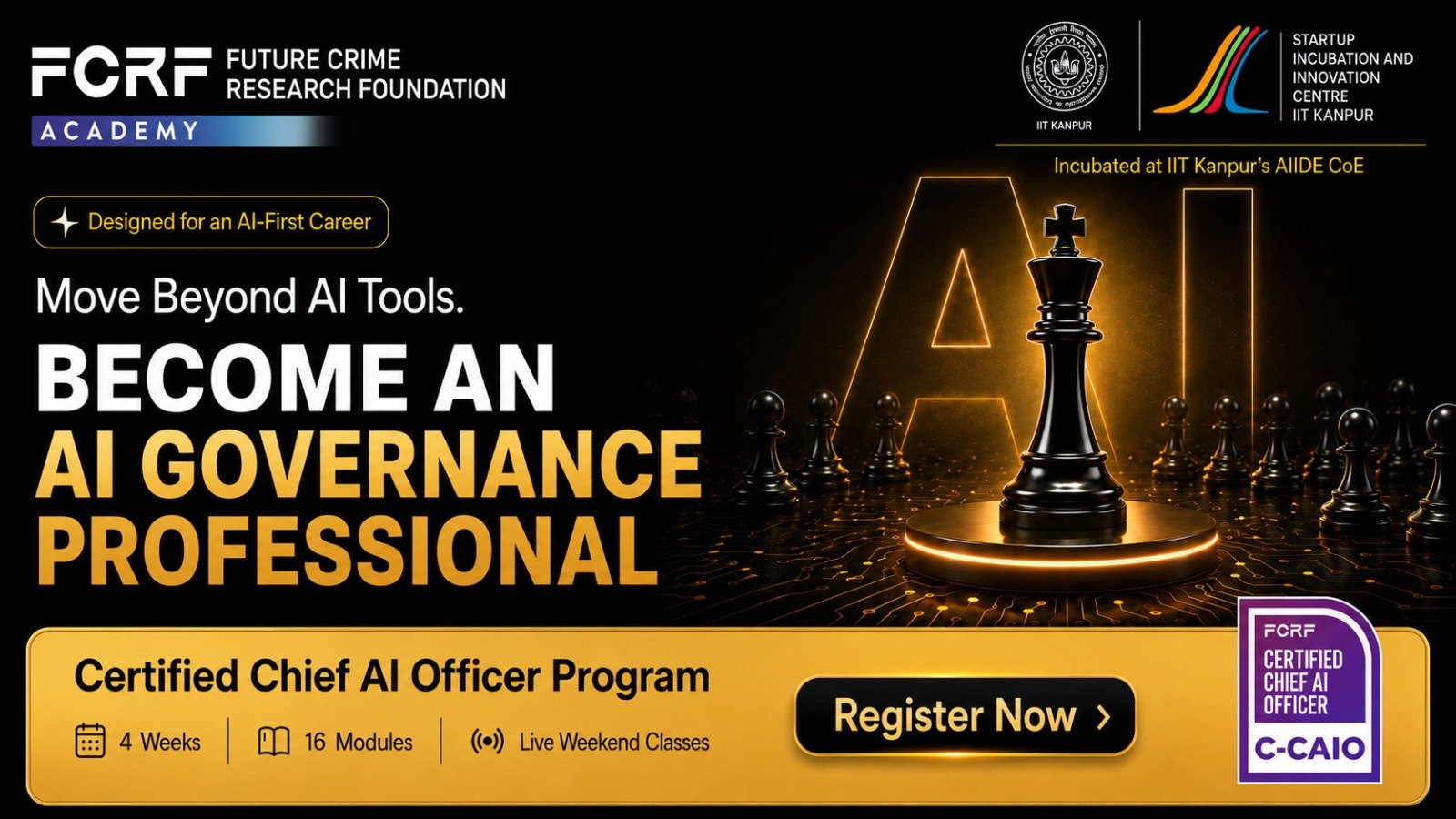

Even before its first live session, FCRF Academy’s Certified Chief AI Officer (C-CAIO) Program has begun to attract the kind of cross-sector interest that signals a larger shift in India’s professional training landscape.
The program, scheduled to begin on 13 June, has already seen participation from hundreds of senior professionals, government officers, lawyers, compliance professionals, cybersecurity practitioners and industry leaders, according to FCRF Academy. The response reflects a growing recognition that artificial intelligence is no longer simply a technology trend or productivity tool. For many organisations, it is now a governance, compliance, cybersecurity and leadership challenge.
The course has been structured in FCRF Academy’s familiar professional certification format: 4 weeks, 16 modules and live weekend classes. But the subject it addresses is new and fast-moving. The role of the Chief AI Officer, or CAIO, is emerging globally as organisations begin to ask who should be responsible for AI strategy, oversight, risk, accountability, vendor review, data governance and regulatory readiness.
In India, where artificial intelligence is being adopted across banking, fintech, law, policing, public administration, education, healthcare, cybersecurity and enterprise operations, the question has become particularly urgent. AI systems are no longer confined to research labs or technical teams. They are entering workflows that involve personal data, decision-making, fraud monitoring, customer interaction, legal research, compliance reporting and cyber defence.
That is why FCRF Academy’s new program appears to have found an early audience: professionals who may not be AI engineers, but who increasingly need to understand how AI should be governed. Interested participants can click here to register now for the C-CAIO program.

Why AI Governance Is Becoming a Boardroom Issue
For the first wave of AI adoption, the focus was largely on use. Professionals learned how to draft faster, research faster, summarise faster and automate routine tasks. But the second wave is about control.
Organisations now face questions that are more complex than whether employees should use AI tools. What data is being uploaded into these systems? Can confidential information be exposed? Who approves an AI use case before deployment? How should vendors be reviewed? What happens if an AI-generated output is wrong, biased or harmful? Who is accountable when AI systems influence customers, employees or citizens?
These are not narrow technical questions. They sit at the intersection of law, compliance, cybersecurity, privacy, business strategy and institutional trust.
In regulated industries, the stakes are even higher. AI may be used for fraud detection, credit assessment, transaction monitoring, market surveillance, customer onboarding, legal analysis, insurance underwriting, recruitment or governance workflows. In each case, the organisation must balance efficiency with transparency, accountability and risk control.
India’s regulatory and policy environment is also moving in a direction that makes AI governance unavoidable. The Digital Personal Data Protection Act has changed the way organisations think about personal data. Cybersecurity concerns around generative AI, deepfakes, synthetic identity, phishing and AI-enabled fraud are rising. Sectoral regulators are watching how automated systems are used in sensitive areas.
Against this backdrop, the Chief AI Officer role is becoming important because AI adoption cannot be responsibly managed by enthusiasm alone. Organisations need professionals who can translate AI opportunity into a governance framework.
A CAIO or AI governance leader must understand enough technology to ask informed questions, enough law to recognise exposure, enough risk management to design controls, and enough business strategy to guide responsible adoption. That mix explains why the FCRF program has attracted learners from varied professional backgrounds.
What FCRF Academy’s CAIO Program Is Designed to Teach
The Certified Chief AI Officer program has been positioned not as a general AI tools course, but as a professional certification in AI governance, risk and responsible leadership.
Its curriculum covers AI and generative AI fundamentals, the role of a Chief AI Officer, AI strategy, AI governance architecture, risk classification, data governance, privacy, cybersecurity, vendor management, deepfake and fraud risks, AI audit readiness, responsible AI principles and India-specific regulatory preparedness.
The India focus is central to the program. Participants are expected to study how AI intersects with the DPDP Act, cybercrime risks, CERT-In-style security concerns, financial-sector governance, sectoral compliance and organisational accountability. The course also addresses practical risks such as prompt misuse, data leakage, AI-enabled phishing, voice cloning, synthetic identity, fake KYC, deepfake-driven reputational harm and employee use of unsanctioned AI tools.
For many professionals, this practical orientation is the draw. The program is not built around the idea that every learner must become a machine learning engineer. Instead, it is designed for professionals who must supervise AI, advise leadership, evaluate risks, review vendors, prepare policies or help their organisations adopt AI responsibly.
That makes the course relevant for a wide professional base: senior executives, lawyers, government officers, CISOs, DPOs, compliance officers, GRC professionals, auditors, consultants, cybersecurity practitioners, law enforcement professionals, fintech teams and technology managers.
In the coming years, many organisations may not formally appoint a Chief AI Officer immediately. But the function itself is already emerging. In some companies, it may sit with the CTO. In others, it may sit with the CISO, legal head, risk team, data protection officer, innovation team or compliance function. The title may vary, but the responsibility is becoming clear: someone must govern AI.
FCRF Academy’s certification is aimed at professionals preparing for that responsibility.
Why FCRF’s Track Record Matters
The early response to the C-CAIO program also reflects FCRF Academy’s existing credibility in the professional certification space.
FCRF Academy, the learning and capacity-building arm of the Future Crime Research Foundation, has built its training identity around cybersecurity, cyber law, data protection, digital forensics, fraud investigation, anti-money laundering, GRC, cyber crisis management and emerging technology risk. Its programs have drawn lawyers, government officers, police officials, cybersecurity professionals, compliance teams, corporate executives, consultants and students seeking specialised training in technology-linked risk domains.
That background gives the CAIO program a distinct character. Many AI courses in the market focus on productivity, tools, automation or prompt engineering. FCRF’s approach places AI within the wider universe of governance, cyber risk, legal accountability, privacy, fraud and regulation.
This distinction matters because the next phase of AI adoption in India will not be judged only by how quickly organisations deploy AI. It will also be judged by how responsibly they manage it.
The same AI systems that can accelerate work can also create privacy exposure, regulatory scrutiny, misinformation, cyber vulnerabilities and reputational damage. The same generative AI tools that help employees become more productive can also be used by fraudsters, impersonators, scammers and attackers. The same automation that helps organisations scale can also create new questions of fairness, accountability and explainability.
FCRF’s work in cybercrime, digital risk and technology governance gives it a relevant foundation for teaching AI governance from a practical Indian perspective.
The strong participation ahead of the program’s 13 June start suggests that professionals are beginning to see AI governance as a career-defining skill. The appeal is not merely in learning what AI can do, but in understanding how it should be supervised.
For senior professionals, the certification offers a way to understand AI at a leadership level. For government officers, it provides a framework to examine public-sector AI use and digital risk. For lawyers and compliance professionals, it opens a pathway into AI advisory and governance. For cybersecurity professionals, it connects AI adoption with emerging threat landscapes. For business leaders, it offers a language for responsible AI transformation.
In that sense, the hundreds already joining the program point to a larger trend: India’s AI future will need more than developers and users. It will need governance leaders.
FCRF Academy’s Certified Chief AI Officer program is being built for that moment.
Interested participants can click here to register now for the C-CAIO program.
Follow for daily updates on cybercrime, corporate fraud, DFIR, hacking, investigations, and digital forensics
