

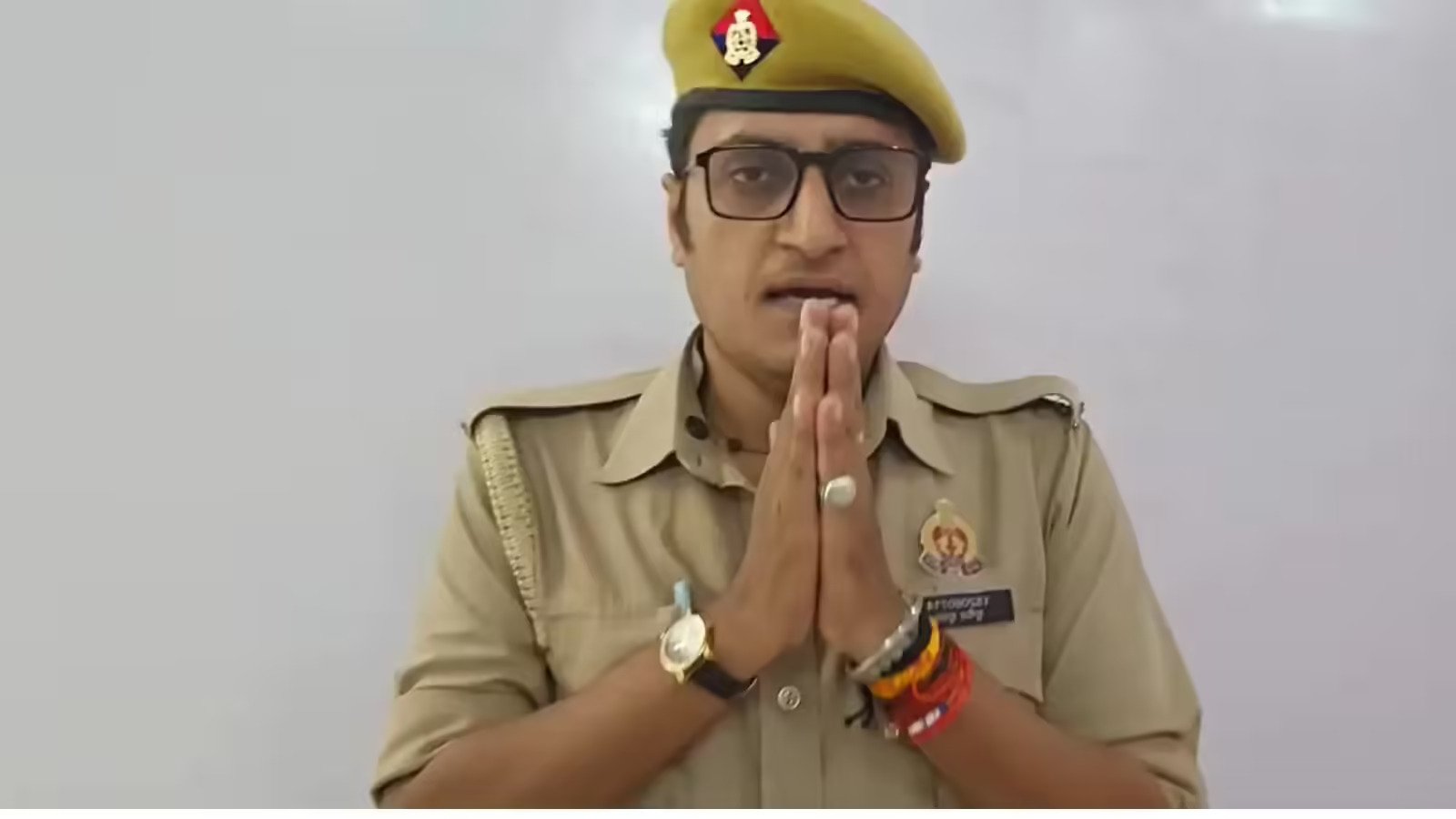

A police constable in Uttar Pradesh has stirred a sharp public controversy after alleging that senior police officials are involved in systematic corruption and claiming that IPS officers should be subjected to “brain mapping” to determine whether they had taken bribes in a given year.
The remarks, made by constable Sunil Kumar Shukla in a video interview that circulated widely online, have drawn attention not only because of their provocative nature, but also because they follow earlier allegations by Shukla that senior police officers and officials in the reserve police lines were running an extortion-like system linked to duty allocation.
Shukla’s claims have not been independently established. Police authorities have already ordered an inquiry into his earlier allegations, and officials have said further action will be taken after the inquiry report is submitted. But the episode has triggered a wider discussion about internal accountability, lower-rank grievances and the fear that often surrounds complaints against powerful officers in uniform.
A Viral Charge Against the Police Hierarchy
In the video, Shukla alleged that corruption within sections of the police system was widely known but rarely spoken about because lower-ranking personnel feared consequences. He suggested that if IPS officers were required to undergo brain mapping on whether they had taken bribes during the year, the results would be so damaging that people might stop appearing for the UPSC examination.
The remark was sweeping and incendiary. It was also framed as a challenge to an institutional culture in which, according to Shukla, wrongdoing is discussed privately but not confronted publicly.
Brain mapping, more formally associated with forensic or investigative techniques used in limited circumstances, is not a routine administrative tool for testing corruption. Courts have also placed constitutional safeguards around involuntary forensic techniques because of concerns over consent, self-incrimination and personal liberty. Shukla’s remark therefore appears less like a formal legal proposal and more like a dramatic expression of distrust in the system.
Yet the force of the statement lay in what it implied: that corruption, if subjected to an objective test, would expose patterns that the system itself is unwilling to admit.
Earlier Allegations of Monthly Payments for Duty Assignments
The controversy did not begin with the brain-mapping remark. Earlier, Shukla, a constable posted in the Reserve Police Lines, had levelled serious allegations of corruption and illegal money collection against several IPS officers and senior police officials through a viral Facebook video.
According to the report, Shukla alleged that policemen were forced to pay money every month in exchange for duty assignments and favourable deployment in the reserve police lines. Addressing Uttar Pradesh Chief Minister Yogi Adityanath in the video, he demanded a high-level and impartial inquiry into what he described as a corruption racket.
He accused IPS officers of running what he called a “zamindari-style extortion system” within the police department. He further alleged that the system operated through a chain of officials beginning with senior IPS officers and extending down to reserve inspectors, calculation in-charges and guard commanders.
According to Shukla, reserve inspectors were appointed by IPS officers, and those reserve inspectors then appointed calculation in-charges responsible for preparing duty rosters. These calculation in-charges, he alleged, appointed guard commanders who collected money from constables and clerical staff for assigning duties.
In the viral video, Shukla claimed that constables and clerical staff were required to pay ₹2,000 every month to guard commanders for getting duties assigned.
Probe Ordered, But Public Anger Grows Online
Taking note of the video, DCP (Lines) Anil Kumar Yadav ordered an inquiry into the matter. Yadav also confirmed that Shukla belongs to the 2015 batch, is currently on leave and had recorded and uploaded the video during this period. He also stated that Shukla’s wife is employed in the police department.
The inquiry has reportedly been assigned to the ACP, Crime Against Women, and officials have said further action will depend on the findings of the inquiry report.
But even before the inquiry reaches a conclusion, Shukla’s allegations have found resonance online. Social media reactions reflected anger at perceived arrogance, corruption and impunity within the higher bureaucracy and police leadership. Some users described the allegations as part of a larger systemic failure; others warned that a whistleblower within the force could face retaliation rather than protection.
One line of reaction suggested that ordinary personnel are often too vulnerable to speak against senior officers. Another framed Shukla as someone exposing a hidden system. A few comments expressed skepticism, suggesting that the system might instead try to discredit him.
The public response illustrates a familiar pattern in institutional controversies: once an insider makes a dramatic claim, the case quickly moves beyond the individual allegation and becomes a referendum on the institution’s credibility.
The Larger Question: Can Police Institutions Investigate Themselves?
Shukla’s allegations sit within a deeper structural problem. Police forces are highly hierarchical institutions. Promotions, postings, duty allocations, leave approvals and disciplinary action all pass through chains of command. For lower-rank personnel, accusing senior officers is not merely a legal or administrative act; it can be a career-defining risk.
That is why allegations involving internal corruption often create a difficult accountability problem. If the inquiry is handled within the same institutional environment, complainants and the public may question its independence. If the allegations are false or exaggerated, officers named or implicated by implication may suffer reputational harm. If the allegations are true, the issue points to an entrenched extraction system within a force meant to enforce the law.
Shukla’s brain-mapping comment has intensified the debate, but the more immediate question is narrower and more concrete: whether constables and clerical staff in the reserve police lines were being forced to pay monthly amounts for duty assignments, and whether senior officers had any role in such a system.
The answer now depends on the inquiry. But the episode has already exposed a trust deficit within and around the police. When a serving constable publicly appeals to the Chief Minister, accuses senior officers of extortion-like practices and says corruption is known but feared into silence, the controversy becomes more than a personnel matter.
It becomes a test of whether the police system can credibly examine allegations made by one of its own against those who sit above him.
