

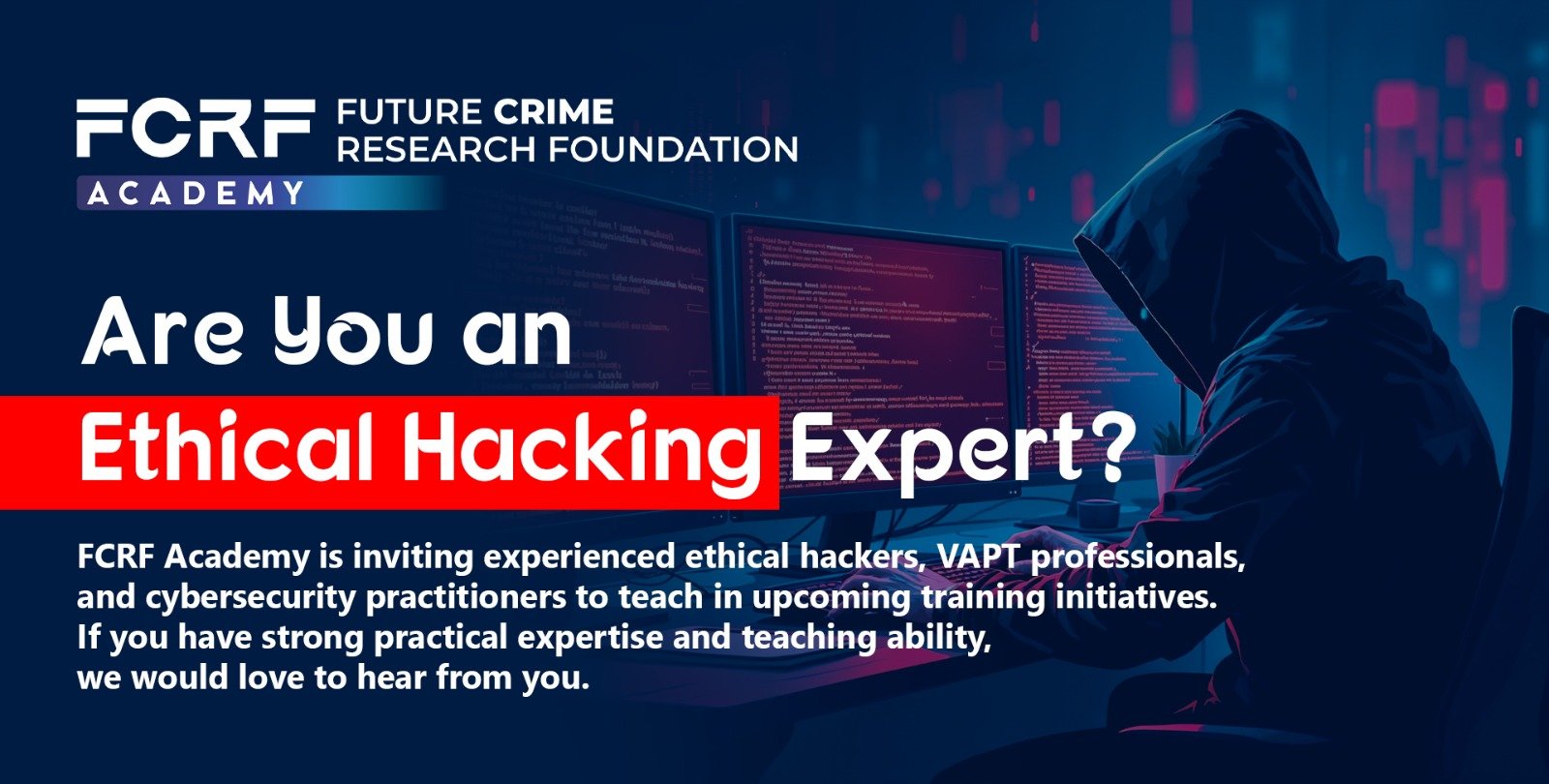

As demand for practical cybersecurity training grows, so too does the need for instructors who have done more than study the field from a distance. FCRF Academy, which has been expanding its portfolio of professional certifications, is now inviting applications from experts in ethical hacking and cybersecurity to join its speaker pool for an upcoming weekend-based training initiative focused on modern vulnerability assessment and penetration testing.
The move signals a broader shift in how cybersecurity education is being positioned in India’s fast-growing professional training market. Rather than relying solely on static theory or generic awareness modules, the proposed teaching model is built around live, structured instruction in real-world attack surfaces: web applications, APIs, internal enterprise systems, cloud deployments, mobile environments and AI-assisted workflows. The academy’s teaching architecture, as outlined in its academic blueprint, is designed around a 60-hour live format spread across 10 weekends, with practical exercises assigned separately.
For prospective instructors, the appeal is not limited to subject matter. FCRF Academy is positioning the invitation as both a professional opportunity and a platform proposition: selected experts would not only receive an honorarium for teaching, but also gain access to a wide and professionally relevant learner base, including students, early-career cybersecurity professionals, developers, IT administrators, auditors and working professionals seeking to move into VAPT-oriented roles.
Register / Apply Now through the following link: https://fcrf.academy/ethical-hacking-instructor-enrollment
A Search for Practitioners, Not Just Presenters
The academy’s outreach appears to be aimed at a particular kind of instructor — not merely someone who can lecture on cybersecurity concepts, but someone who can translate operational experience into structured learning. The curriculum around which speaker registrations are being sought is notably broad in its coverage. It begins with ethical hacking foundations, scoping, rules of engagement and legal-ethical boundaries, then moves through reconnaissance, OSINT, scanning and enumeration before expanding into deeper technical tracks such as web application testing, API security, Linux and Windows assessment, Active Directory review, cloud security, DevSecOps, mobile testing and AI-enabled application security.
That breadth matters. In many traditional cyber training programs, “ethical hacking” is treated as a narrow or heavily tool-driven subject, often reduced to web attacks or network scanning. But the blueprint here suggests a more layered view of the discipline — one that recognizes that offensive security today increasingly intersects with cloud misconfiguration, secrets exposure, API architecture, Android app behavior and even the risks introduced by AI-powered applications. FCRF Academy’s speaker call, then, is less a search for a single all-purpose trainer than for professionals who can credibly teach different parts of that ecosystem.
That is also why the registration process has been structured to identify domain fit quickly. Interested applicants are expected to indicate which of the major teaching areas they can cover confidently — a list that includes foundations and legal boundaries, networking and OSINT, vulnerability assessment, web security, API testing, internal enterprise assessment, network and wireless review, cloud and DevSecOps security, mobile security, and AI-assisted testing and reporting.
Register / Apply Now through the following link: https://fcrf.academy/ethical-hacking-instructor-enrollment
A Curriculum Built for the Present Tense of Cybersecurity
One of the more notable aspects of the initiative is the explicit integration of AI into the teaching framework. The academy’s underlying curriculum does not treat AI as a marketing add-on. Instead, it places AI in two distinct roles: first, as a productivity layer for cybersecurity practitioners — helping with checklist generation, configuration review support, summarization of logs and scan results, scripting assistance and report drafting — and second, as a subject of testing in its own right, with modules addressing prompt injection, insecure output handling, data leakage and misuse of AI-connected tools.
This reflects a wider industry reality. Ethical hacking and VAPT work are no longer confined to conventional web-server-network stacks. Modern organizations increasingly operate across hybrid cloud systems, CI/CD pipelines, mobile interfaces and AI-enabled workflows, creating a larger and more fragmented attack surface. Any serious teaching initiative in this space now has to prepare learners — and therefore instructors — to address those changes.
The proposed structure also suggests that the academy is trying to distinguish practical instruction from passive content delivery. Each live teaching block is paired with guided practical work outside the official hour count, allowing instructors to focus class time on methodology, validation, interpretation and reporting rather than mere demonstration. In effect, the academy appears to be making a case that the market no longer needs just more cybersecurity courses; it needs teachers who can help learners think and operate like disciplined testers.
Register / Apply Now through the following link: https://fcrf.academy/ethical-hacking-instructor-enrollment
Honorarium, Reach and a Growing Professional Platform
For instructors considering whether such an invitation is worth their time, FCRF Academy is emphasizing two incentives. The first is direct: selected experts would be provided an honorarium for their teaching engagement. The second is reputational and professional: the chance to address a large, diverse and professionally motivated audience that many practitioners, despite deep technical expertise, may not otherwise encounter in one structured academic setting.
That pitch is increasingly common in the training economy, where institutions compete not only for learners but for credible faculty. But its success will depend on whether the academy can attract instructors who see teaching not as a side presentation, but as a serious extension of practice. In offensive security, where the difference between jargon and judgment is often obvious within minutes, learners tend to recognize quickly whether an instructor has genuinely operated in the field.
For now, the academy is framing the exercise as an open invitation to cybersecurity professionals who want to be part of that venture — a speaker registration drive for those with practical experience across tools, methodologies and modern security domains. Applications are being invited from ethical hackers and cybersecurity experts interested in teaching these areas in a structured weekend format.
Register / Apply Now through the following link: https://fcrf.academy/ethical-hacking-instructor-enrollment
Follow for daily updates on cybercrime, corporate fraud, DFIR, hacking, investigations, and digital forensics
