

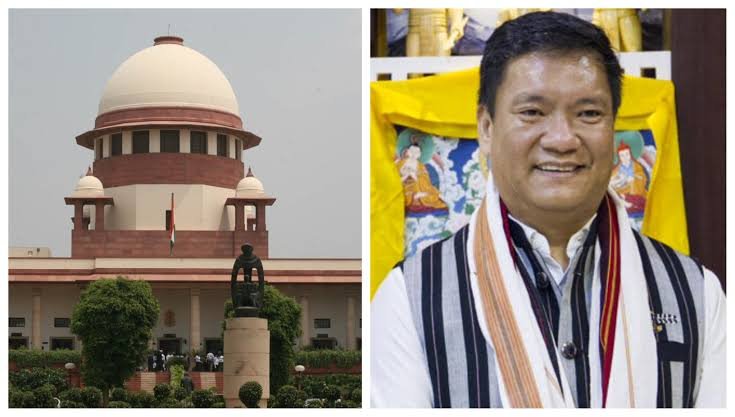

New Delhi: The Supreme Court has directed the Central Bureau of Investigation (CBI) to initiate a preliminary inquiry into the allegations surrounding the award of public works contracts in Arunachal Pradesh, which are claimed to have been granted to firms connected to Chief Minister Pema Khandu’s immediate family. The Court’s decision came after hearing a Public Interest Litigation (PIL) filed by two non-governmental organizations (NGOs) alleging that government contracts were being unfairly awarded to companies directly linked to the Chief Minister, his wife, and his mother.
“We order the CBI to conduct a preliminary inquiry. The CBI shall submit a status report within 16 weeks on whether an independent investigation is required,” stated the bench of Justice Vikram Nath, which issued the directive.
The petitioners—Save Mon Region Federation and Voluntary Arunachal Sena—allege that over the last 10 years, public works contracts amounting to approximately Rs 1,270 crore have been awarded to firms that are either owned by or connected to the Chief Minister and his close family members. Advocate Prashant Bhushan, representing the petitioners, argued that these companies were awarded lucrative government contracts, including those for public infrastructure and development, without following proper tendering processes.
FCRF Launches Premier CISO Certification Amid Rising Demand for Cybersecurity Leadership
Details of Alleged Irregularities
The PIL claims that 31 contracts were awarded over a period of 11 years to Brand Eagles, a firm owned by the Chief Minister’s wife. Additionally, another company, Frontier Associates, which is also reportedly owned by Khandu, was awarded 91 contracts worth Rs 145 crore. According to the petitioners, a total of 121 works, amounting to Rs 245 crore, were awarded through tenders, while 322 works worth Rs 25 crore were granted without any tender process.
Further affidavits have suggested that these firms, associated with Khandu’s family, were awarded a significant percentage of contracts, with around 3% of the state’s total government contracts allegedly being directed to them. Bhushan noted that in total, the companies linked to the Chief Minister have received substantial work orders over the last decade, raising concerns about the transparency and legitimacy of the tendering process.
“These 15 firms, with direct connections to Khandu’s family, have been receiving government contracts in a highly disproportionate manner. The situation reeks of corruption, and an independent investigation is necessary,” Bhushan said during the hearing.
The petitioners have expressed doubts regarding the impartiality of the state police in investigating the matter due to the political position held by Pema Khandu. Therefore, they have called for a Special Investigation Team (SIT) to oversee the inquiry into the allegations.
Court’s Directives and Future Steps
The Supreme Court, in its ruling, has outlined several crucial directives. The CBI is expected to register a preliminary inquiry covering the award and execution of contracts from 2015 to 2025. The inquiry will focus on the contracts awarded to the firms owned by Khandu’s family members, and the state government of Arunachal Pradesh has been instructed to cooperate fully with the CBI investigation.
The Court has also ordered that the Arunachal Pradesh government designate a nodal officer who will be responsible for facilitating the timely sharing of relevant documents and records with the CBI. The state government has been given a one-week deadline to comply with the Court’s order.
During the hearing, the petitioners highlighted that these irregularities are part of a larger pattern of preferential treatment in the allocation of public works contracts, which they believe undermines the principles of fair governance and transparency.
Political Reactions and Public Interest
The allegations have already sparked political debates within the state. The opposition parties in Arunachal Pradesh have called the situation a clear case of nepotism and have demanded a thorough investigation into the matter. While the Chief Minister has yet to respond directly to these specific allegations, the ruling party has dismissed the claims as politically motivated.
The case has also attracted national attention due to its potential implications for the future of public procurement processes in India. Given the high-profile nature of the allegations, the investigation is likely to have broader consequences, not only for Arunachal Pradesh but also for governance practices across the country.
In response to the Supreme Court’s order, political observers have pointed out the importance of ensuring accountability in the award of public contracts and maintaining the integrity of governance. They argue that the investigation must be thorough and transparent to preserve public trust in the government’s ability to administer resources fairly.
Follow for daily updates on cybercrime, corporate fraud, DFIR, hacking, investigations, and digital forensics
