

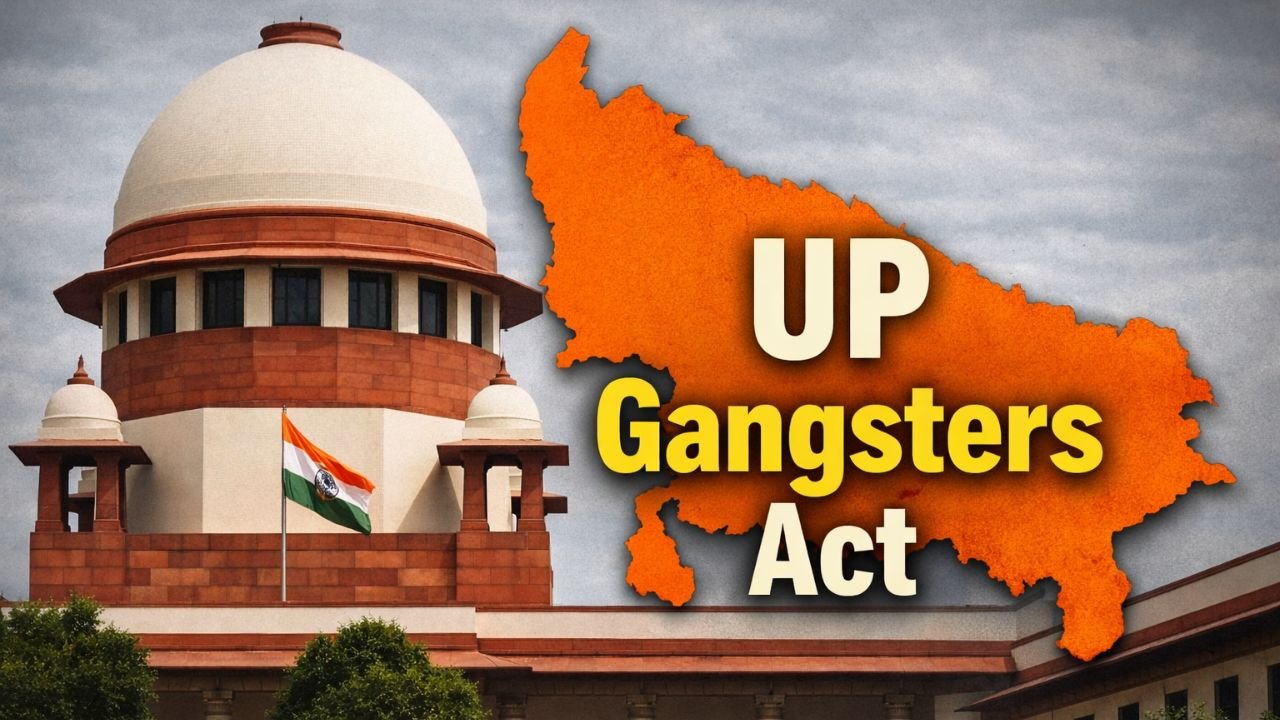

The Supreme Court on Saturday set aside criminal proceedings against Gabbar Singh, also known as Devendra Pratap Singh and Rajesh Singh, holding that the State of Uttar Pradesh had failed to follow the mandatory procedure required before invoking one of its most severe preventive criminal laws. The bench, comprising Justices Sanjay Kumar and K. Vinod Chandran, found that the “gang chart” forming the basis of the FIR under Section 3(1) of the Uttar Pradesh Gangsters and Anti-Social Activities (Prevention) Act, 1986, lacked the recommendations and signatures required under the statute and the 2021 Rules framed under it.
The ruling turned on what might, in a narrower case, have been described as paperwork. But the court treated the omission as something far more serious. In the architecture of the Gangsters Act, a gang chart is not a clerical formality; it is the document that begins the process by which the State can brand an individual a gangster and expose him to the sweeping consequences that follow. Because the law is so consequential, the court said, the process laid down by statute must be followed exactly.
FCRF Launches Premier CISO Certification Amid Rising Demand for Cybersecurity Leadership
That principle, the bench noted, is hardly novel. Indian courts have long held that where a statute says a thing must be done in a particular manner, it must be done in that manner or not at all. What gave the observation unusual force here was the court’s description of the law itself. The bench called attention to the “precarious nature” of a statute that permits “mere naming” of a person as a gangster and spoke of the “perilous consequences” that such labeling can have for liberty and reputation.
How the Gang Chart Became the Case
The case arose from an FIR registered in Bahraich, where the prosecution alleged that the appellant was part of a gang engaged in offenses including land grabbing, extortion and forgery. To bring the case within the Gangsters Act, the State relied on a gang chart, the foundational document through which the police and district administration are expected to record their satisfaction that the law should be invoked.
Under the 1986 Act and the Uttar Pradesh Gangsters and Anti-Social Activities (Prevention) Rules, 2021, that process is structured and layered. The Station House Officer, acting as the nodal officer, initiates the chart. The Additional Superintendent of Police is required to make an express recommendation. Thereafter, the Superintendent of Police and the District Magistrate are to consider the material, arrive at satisfaction and approve the document in a joint process reflected by signatures. Only then does the chart assume legal character under the statutory scheme.
The chart in this case, the court found, had not traveled that route. The certified copy forwarded to the jurisdictional court with the FIR did not bear the recommendations or signatures that the Rules require. The court underscored that there is no provision for sending such a document to court before it becomes a valid gang chart in the eyes of law. At the very least, the bench said, a chart forwarded by the nodal officer should have carried the nodal officer’s own recommendation and signature. Even that was absent.
The defect was not treated as curable or peripheral. It went to the root of the prosecution. Because the FIR rested on a document that had not matured into a lawful gang chart, the court held that the basis for invoking the Gangsters Act had collapsed. It therefore found no reason to sustain the Allahabad High Court’s earlier refusal to quash the proceedings.
The Court’s View of Liberty Under a Harsh Statute
What distinguished the judgment was not only its technical reading of the Rules but its deeper anxiety about the power embedded in the statute. The court’s language suggested unease with the ease with which the machinery of the Act can be set in motion. To be designated a gangster under the Uttar Pradesh law is not merely to face another criminal charge; it is to be placed within a legal category that carries instant stigma, expanded coercive power and a presumption of dangerousness.
That helps explain the bench’s insistence on exact compliance. In ordinary criminal administration, errors in documents are often defended as inadvertent, correctable or harmless. But where the State seeks to rely on an extraordinary law, courts have historically demanded greater discipline from the prosecution, not less. The Supreme Court’s message in this case was that procedural safeguards are the price the State pays for using a stringent law. Without them, the coercive action loses legal legitimacy.
The judgment did not decide the larger constitutional validity of the Gangsters Act, nor did it rule on every consequence that may flow from a gangster designation. The bench expressly left those wider questions for “an appropriate case.” Yet the phrasing matters. By describing the law’s consequences as perilous, the court appeared to signal that the judiciary is alert to the dangers of routine or careless invocation of statutes that place liberty at heightened risk.
A Message Beyond One FIR
In the immediate sense, the ruling is a narrow one: an FIR has been quashed because the statutory process was not followed. But its practical implications may extend far beyond Bahraich. The judgment is likely to be cited in future challenges where the police or district authorities invoke the Gangsters Act without strict documentary compliance, especially in cases where approvals are hurried, signatures are missing or recommendations are implied rather than expressly recorded.
It may also sharpen scrutiny of how preventive and anti-gang laws are administered in Uttar Pradesh, where such statutes have often been defended by the State as necessary tools against organized criminality. The court did not deny the State’s interest in combating serious crime. What it denied was the idea that urgency can excuse procedural looseness. In a legal system governed by statute, the bench suggested, power must move along the path the law prescribes.
For now, the case stands as a reminder of a familiar constitutional tension. Governments facing pressure to act against entrenched criminal networks often seek broader powers and faster processes. Courts, when called upon later, ask whether those powers were exercised within the limits the law itself imposed. In Gabbar Singh alias Devendra Pratap Singh alias Rajesh Singh v. State of U.P. and Ors., the Supreme Court’s answer was clear: when liberty is at stake under a harsh law, the procedure is not secondary to justice. It is part of justice itself.
