

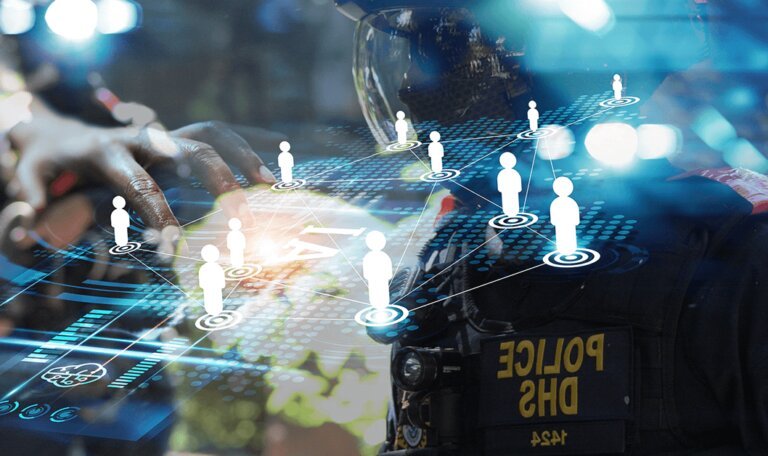

A newly disclosed dataset of federal contracts has shed light on the breadth of artificial intelligence technologies being developed for the United States Department of Homeland Security, revealing projects aimed at predictive policing, airport surveillance and mobile biometric identification.
The information, obtained and reported by The Guardian, comes from the Department of Homeland Security’s technology incubator, the Office of Industry Partnership (OIP). The records describe hundreds of projects funded through the agency’s Small Business Innovation Research program, which provides federal support for early-stage technologies proposed by private companies.
The contracts suggest the department has explored a wide array of AI-driven surveillance tools, including software designed to analyze emergency call data, systems capable of tracking individuals through airport camera networks, and mobile devices that enable agents to collect biometric data using smartphones. The data spans two decades of funding and includes more than 1,400 contracts worth a combined $845 million.
Algoritha Security Emerges As India’s Leading Corporate Investigation Powerhouse
AI Tools Designed to Predict Crime Patterns
Among the projects described in the leaked records is an artificial intelligence platform intended to analyze emergency call data nationwide and forecast patterns of criminal activity. On May 7, three contracts totaling $524,000 were awarded for systems that would ingest data from the country’s more than 5,000 emergency 911 call centers. One of the proposals outlined software designed to identify emerging crime trends and generate geospatial “heat maps” for law enforcement.
The most expansive proposal came from Cassius LLC, a newly registered company based in Bangor, Maine. The firm proposed building a system called the Consolidated Incident Management Analytics System, or CIMAS.
According to project documents, the platform would combine a centralized data lake with artificial intelligence analytics to collect and anonymize emergency call and incident data from public safety answering points across the United States.
The system would then generate geographic maps and predictive models intended to forecast incident trends and provide what the proposal described as “actionable insights to responders.” Cassius has no previous history of contracting with the Department of Homeland Security. Its website describes the company as an IT consulting firm but lists no team members, and the page labeled “our team” is currently nonfunctional.
Civil liberties advocates have long raised concerns about predictive policing technologies. The Brennan Center for Justice has described such systems as a form of “tech-washing,” arguing that algorithms can lend a sense of objectivity to policing strategies that may reproduce existing biases. Several large police departments, including those in Los Angeles and Chicago, abandoned predictive policing programs between 2019 and 2020.
Surveillance Systems Target Airport Security
Other contracts described in the leaked dataset focus on expanding automated surveillance capabilities in airports. Four additional projects awarded on May 7, totaling approximately $699,000, involve technologies designed to monitor passengers approaching Transportation Security Administration checkpoints.
These systems rely on artificial intelligence to analyze live airport camera feeds and identify individuals based on physical characteristics. One proposed system, developed by the company Intellisense, is designed to detect and track people within surveillance footage while cataloging visual attributes such as clothing, accessories and footwear.
According to the project description, the system would automatically alert security personnel by generating reports and flags about individuals detected by the algorithm.
Another proposal, from the company Synthetic Applied Technologies, describes deep learning software optimized to process real-time CCTV video streams in airport pre-checkpoint areas using existing hardware. Two other firms, AnalyticalAI and Toyon Research Corporation, received contracts worth roughly $174,000 and $175,000 respectively for similar technologies.
The companies involved are not new to government contracting. Synthetic Applied Technologies has received roughly $2.8 million through seven previous contracts related primarily to explosives detection. Toyon Research Corporation, based in California, has held more than a dozen Department of Homeland Security contracts since 2005.
Intellisense itself emerged as a spin-off from Physical Optics Corporation in 2018. Together, the two companies have received 59 DHS research contracts worth more than $17 million since 2004.
Mobile Biometrics and Expanding Data Collection
A third category of projects focuses on mobile biometric systems that would allow federal agents to collect identifying data using smartphones.
Several contracts issued since the beginning of the Trump administration funded tools intended to enable field agents to capture fingerprints, iris scans and facial images using portable devices. On May 7, three new contracts were awarded to companies developing these technologies.
Idea Mind LLC received $174,464 for a system called Vibe, an adapter designed to connect fingerprint and iris scanners to mobile phones using USB-C or Lightning ports. The device was designed to work with both Android and iOS systems without requiring custom software drivers.
Intellisense Systems received $174,990 for a similar device known as Flow. The proposal described a handheld unit that integrates a smartphone and biometric scanner into a single device capable of capturing fingerprints, facial images and iris scans.
A third company, Integrated Biometrics, received $167,627 for a system called Bios Link, which it said would support Department of Homeland Security components, intelligence agencies and international partners. These technologies could be used by immigration agents, border officials and other law enforcement personnel operating in the field.
The role of biometric data collection by agencies such as Immigration and Customs Enforcement and Customs and Border Protection has drawn scrutiny in recent years, particularly during enforcement operations in large cities.
Leaked Data Reveals Scope of DHS Technology Pipeline
The contract data was obtained by a pseudonymous cyber-hacktivist and provided to journalists through the transparency nonprofit Distributed Denial of Secrets.
While some of the information was previously public, the dataset reveals a more comprehensive picture of the department’s technology pipeline. It includes records for more than 6,800 companies that submitted proposals to the Office of Industry Partnership.
The program operates under the Small Business Innovation Research initiative, created by Congress in 1982 and reauthorized in 2022. The program is intended to support small businesses developing technologies with potential commercial applications.
Under the structure of the program, contracts typically begin as proof-of-concept grants worth between $100,000 and $175,000 before progressing to larger prototype awards that can exceed $1 million. The leaked records span projects dating from 2004 through late 2025.
The data also arrives amid renewed attention to the department’s surveillance programs following a $165 billion funding increase approved in a recent federal spending bill.
Civil liberties advocates say the records illustrate the scale of federal investment in emerging monitoring technologies. Jeramie Scott, senior counsel and director of the Surveillance Oversight Project at the Electronic Privacy Information Center, said the trend reflected growing interest within government agencies in automated surveillance tools.
“It very much feels like sometimes these people are watching dystopian science fiction movies and thinking, ‘Oh, that looks good,’” Scott said. “That’s not the lesson from dystopian science fiction. They’re taking the wrong lesson from it.”
