

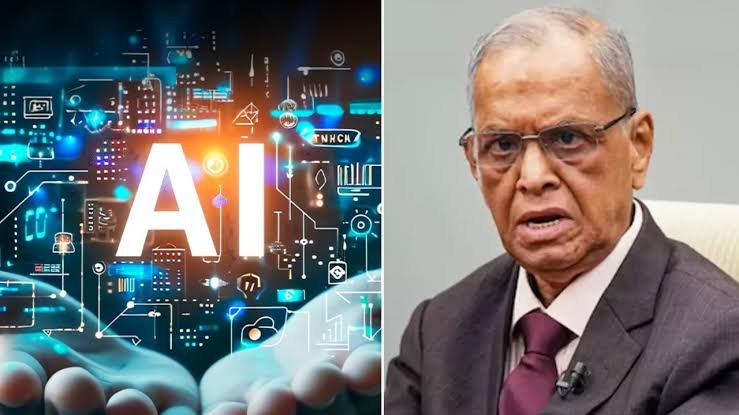

As anxiety over artificial intelligence intensifies across global markets, a sharp sell-off in technology stocks and a pointed message from one of India’s most prominent business leaders have underscored a widening debate: whether the new generation of AI tools will merely reshape white-collar work — or significantly reduce it.
Market Tremors After a New Wave of AI Tools
The latest jolt to investor confidence came after a series of high-profile product launches by the U.S.-based artificial intelligence firm Anthropic. The company has been rolling out workplace-focused tools under its Claude platform that allow organizations to automate tasks across legal work, finance, human resources, engineering and operations.
These systems are designed to plug into widely used enterprise software, carry context across documents and assist in complex workflows that have traditionally required large teams. In effect, they promise not only incremental efficiency gains but the ability to compress processes that once unfolded over months or years.
The rapid pace of these developments has unsettled investors. Software and IT services stocks have come under pressure amid concerns that AI could erode long-running consulting and modernization work — a core revenue stream for many global technology firms.
That unease sharpened earlier this week when shares of IBM fell sharply in a single session, marking their steepest one-day decline in over two decades. The drop reflected broader anxiety about how quickly AI-driven automation might disrupt the economics of enterprise IT services.
FCRF Launches Flagship Certified Fraud Investigator (CFI) Program
The COBOL Question
The sell-off followed claims that Anthropic’s AI tools can now understand and modernize COBOL, a programming language created in the late 1950s that continues to underpin critical systems in banking, airlines and government.
For companies such as IBM, legacy modernization projects involving COBOL have historically been time-consuming, consultant-heavy and financially significant undertakings. Such work has often required specialized teams to interpret aging code, migrate systems and ensure continuity in mission-critical environments.
The suggestion that AI systems could streamline that process — potentially compressing years of work into much shorter timelines — has forced investors to reassess the future economics of enterprise IT services. If modernization becomes faster and less labor-intensive, the structure of large consulting engagements could change in ways that are difficult to quantify.
The concern is not limited to one company or one language. Rather, it reflects a broader question confronting the technology services industry: whether AI will supplement existing workflows or fundamentally reduce the need for human-intensive project structures that have defined the sector for decades.
A Familiar Voice in a New Debate
Against this backdrop of market volatility, Narayana Murthy, the founder of Infosys, offered a message directed at young Indians.
A few months after his remarks on a 70-hour workweek sparked a nationwide debate, Mr. Murthy turned his attention to artificial intelligence and the growing fear that machines could replace white-collar jobs. As anxiety mounts across global and Indian markets over the speed of AI advancement, he urged young people not to panic but to prepare.
He said that AI should not be seen as an adversary but as a tool that must be understood and used wisely. The responsibility, he argued, lies with individuals to master these technologies, deploy them in an assistive manner and combine them with discipline, hard work and continuous learning.
“There is no need for youngsters to get worried,” he said.
Productivity, Not Parity
Speaking about his own use of generative AI, Mr. Murthy said the technology does not automatically level the playing field. Instead, he suggested, it rewards those who think better and learn faster.
“My own experiments with using generative AI for productivity have shown me that a smarter mind will get better quality and better level of productivity from using these assistive technologies,” he told.
His remarks framed AI less as a force of displacement and more as a tool whose impact depends on the capabilities of its user. In that view, the dividing line is not between humans and machines, but between those who adapt quickly and those who do not.
The tension between these perspectives — investor apprehension over compressed consulting cycles and a business leader’s call for adaptation — reflects the uncertainty defining this moment. As companies test the limits of AI’s ability to interpret legacy systems and automate complex tasks, markets and workers alike are left recalibrating their expectations of what the technology may ultimately mean for the structure of modern work.
