

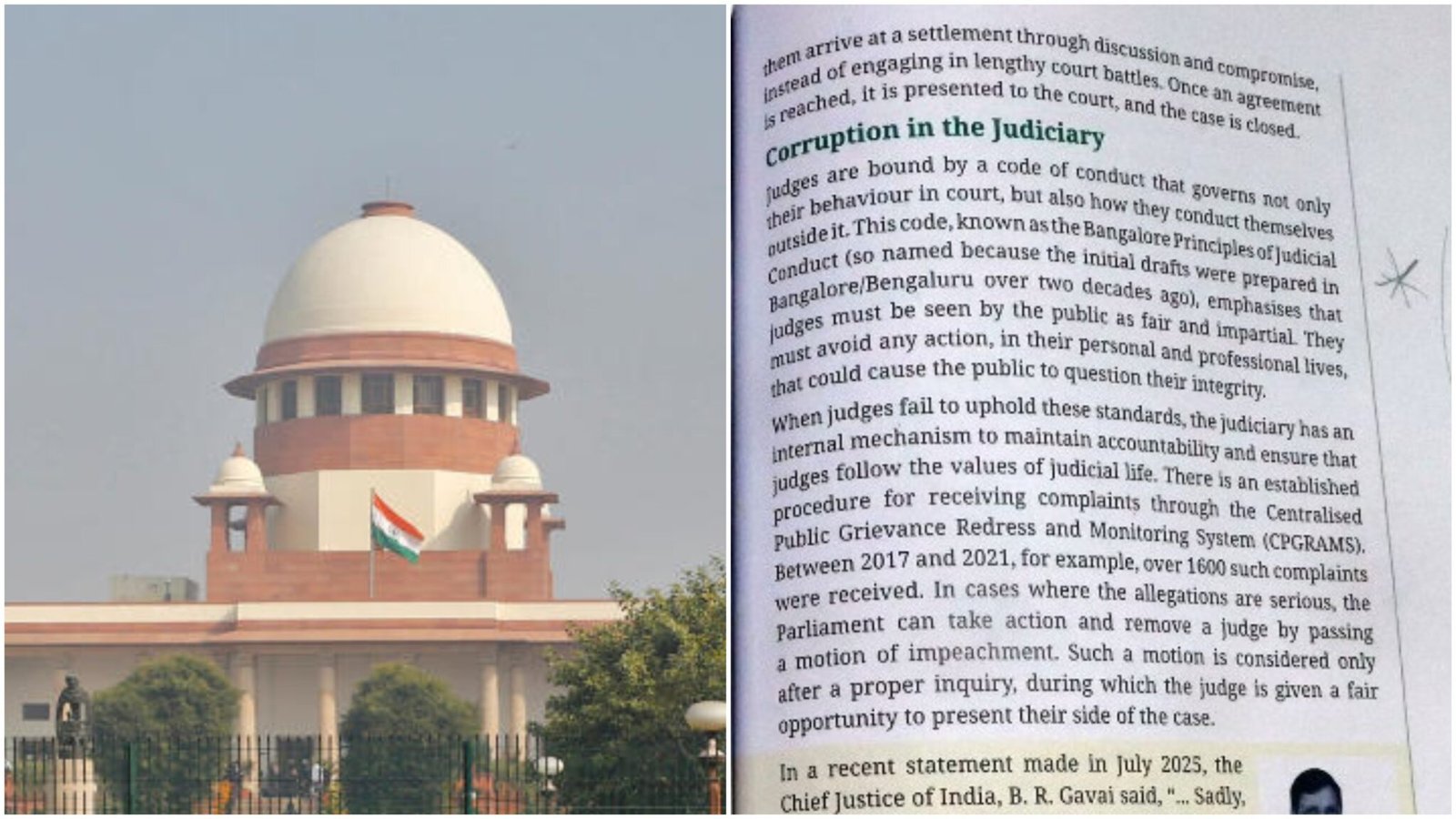

NEW DELHI: India’s Supreme Court on Thursday imposed a sweeping ban on a Class 8 social science textbook published by the National Council of Educational Research and Training, or NCERT, after it was found to contain references to “corruption in judiciary” and case backlogs as major challenges facing the courts.
The order, delivered in a suo motu proceeding initiated by the court, directed that all physical copies of the book be seized and removed from circulation. It also barred any further publication, reprinting or digital dissemination of the chapter in question. Schools were instructed not to impart any instruction based on the book.
The bench, led by Chief Justice of India Surya Kant and comprising Justices Joymalya Bagchi and Vipul M. Pancholi, described the publication as a serious misconduct that could fall within the ambit of criminal contempt of court if found to be a deliberate act intended to scandalize the judiciary.
Earlier in the week, media reports had highlighted that the newly issued textbook listed corruption in the judiciary among systemic concerns. Senior Advocates Kapil Sibal and A.M. Singhvi orally mentioned the matter before the Chief Justice’s bench, arguing that the content cast aspersions on the institution as a whole.
The Chief Justice responded that he was aware of the issue and that many judges were “perturbed by the developments.” He announced that he would not allow anyone to “taint the integrity and defame the entire institution,” adding that the court had decided to take suo motu action. The move, he said, appeared to be a “calculated measure.”
FCRF Launches Flagship Certified Fraud Investigator (CFI) Program
The Court’s Rebuke
In court, the language was pointed. The bench observed that the chapter referred to the number of complaints received against judges, creating the impression that no action had been taken. It further noted that remarks by former Chief Justice of India B.R. Gavai were presented out of context in a way that suggested that the sitting Chief Justice had acknowledged corruption in the judiciary.
The justices stated that the chapter made no reference to steps taken by the judiciary to strengthen democratic institutions or to instances where high-ranking officials had been censured by the court for corrupt practices and siphoning of public funds.
“The silence is particularly egregious,” the bench observed, adding that the choice of words in the book did not appear to be a simple inadvertence or bona fide error. At the same time, the court clarified that it did not intend to use the proceedings to stifle legitimate criticism.
“We do not propose to initiate the suo motu proceedings to stifle any legitimate criticism or to stop any individual from exercising the right to scrutinise public institutions, including the judiciary,” the bench said.
But it also warned that if the publication were allowed to circulate unchecked, it could erode the judiciary’s stature in public esteem, particularly among “impressionable young minds.”
The court issued show-cause notices to the Secretary of School Education in the Ministry of Education and to the NCERT Director, asking why action under the Contempt of Courts Act or other laws should not be initiated against them.
NCERT’s Response and the Hearing
As proceedings opened, Solicitor General Tushar Mehta informed the court that NCERT had withdrawn the Class 8 social science chapter containing the references and had apologised for what it described as an error of judgment.
In a statement cited during the hearing, NCERT said it remained open to constructive feedback as part of its continuous review process and that the chapter would be rewritten in consultation with appropriate authorities. The revised material, it said, would be made available to students at the start of the 2026–27 academic session. The statement acknowledged that certain content in the chapter was “inappropriate” and characterised the lapse as unintentional.
The Chief Justice, however, remarked that the press release issued by NCERT contained not “a single word of apology.” He also noted that when the court’s Secretary General had earlier sought clarification about the reported content, NCERT had defended the chapter. The Solicitor General assured the bench that individuals who had defended the chapter would not be associated with NCERT or any other ministry in the future.
“That’s very little consequence. They fired gunshot; judiciary is bleeding today,” the Chief Justice said.
Mr. Mehta further told the court that only 32 copies of the book had reached the market and that they would be retrieved. He also referred to another chapter titled “Justice delayed is justice denied,” which contained inaccurate figures regarding case backlogs.
“We cannot teach our children that justice is denied in the country,” he said, adding that he would personally vet the revised chapter before it was republished.
Seizure, Accountability and Contempt
Beyond ordering a ban, the court directed the NCERT Director to furnish the names and credentials of all individuals involved in preparing the chapter. It asked for the original minutes of meetings during which the chapter was deliberated and finalized to be produced at the next hearing. The bench said there was a need to identify those responsible and fix accountability.
“As the head of the institution, I must find out who the persons who are responsible behind it. Heads must roll,” the Chief Justice said, adding that the court would not close the proceedings.
The order mandated that NCERT, in coordination with Union and State education departments, ensure that all copies of the book — whether in storage, retail outlets or educational institutions — be seized and removed from public access. Compliance reports were to be filed within two weeks.
The court directed that no instruction be imparted to students on the basis of the book. It imposed a complete blanket ban on further publication, reprinting or digital dissemination of the chapter, warning that any attempt to circumvent the order through electronic means or altered titles would be treated as willful breach.
Finally, the bench said it would examine whether the public regret expressed by NCERT was genuine or an attempt to avoid criminal liability. The case, initiated by the court itself, now turns on whether the publication amounted to contempt and who, if anyone, will be held personally responsible for its contents.
Follow for daily updates on cybercrime, corporate fraud, DFIR, hacking, investigations, and digital forensics
