


Security researchers have identified a sophisticated crypto-mining campaign capable of infiltrating even air-gapped systems, using infected external drives and stealthy system-level techniques to persist undetected.
In the evolving contest between cyber defenders and attackers, one of the most closely guarded environments — the air-gapped network — has long been treated as a final line of defense. Physically isolated from the internet, these systems are common in critical infrastructure, research laboratories and other high-security settings where the risk of data breach must be minimized.
But security analysts say a newly documented strain of crypto-mining malware is challenging that assumption.
The campaign, which spreads primarily through external storage devices such as USB drives and portable hard disks, combines social engineering, worm-like propagation and kernel-level exploitation. Its aim is not sabotage or ransom, but something quieter and more enduring: hijacking system resources to mine cryptocurrency, generating continuous revenue while remaining largely invisible to users.
A Threat Built for Persistence
Crypto-jacking — the unauthorized use of computing resources to mine digital currency — is not new. Early variants relied on browser-based scripts that siphoned processing power temporarily. Over time, those operations evolved into more complex, system-level infections.
The malware described in recent findings reflects that progression. Once installed, it deploys multiple coordinated components that establish a persistent foothold. At the center of the infection is a file named “Explorer.exe,” which acts as a controller, orchestrating different stages of the attack and maintaining communication between payloads.
Researchers note that some of the malware’s elements masquerade as legitimate Windows processes, a tactic designed to evade detection and prolong its presence. Unlike ransomware, which announces itself through disruption, crypto-mining malware thrives on discretion. Its success depends on remaining unnoticed while it steadily consumes computational power. The result is a passive, ongoing revenue stream for attackers — one that does not require negotiation or public exposure.
Certified Cyber Crime Investigator Course Launched by Centre for Police Technology
Crossing the Air Gap
What distinguishes this campaign is its ability to move into environments traditionally considered sealed off from online threats. Air-gapped systems, by design, lack direct connections to external networks. They are used where security is paramount: industrial control systems, scientific research facilities, and certain government operations. The assumption has long been that isolation provides protection.
This malware bypasses that isolation by exploiting a trusted intermediary: removable media. Infected software — often bundled with pirated applications and disguised as legitimate productivity tools — is introduced through social engineering. When a user installs the compromised program, the malware activates and begins deploying its components.
It monitors hardware events using Windows device notifications such as WM_DEVICECHANGE and DBT_DEVICEARRIVAL, detecting when new storage devices are connected. It confirms the presence of storage volumes and scans drive letters typically associated with removable media — E through Z — before copying its payload onto the device. A function identified in analysis as “sub_140014190” is responsible for replicating the malicious files to connected drives.
Once those drives are inserted into another machine — including an isolated one — the infection can continue its spread. In effect, the removable device becomes a bridge across the air gap.
The Mechanics of Infection
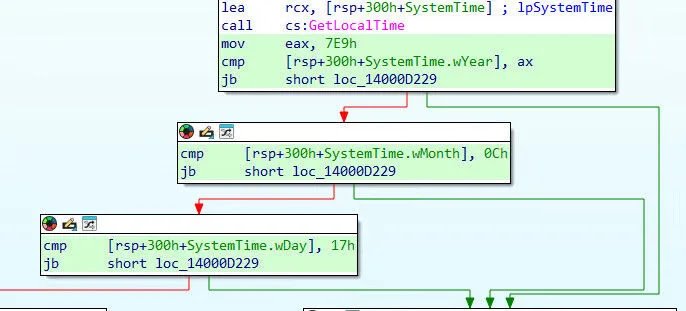
The malware’s execution begins with user action. After installation of the bundled software, it drops multiple payloads that operate together to secure persistence. Code excerpts analyzed by researchers show routines that retrieve local system time and module file names, followed by function calls associated with internal flags — including one labeled “barusu.” Though technical in nature, these artifacts illustrate the structured logic underpinning the malware’s behavior.
The “Explorer.exe” component coordinates activity across the infected system, from initial setup to ongoing operation. It is designed to avoid detection and ensure longevity, blending with legitimate processes where possible.
The infection does not immediately disrupt normal operations. Instead, it quietly commandeers processing resources for cryptocurrency mining. The performance impact may be subtle, particularly in environments with significant computing capacity, making detection more difficult.
Security Assumptions Under Strain
The campaign underscores a growing reality in cybersecurity: physical isolation alone is no longer sufficient. Because removable media remains common in high-security environments — used for software updates, data transfers or maintenance — it represents a persistent vulnerability. The malware’s design exploits that trust relationship, leveraging routine workflows to propagate.
Security experts emphasize that organizations must strengthen controls around external devices and maintain continuous monitoring, even within isolated systems. Regular software updates and employee awareness training — particularly regarding the risks associated with pirated software — are critical countermeasures.
The emergence of this malware does not signal the end of air-gapped defenses. But it does illustrate how modern threats adapt, exploiting the smallest bridges between trusted and untrusted systems — and turning them into conduits for quiet, sustained intrusion.
