


NEW DELHI — When Jensen Huang, Founder and Chief Executive of Nvidia — the company whose advanced GPUs power much of the world’s artificial intelligence infrastructure — appears in New Delhi this week, it will mark more than a ceremonial visit. It signals India’s emergence as a serious node in the global AI supply chain.
Joining him is Dario Amodei, Chief Executive of Anthropic, one of the world’s leading AI safety and frontier-model companies; Brad Smith, President and Vice Chair of Microsoft, a central architect of global AI governance conversations; Julie Sweet, Chair and CEO of Accenture, representing the enterprise AI transformation wave; Cristiano Amon, President and CEO of Qualcomm; Börje Ekholm, President and CEO of Ericsson; and Kiran Mazumdar-Shaw, Chairperson of Biocon Group, symbolizing AI’s growing intersection with biotechnology and healthcare.
Together, they form a roster rarely assembled outside global forums like Davos — underscoring the scale of the India AI Impact Summit and the geopolitical weight it now carries.
India’s AI Ambition Meets Global Capital and Governance
The summit arrives at a time when India’s AI economy is projected to touch $17 billion by 2027. Government-backed initiatives such as the IndiaAI Mission are expanding compute infrastructure, nurturing indigenous models and embedding AI into public systems.
But this is not simply an industry showcase. The presence of leaders from Nvidia, Anthropic, Microsoft, Qualcomm and Ericsson reflects the deeper question at stake: who will define the guardrails for the next generation of artificial intelligence?
Main-stage sessions anchored by the Stanford Institute for Human-Centered AI (HAI) will focus on trust and accountability in the AI era. The Harvard Kennedy School’s Belfer Center, through The Move37 Project, is partnering on dialogues around AI in diplomacy and negotiation. The Gates Foundation is leading conversations on information integrity and youth empowerment. The World Health Organization is contributing insights on AI in public health systems. JICA joins as a strategic knowledge and network partner, reflecting a widening Asia-Pacific collaboration.
In this constellation of global institutions, India is positioning itself not only as a beneficiary of AI transformation but as a rule-setter.
FCRF’s Security Lens: AI for Secure India
Amid the high-level discourse on compute and governance, cybersecurity remains a central concern — and it is here that the Future Crime Research Foundation (FCRF) emerges prominently as a Knowledge Partner.
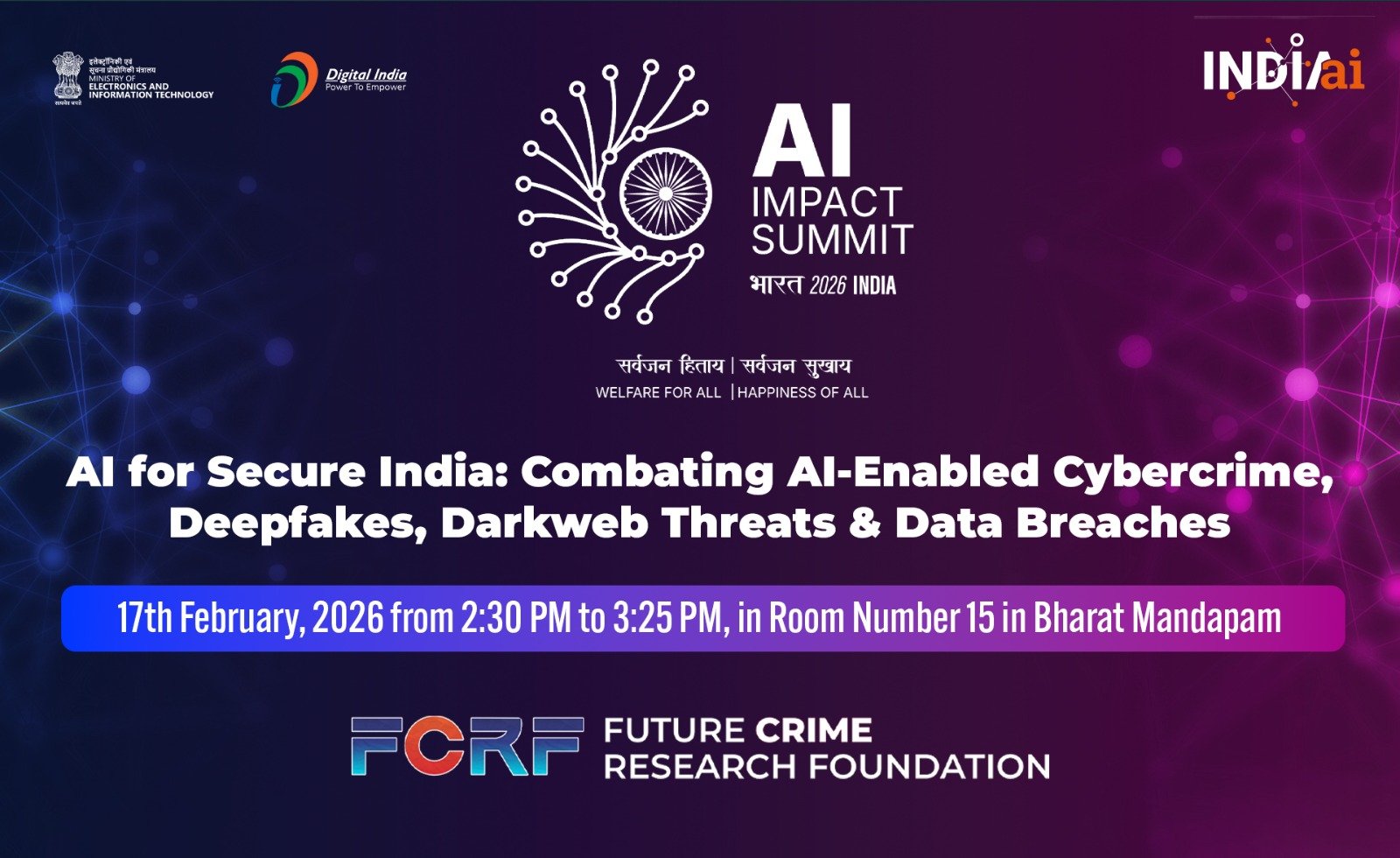
FCRF will host a dedicated session titled: “AI for Secure India: Combating AI-Enabled Cybercrime, Deepfakes, Darkweb Threats and Data Breaches.”
Date: 17 February 2026
Time: 2:30 PM – 3:30 PM
Venue: Bharat Mandapam, L1 Meeting Room No. 15
The session will be moderated by Prof. Triveni Singh, former IPS officer and Chief Mentor at FCRF, and will bring together a panel of legal, industry and cybersecurity experts, including:
- Rakesh Maheshwari, Cyber Law & Data Governance Expert
- Senior Advocate Vivek Sood, Supreme Court of India
- Tarun Wig, Co-Founder & CEO, Innefu Labs
- Dr. Sapna Bansal, Shri Ram College of Commerce, University of Delhi
- Navneethan M., Senior Vice President & Chief Information Security Officer
The focus is unambiguous: artificial intelligence has become both a catalyst for economic acceleration and a multiplier of cyber risk. From AI-generated deepfakes and automated phishing ecosystems to dark web marketplaces leveraging machine learning, the threat landscape has grown more algorithmic and less predictable.
By placing this session within the summit’s core programming, FCRF reinforces a central message — that security must be embedded into AI systems from inception, not retrofitted after disruption.
Interested participants can register for the FCRF session through the following link: https://impact.indiaai.gov.in/registration
Between Innovation and Integrity
As global executives debate compute, safety and scalability inside Bharat Mandapam, the larger narrative unfolding is one of balance. India’s AI ambitions are expansive — but they are increasingly framed around “trust-centric innovation.”
The convergence of Nvidia’s hardware leadership, Anthropic’s AI safety focus, Microsoft’s governance lens, and India’s domestic policy framework suggests that the future of artificial intelligence will not be written in Silicon Valley alone.
In New Delhi this week, amid packed halls and tightly choreographed panels, the real negotiation may not be about technological supremacy — but about how to build an AI-powered economy that is simultaneously innovative, sovereign and secure.
And in that equation, cybersecurity — as FCRF’s session makes clear — is no longer peripheral. It is foundational.
