


As India races to position itself as a global leader in artificial intelligence, a quieter but urgent conversation is gathering momentum one that asks how the country intends to police the very technologies it celebrates.
AI Security Takes the Main Stage at India-AI Impact Summit 2026
When the India-AI Impact Summit 2026 convenes in New Delhi this February, much of the discussion will center on innovation, economic acceleration and digital transformation. Yet one session, scheduled midway through the summit, is set to shift the tone toward accountability.
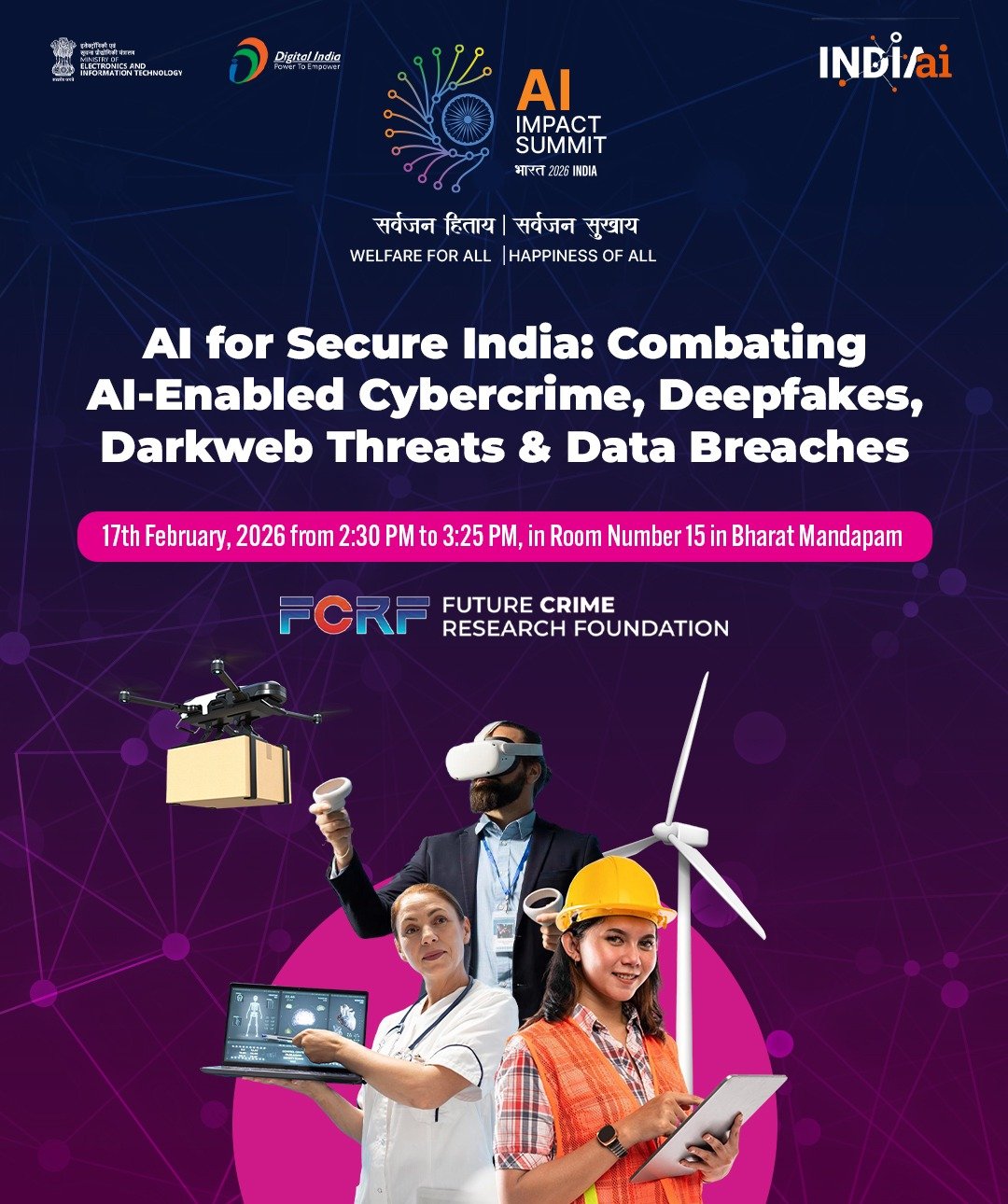
As Knowledge Partner, the Future Crime Research Foundation (FCRF) will host a main agenda discussion that examines the growing intersection between artificial intelligence and cybercrime.
Session Details
Topic: “AI for Secure India: Combating AI-Enabled Cybercrime, Deepfakes, Darkweb Threats & Data Breaches.”
Date: 17th February 2026
Time: 2:30 PM – 3:30 PM
Venue: Bharat Mandapam, New Delhi
Link for registration– https://impact.indiaai.gov.in/registration
The 55-minute session is expected to draw regulators, investigators, legal professionals and technology leaders seeking clarity on how AI-enabled threats are reshaping India’s enforcement landscape.
The Expanding Terrain of AI-Enabled Crime
Over the past several years, law enforcement agencies across India have reported a rise in crimes powered or amplified by artificial intelligence — voice-cloned extortion calls, synthetic video impersonations, automated phishing campaigns and dark web marketplaces trading stolen data at scale.
Unlike earlier forms of cybercrime that depended primarily on technical intrusion, AI-assisted offenses often rely on realism — the ability to convincingly imitate identity, speech and circumstance. As generative tools become widely accessible, the line between digital manipulation and criminal deception grows thinner.
The session will explore how investigative procedures, evidentiary standards and regulatory safeguards must evolve in response to this new threat environment.
A Panel Bridging Enforcement, Law, Academia and Industry
Moderating the discussion will be Triveni Singh Ex-IPS Officer, Cybercrime Expert and Chief Mentor at FCRF, whose career spans decades of digital crime investigations and institutional reform.
Joining him on the panel:
Rakesh Maheshwari, Former Senior Director at MMeitY and a key figure in India’s cyber law and data governance framework, expected to contextualize enforcement under the IT Act and regulatory architecture.
Deepak Kumar Singh, Associate Professor at IIIT Lucknow and AI researcher, expected to address the technical evolution of generative systems and their forensic implications.
Sapna Bansal, Director of Institutional Outreach and Inclusivity at Shri Ram College of Commerce, University of Delhi, bringing a governance and public policy perspective to AI’s societal impact.
Vivek Sood, Senior Advocate at the Supreme Court of India, likely to examine constitutional safeguards, intermediary liability and accountability in algorithmic systems.
Tarun Wig, Co-Founder and CEO of Innefu Labs, offering insight into AI-powered cybersecurity and intelligence solutions deployed across public and private sectors.
Together, the panel represents a rare cross-section of expertise — spanning investigative practice, constitutional law, AI research and industry deployment.
From Innovation to Institutional Preparedness
India’s AI ambitions are unfolding alongside growing digital exposure. As artificial intelligence integrates into governance systems, financial services and everyday communication, the risks are no longer hypothetical.
By positioning this discussion within the Summit’s main agenda, FCRF’s role as Knowledge Partner reflects a broader institutional shift: the recognition that technological advancement must be matched by regulatory clarity, forensic capacity and legal accountability.
The February 17 session is expected to probe a central tension of the AI era — how to preserve innovation while ensuring that responsibility for misuse remains clearly defined. In a Summit largely devoted to opportunity, this conversation will focus on consequence.
Follow for daily updates on cybercrime, corporate fraud, DFIR, hacking, investigations, and digital forensics
