

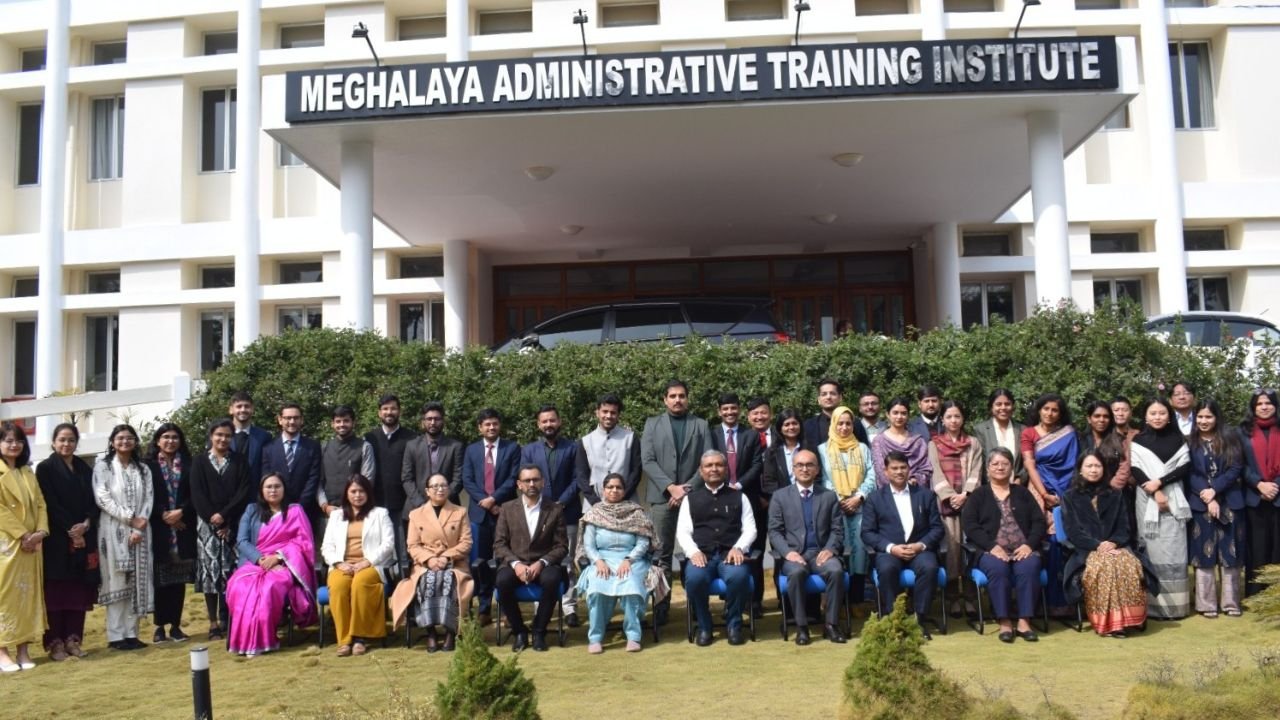

On February 1, a one-week training programme for IAS officer trainees of the 2024 batch began in Shillong, marking a deliberate effort by India’s premier civil-services institutions to expose young officers to governance challenges beyond the country’s administrative heartland.
The programme is being conducted by Lal Bahadur Shastri National Academy of Administration in collaboration with the Meghalaya Administrative Training Institute, and brings together officer trainees allotted to the North-East cadre and the AGMUT cadre, which covers Arunachal Pradesh, Goa, Mizoram and Union Territories.
Certified Cyber Crime Investigator Course Launched by Centre for Police Technology
Officials involved in the programme said the initiative reflects a broader rethinking within the civil services training ecosystem — one that recognises the importance of early, location-specific exposure for officers who will soon be responsible for administering some of India’s most complex and diverse regions.
Governance in the North-East Context
Sessions during the programme focus on governance frameworks unique to the North-Eastern states, where administrative decisions often intersect with customary laws, autonomous district councils, sensitive border geographies and distinct socio-political histories.
Trainers at the Shillong institute said the curriculum goes beyond procedural learning, emphasising how policy implementation can differ markedly from mainland India. Land ownership systems, community institutions and centre-state relations, they noted, frequently require officers to adapt standard administrative tools to local realities.
For trainees, many of whom are encountering the region for the first time, the exposure is intended to challenge assumptions formed during foundational training. “Understanding governance here means understanding people first,” one senior faculty member involved in the programme said, pointing to the limits of purely rule-based administration in the region.
From Mussoorie to Shillong
The collaboration also signals a shift in how Lal Bahadur Shastri National Academy of Administration structures its training calendar. Traditionally centred in Mussoorie, the academy has in recent years expanded field-based modules to ensure that probationers engage early with diverse administrative environments.
By situating this programme in Shillong, organisers aim to bridge the gap between theory and practice, allowing officers to observe how district administrations function in terrain marked by logistical constraints and layered governance structures.
Officials familiar with the planning said the Shillong module was designed not as an isolated exposure visit but as a foundation for future postings, where officers will be expected to navigate development priorities alongside long-standing local sensitivities.
Preparing Officers for Complex Cadres
The inclusion of AGMUT and North-East cadre officers reflects the particular demands placed on administrators in these regions, where postings often involve rapid transitions between vastly different administrative settings.
Senior civil servants say early immersion helps reduce the learning curve once officers take charge in the field. Exposure to regional institutions, they argue, also builds institutional empathy — a quality increasingly seen as essential for effective governance in areas where mistrust of state authority has historical roots.
As the week-long programme continues, trainees are expected to engage with case studies, local administrators and faculty members who have spent years working in the region. For many, the experience is likely to shape not just their first postings, but how they understand the role of the state itself.
In Shillong, far from the corridors of central power, India’s next generation of administrators is being asked to learn governance where it is often most fragile — and most consequential.
About the author — Suvedita Nath is a science student with a growing interest in cybercrime and digital safety. She writes on online activity, cyber threats, and technology-driven risks. Her work focuses on clarity, accuracy, and public awareness.
