
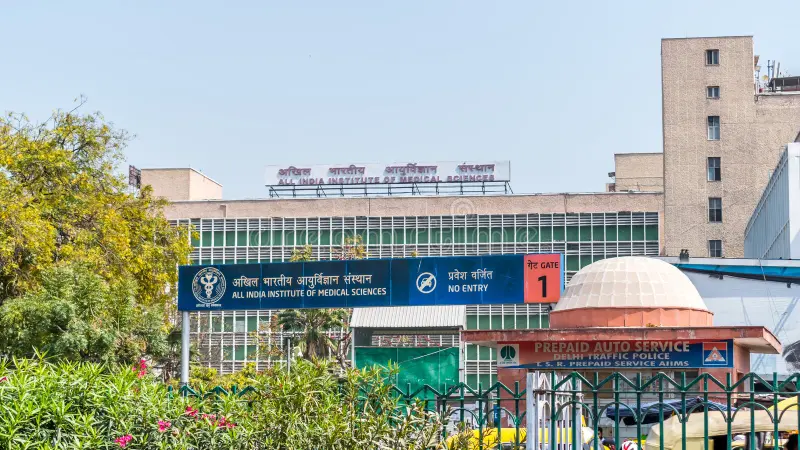
Shahpur police have arrested a woman for allegedly cheating a family of ₹7.46 lakh by promising a job at the country’s premier medical institution, All India Institute of Medical Sciences. Police said the accused is part of a larger organised fraud racket that targeted unemployed youth by offering fake appointments in reputed government institutions.
The arrested woman has been identified as Parvati alias Muskan, a resident of Jogam village under Gauri Bazar police station in Deoria district. She was living in Kudaghat, Vishunpura area under the AIIMS police station limits at the time of her arrest. Police confirmed that two other associates involved in the scam are currently absconding and efforts are underway to track them down.
According to investigators, the accused woman already has two earlier fraud cases registered against her, indicating a pattern of repeat offences. Preliminary questioning suggests that the gang systematically approached job seekers and their families, exploiting their desperation for secure employment.
Certified Cyber Crime Investigator Course Launched by Centre for Police Technology
The case came to light after Sangam, a resident of Sarvodaya Nagar, Bichhiya in Shahpur area, lodged a complaint alleging that his sister Chandni was cheated in the name of securing employment at AIIMS, New Delhi. Police said the initial contact was made by Atul Sharma, a resident of Rajdhani locality under Jhungaha police station, who claimed he could arrange a job through his “high-level connections”.
To make the offer appear credible, the accused projected themselves as well-connected intermediaries and assured quick appointment and training at AIIMS. Trusting their claims, the victim’s family began transferring money as demanded.
Police records show that after November 6, 2023, payments were made in multiple instalments. During the investigation, it was established that a total amount of ₹7.46 lakh was transferred into bank accounts belonging to Muskan Vishwakarma and Sajal Pandey, both linked to the accused group.
After receiving the money, the accused handed over forged appointment letters, joining letters and other fabricated documents in Chandni’s name, falsely bearing the name and credentials of AIIMS. The documents were designed to closely resemble official communication, police said.
Another accused, Avneesh Singh, allegedly played a key role in maintaining contact with the victim and repeatedly reassured the family that Chandni’s posting and training in New Delhi would begin shortly. On the strength of these assurances, the victim travelled to Delhi along with his sister to complete the joining process.
However, when the documents were presented before AIIMS authorities, officials immediately identified the appointment and joining letters as fake, exposing the fraud. The family then realised they had been cheated.
When Sangam contacted the accused and demanded his money back, he was allegedly threatened with dire consequences, including threats to life. Following this, the victim approached the police superintendent with a written complaint.
On the superintendent’s directions, Shahpur police registered a case under relevant sections and initiated a detailed investigation. Bank transaction records, technical evidence and document verification led to the arrest of Parvati alias Muskan.
Station House Officer Chandrabhan Singh said the accused is being interrogated and the police have identified the remaining members of the gang. “Raids are being conducted to arrest the absconding accused. We are also examining whether the gang has cheated other victims using similar methods,” he said.
Police have issued a public advisory urging citizens to remain cautious of job offers that demand money, especially when payments are sought through personal bank accounts. Applicants have been advised to verify any recruitment offer directly through the official websites or offices of government institutions.
The case once again highlights how fraudsters are exploiting unemployment and trust to siphon off hard-earned money, and police stressed that prompt reporting of such cases is critical to preventing further victims.
About the author – Rehan Khan is a law student and legal journalist with a keen interest in cybercrime, digital fraud, and emerging technology laws. He writes on the intersection of law, cybersecurity, and online safety, focusing on developments that impact individuals and institutions in India.
