

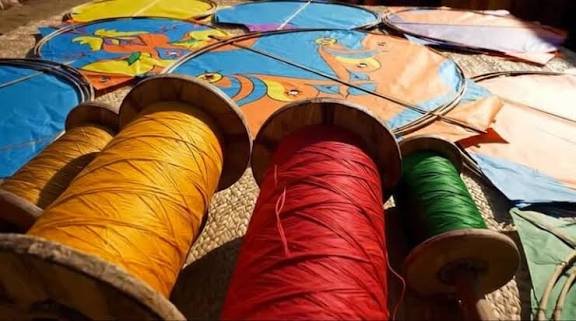

Lucknow: In a hardening of the state’s stance against the banned Chinese manja, the Uttar Pradesh government has directed that any death caused by the lethal kite string will be treated as murder, signalling zero tolerance amid a rising toll across districts. The order follows fresh fatalities in the capital and elsewhere, prompting the chief minister to ask why the prohibited material continues to be sold and used despite a standing ban.
Chairing a high-level review, Yogi Adityanath instructed senior police officers to launch a statewide enforcement drive, conduct intensive raids on supply chains and retail points, and submit a top-level assessment of lapses that allowed the dangerous string to circulate. Officials were told that accountability would be fixed where negligence or collusion is found.
The immediate trigger was the death of Mohammad Shoaib (33), a resident of Dubagga, whose neck was slashed by Chinese manja near the Haiderganj overbridge in Lucknow earlier this week. The incident came close on the heels of similar fatalities and grievous injuries reported from multiple districts, renewing concerns over public safety during the kite-flying season.
Certified Cyber Crime Investigator Course Launched by Centre for Police Technology
Series of fatalities sparks action
Police records and district reports point to a pattern of repeat incidents over the past year. In Jaunpur, Dr Sameer Hashmi died after being cut by the string. In Meerut, several commuters have suffered severe injuries in recent weeks. Earlier cases include the death of Ravi Sharma in Shahjahanpur (October 2025), a constable Shahrukh Hasan who died while on duty (January 2025), and Salman in Aligarh (September 2025). During Makar Sankranti this year, hospitals across states reported deaths and multiple injuries linked to manja-related accidents.
“These are not accidents in the conventional sense,” a senior official said. “The string is engineered to cut. Treating fatalities as culpable homicide amounting to murder will strengthen deterrence and sharpen investigations.”
Why Chinese manja is deadly
Unlike traditional cotton kite string, Chinese manja—also called plastic or synthetic manja—is made from nylon or polyester filaments coated with microscopic abrasive particles. These often include glass dust and metal powders such as aluminium, steel/iron or tungsten carbide. The particles are fine enough to be invisible to the naked eye, but together they turn the string into a razor-like edge capable of slicing skin, tendons and even protective clothing at speed.
Because of the grave risk to pedestrians, two-wheeler riders and birds, the material is banned in several cities and states. Enforcement, however, has struggled to keep pace with clandestine manufacturing, online sales and informal markets.
Statewide raids, tougher cases
Under the new directive, police units have been asked to map suppliers, track online listings, and conduct surprise inspections of markets known for kite accessories. Officers have been told to invoke stringent penal provisions in cases of death or grievous hurt, while municipal bodies will be roped in to check storage and disposal.
The chief minister has also sought a review of prosecution outcomes in earlier cases to identify bottlenecks. “If a ban exists but the product is freely available, enforcement has failed somewhere,” an official said, adding that the review would cover licensing, border checks and courier routes.
Public advisory
Authorities have urged citizens to avoid plastic or synthetic strings, report sellers to local police, and exercise caution during festivals. Parents have been advised to keep children away from hazardous materials, while two-wheeler riders are being encouraged to use protective gear during peak kite-flying hours.
With deaths now to be booked as murder, the government hopes the combination of harsher charges, aggressive policing and public vigilance will finally choke the trade in Chinese manja—and prevent further loss of life on UP’s roads.
