
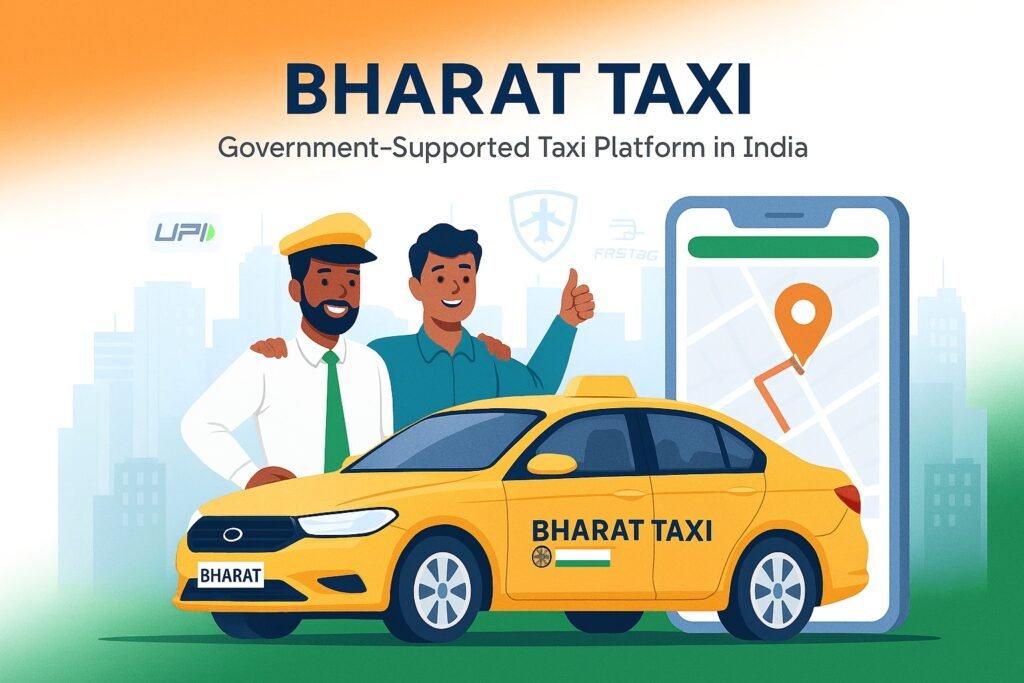
India’s ride-hailing landscape is set for a major shake-up with the launch of ‘Bharat Taxi’, the country’s first cooperative-based ride-hailing platform, which begins operations in Delhi and the National Capital Region on Wednesday. The platform will be formally inaugurated by Union home and cooperation minister Amit Shah at Vigyan Bhavan, signalling the government’s push to create a driver-owned alternative to aggregator-led services such as Ola and Uber.
After a pilot phase in December 2025, Bharat Taxi is being rolled out across Delhi-NCR on a large scale. Officials associated with the project said the launch will be accompanied by a massive driver awareness rally, with an estimated 2.5 lakh vehicles expected to participate, underscoring the scale at which the cooperative aims to operate from day one.
Certified Cyber Crime Investigator Course Launched by Centre for Police Technology
Drivers as owners, not partners
At the heart of Bharat Taxi is a zero-commission cooperative model that radically departs from existing ride-hailing platforms. Unlike private aggregators that charge drivers significant commissions on every ride, Bharat Taxi positions drivers as co-owners of the platform.
Each registered driver will hold five shares in the cooperative, making them stakeholders rather than mere service providers. There will be no per-ride commission, with drivers required to pay only a nominal ₹30 daily usage fee for access to the app. Officials said this structure ensures that the bulk of earnings stays with drivers, improving income stability and reducing dependency on opaque pricing algorithms.
Cheaper rides for passengers
The absence of commissions is expected to directly benefit commuters. Authorities behind the platform claim that fares on Bharat Taxi could be up to 30% cheaper than those charged by private ride-hailing apps. In conventional models, passengers indirectly bear the burden of commissions—often ranging between ₹30 and ₹50 per trip—which are built into fares. By eliminating these costs, Bharat Taxi aims to offer more affordable and predictable pricing.
Importantly, the platform will also operate without surge pricing, a long-standing complaint among urban commuters. Officials said fare transparency and stability would be a key differentiator as the service scales up.
Strong focus on passenger safety
Passenger safety—particularly that of women—has been positioned as a central feature of Bharat Taxi. The app includes dedicated safety tools, including an in-app emergency help button and a centralised helpline. In collaboration with Delhi Police, 35 special assistance booths have been set up across the city to ensure swift redressal of complaints.
All drivers, referred to as ‘Sarathis’, will undergo complete verification, officials said, adding that background checks and continuous monitoring are integral to the platform’s design. The aim, they said, is to create a safer and more accountable ecosystem for both drivers and passengers.
Backed by major cooperatives
Bharat Taxi is being operated by Sahakar Taxi Cooperative Limited, and is supported by some of the country’s most prominent cooperative institutions, including Amul, IFFCO, NABARD and NAFED. The involvement of these established entities is being cited as a key factor enhancing the platform’s credibility and long-term viability.
Officials said the cooperative backbone ensures that profits are reinvested for driver welfare, technology upgrades and service expansion, rather than being siphoned off as corporate margins.
Plans for nationwide expansion
During the pilot phase in Delhi and Gujarat, Bharat Taxi reportedly handled an average of 5,500 rides per day, encouraging planners to fast-track expansion. The stated goal is to establish operations in every state and major city within the next two years. Dedicated support centres are planned in each state, alongside new social security initiatives for drivers, including insurance and welfare schemes.
With today’s launch, Bharat Taxi represents one of the most ambitious experiments in applying the cooperative model to a large-scale digital platform. Whether it can sustainably challenge entrenched private players will depend on execution, driver retention and customer experience. For now, its arrival marks a significant moment for India’s gig economy—one that seeks to rebalance power from platforms back to the people who keep them running.
About the author – Rehan Khan is a law student and legal journalist with a keen interest in cybercrime, digital fraud, and emerging technology laws. He writes on the intersection of law, cybersecurity, and online safety, focusing on developments that impact individuals and institutions in India.
