
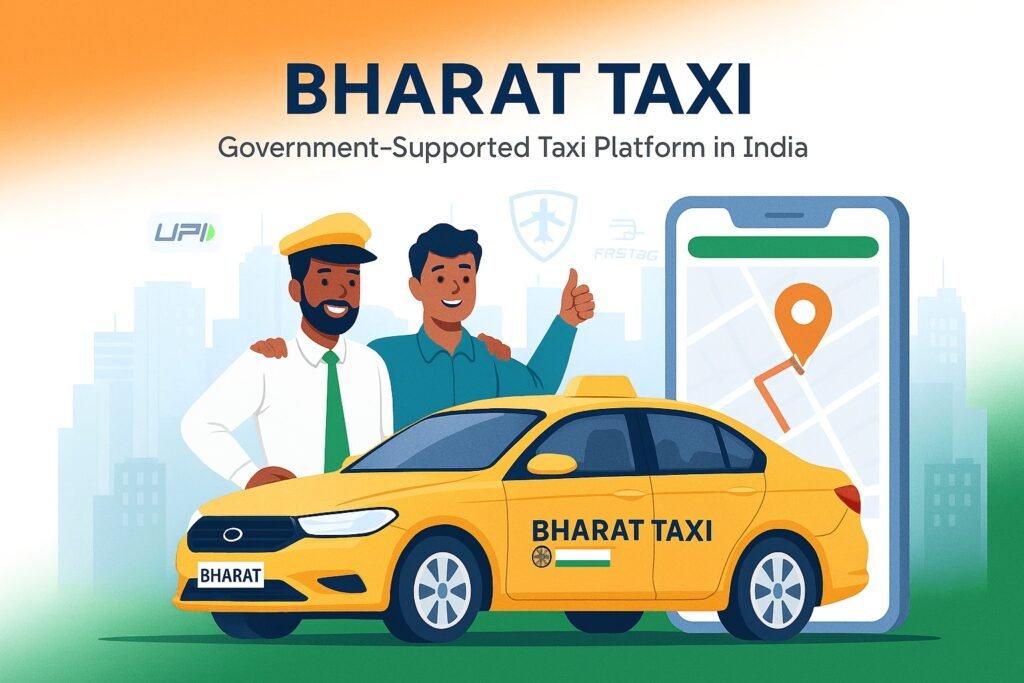
In a significant push to strengthen the cooperative sector, Union Minister for Cooperation Amit Shah will today launch ‘Bharat Taxi’ in the national capital. Touted as India’s first cooperative-based ride-hailing platform, the initiative seeks to move away from conventional aggregator-led models by placing drivers at the centre of ownership, operations and value creation.
According to the Ministry of Cooperation, ‘Bharat Taxi’ will enable drivers—referred to on the platform as ‘Sarathis’—to operate under a zero-commission model. This means the entire earnings from each ride will flow directly to the drivers, without any platform deductions. The service will also be free from surge pricing, ensuring transparent and stable fares for passengers while protecting drivers’ incomes from unpredictable pricing mechanisms.
The ministry said the initiative blends the core principles of the cooperative movement—collective ownership and equitable benefit-sharing—with modern digital mobility solutions. The government expects the platform to improve drivers’ income security while offering passengers a reliable, affordable and accountable alternative in the ride-hailing space.
Certified Cyber Crime Investigator Course Launched by Centre for Police Technology
Driver-centric ownership and social security
A key pillar of ‘Bharat Taxi’ is social security for drivers. The ministry said Sarathis associated with the platform will be provided health insurance, accident insurance, retirement savings options, along with access to a dedicated driver support system. These measures aim to address long-standing concerns around job security and welfare in the gig economy.
Beyond welfare, drivers are also expected to play a meaningful role in platform governance. Under the cooperative structure, participation in decision-making, profit distribution and service standards has been built into the model. Officials said this approach is designed to free drivers from what the government describes as “exploitative aggregator-based systems.”
‘Bike Didi’ initiative boosts women’s participation
To promote women’s empowerment, ‘Bharat Taxi’ has been linked with initiatives such as ‘Bike Didi’. According to the ministry, more than 150 women drivers have already joined the platform under this programme. The government believes this will open up safe, dignified and sustainable income opportunities for women, particularly in urban and semi-urban areas.
Cooperative-led, citizen-friendly mobility
Officials said the objective of ‘Bharat Taxi’ is not merely to introduce another ride-hailing app, but to create a citizen-centric mobility solution rooted in cooperative values. Fare-setting, service quality and grievance redressal are expected to follow transparent processes, with scope for local needs and regional participation to be factored into operations.
The platform is expected to expand nationwide in phases, with services being rolled out gradually across cities and states after the launch. The government sees the initiative as a means to promote employment generation, income stability and digital inclusion through the cooperative framework.
Expectations of wider impact
Sector observers say that if ‘Bharat Taxi’ successfully delivers on its stated principles—zero commission, no surge pricing and robust social security—it could emerge as a credible alternative benchmark in India’s ride-hailing market. Such a shift could enhance drivers’ bargaining power while giving consumers access to a more affordable and trustworthy option.
With today’s launch, the government is formally embarking on a large-scale experiment in cooperative-driven digital platforms. In the months ahead, attention will be focused on how the model performs on the ground—particularly its impact on drivers’ earnings, service standards and competition in the mobility sector.
About the author – Rehan Khan is a law student and legal journalist with a keen interest in cybercrime, digital fraud, and emerging technology laws. He writes on the intersection of law, cybersecurity, and online safety, focusing on developments that impact individuals and institutions in India.
