

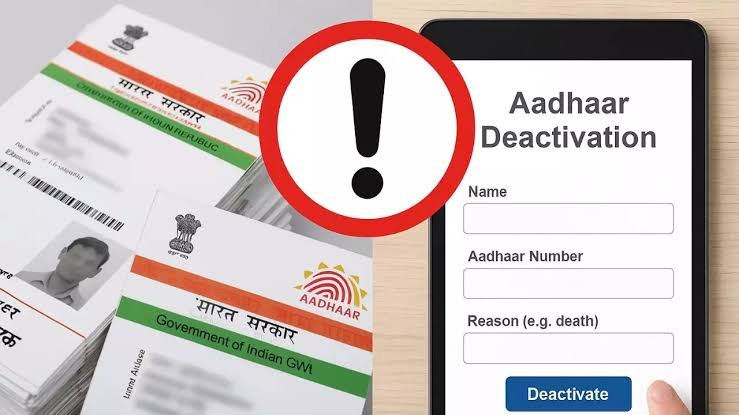

New Delhi: In a significant move to make the Aadhaar database more accurate and reliable, the Unique Identification Authority of India (UIDAI) has deactivated more than 25 million Aadhaar numbers belonging to deceased individuals. The exercise is part of a nationwide drive aimed at preventing identity-related fraud and ensuring that government welfare benefits reach only eligible beneficiaries.
According to UIDAI, keeping an Aadhaar number active after the death of an individual increases the risk of misuse—particularly in subsidies, pensions and other social welfare schemes. For this reason, post-death deactivation of Aadhaar has been identified as a mandatory and high-priority measure. At present, India has close to 1.34 billion active Aadhaar holders.
Why Aadhaar deactivation after death is necessary
The Ministry of Electronics and Information Technology has clarified that deactivating Aadhaar after death helps prevent unauthorised use of identity and curbs misuse of public funds. The authority has also pointed out that the address recorded in Aadhaar does not always correspond to the state or Union Territory where the death is officially registered—making cross-verification of data from multiple sources essential.
Certified Cyber Crime Investigator Course Launched by Centre for Police Technology
Security measures to prevent fraud
To strengthen Aadhaar security and reduce the risk of misuse, UIDAI has implemented several safeguards, including:
- Biometric lock/unlock: To prevent unauthorised authentication attempts
- Aadhaar lock/unlock facility: Allowing users to control the usability of their Aadhaar number
- Face authentication with liveness detection: To prevent spoofing and impersonation
- Offline verification tools: Secure QR code, paperless offline e-KYC and related features
- No sharing of core biometrics: Ensuring biometric data remains confidential
- Encrypted storage: Mandatory use of Aadhaar data vaults for secure storage
- Regular database clean-up: Removal of duplicates and deactivation of Aadhaar numbers of deceased persons
- Controlled update process: Demographic updates allowed only on the basis of UIDAI-approved documents
Data matching and the road ahead
To identify Aadhaar numbers linked to deceased individuals, UIDAI has relied on data from the Registrar General of India (RGI), state and Union Territory agencies, the Public Distribution System (PDS) and the National Social Assistance Programme. The authority is also working with banks and other institutions to gain access to verified death records.
UIDAI has reiterated that Aadhaar numbers are never reissued. Deactivation after death is essential to prevent fraud and illegal use of welfare benefits. The move is being seen as a crucial step towards strengthening the credibility, transparency and integrity of the Aadhaar ecosystem.
