

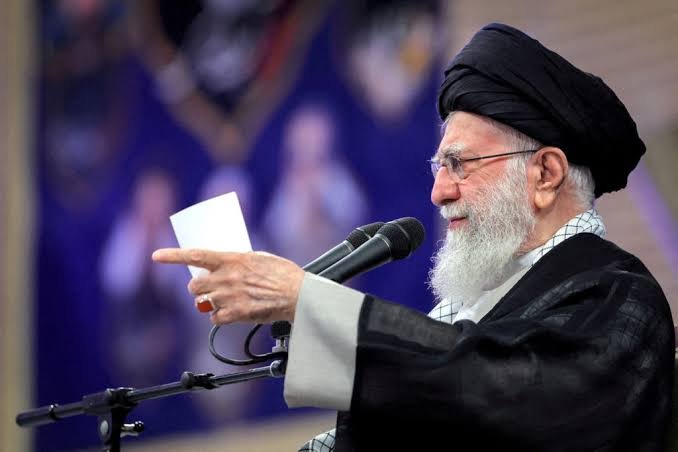

Tehran: Iran’s Supreme Leader Ayatollah Ali Khamenei on Sunday issued a stark warning to the United States, saying any military action against Iran would ignite a regional war, as tensions in West Asia escalated sharply over protests, sanctions and security threats.
Addressing the nation, Khamenei said Iran had no intention of starting a war or attacking any country, but would respond “decisively and forcefully” if provoked. “We are not afraid of American warships or threats,” he said, urging Iranians not to be intimidated by what he described as psychological pressure from Washington. He added that Iran remained open to fair and unbiased dialogue, provided there were no attempts to weaken its defence capabilities.
The remarks come amid heightened rhetoric from Washington and renewed focus on Iran following unrest inside the country and warnings linked to the death sentence given to a protester. Iranian authorities on Sunday released a detained demonstrator on bail, a move that followed strong signals from the US that any execution could lead to military consequences.
Certified Cyber Crime Investigator Course Launched by Centre for Police Technology
Protester released amid pressure
Iranian media confirmed that Irfan Sultani, a prominent face among recent protests, was released on bail after international attention intensified around his case. US officials had earlier warned that Sultani faced the death penalty, prompting fears of escalation. Tehran, however, dismissed external pressure, with senior leaders reiterating that judicial matters were internal affairs.
Iran’s foreign minister Abbas Araghchi said there was little trust in negotiations with the US, arguing that past engagements had failed to deliver tangible relief to Iran despite concessions.
‘We will not be bullied’
Khamenei also addressed claims about US naval deployments near Iran, stating that the presence of American warships would not deter Tehran.
“We are not seeking conflict, but if anyone attacks us or tries to destabilise the country, the response will be firm,” he said.
Referring to recent unrest, the Supreme Leader described the protests as an attempted coup, accusing rioters of attacking police stations, government offices and religious sites, and burning holy texts. He claimed the unrest had been brought under control.
Tensions with Europe escalate
The confrontation widened after comments from Iran’s parliament leadership. Speaker Mohammad Bagher Ghalibaf said Iran would now consider European Union armed forces as terrorist entities, following actions taken by the European Union against Iran’s Islamic Revolutionary Guard Corps.
The statement marked a sharp deterioration in Iran–EU ties and came as lawmakers in Tehran staged a show of defiance, with several MPs appearing in Revolutionary Guard uniforms and raising slogans against the US and Israel.
Military drills near global oil route
Against this backdrop, Iran announced military exercises near the Strait of Hormuz over Sunday and Monday. The narrow waterway is among the world’s most critical energy corridors, carrying nearly a fifth of global oil trade. Any disruption there could have immediate and severe implications for global energy markets.
Iranian officials said the drills were routine and defensive in nature, but the timing added to concerns over a potential flashpoint, particularly given rising geopolitical strain.
Israel–US coordination in focus
Meanwhile, Israel has stepped up consultations with Washington. Israeli media reported that the country’s military chief had travelled to Washington for talks with senior US defence officials amid the Iran crisis. The visit reportedly took place soon after former US president Donald Trump warned Tehran of possible retaliation over protester deaths.
Protests and rights claims continue
Inside Iran, sporadic protests linked to economic stress and inflation were reported on Sunday, though authorities said there was no major violence. A US-based human rights group claimed it had confirmed 6,563 deaths during months of unrest, including over 6,000 protesters and more than 120 children. The group said ongoing internet restrictions imposed in January continued to hamper information flow from inside the country.
