

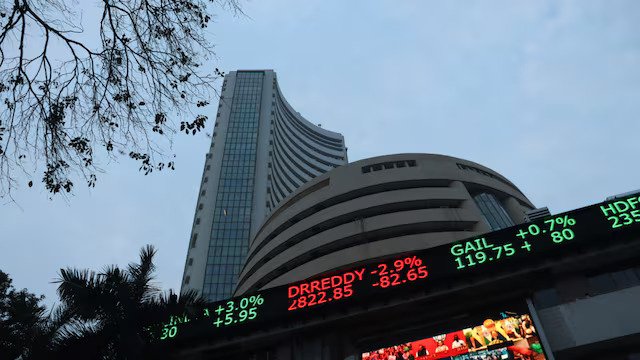

New Delhi: Indian equity markets came under sharp pressure following the presentation of Union Budget 2026–27, with benchmark indices sliding more than 1% in early trade before trimming losses later in the session. Investor sentiment was weighed down by an unexpected increase in securities transaction tax (STT) on derivatives, a larger-than-anticipated market borrowing programme, and the absence of any relief on capital gains taxation.
The sell-off reflected concerns that higher transaction costs and rising bond yields could hurt trading volumes, financial sector profitability and near-term market momentum, even as the Budget stayed largely within expected contours on growth and fiscal priorities.
STT hike triggers derivatives jitters
The most immediate trigger for the market reaction was the sharp hike in STT on derivatives. The tax on futures trades has been raised to 0.05% from 0.02%, while the levy on options transactions has increased to 0.15% from 0.1%—an increase of up to 150% in certain segments.
Market participants said the move could significantly dampen activity in the futures and options space, which has been a major driver of volumes and earnings for exchanges and brokerage firms. Traders warned that higher transaction costs may discourage participation, particularly among retail investors, at a time when derivatives volumes account for a substantial share of overall market turnover.
Borrowing programme adds to pressure
Adding to the unease was the government’s announcement of a record gross market borrowing of ₹17.2 lakh crore for 2026–27. The higher borrowing figure exceeded many street estimates and raised concerns about upward pressure on government bond yields.
Rising yields tend to hurt interest-sensitive sectors, particularly banks, by reducing the mark-to-market value of bond holdings. Banking stocks, especially state-owned lenders, came under notable selling pressure as investors priced in potential stress on treasury portfolios.
Certified Cyber Crime Investigator Course Launched by Centre for Police Technology
Capital gains expectations unmet
Markets were also disappointed by the lack of changes to capital gains taxation, an area where some investors had hoped for rationalisation to improve India’s competitiveness relative to global peers. While the Budget focused on compliance simplification and stability in direct taxes, the absence of relief on investment taxation added to negative sentiment in the immediate aftermath.
Analysts noted that while the capital gains framework was not worsened, expectations had been elevated due to discussions around aligning India’s tax structure with international markets.
Divergent views on lasting impact
Despite the sharp initial reaction, views remain divided on whether the Budget-related sell-off will have a lasting impact. Some market watchers believe the reaction was driven more by short-term positioning and surprise elements, particularly the STT hike, rather than any fundamental deterioration in the economic outlook.
Others pointed out that the Budget continues the government’s emphasis on infrastructure-led growth, job creation and industrial investment, which could support earnings over the medium term. From this perspective, the market reaction may fade as investors refocus on growth drivers and corporate fundamentals.
Sectoral churn reflects recalibration
The day’s trade saw pronounced sectoral churn. Banking and capital-market-linked stocks bore the brunt of selling due to yield and derivatives concerns, while select infrastructure-linked names found relative support amid continued capex commitments.
Traders said the divergence underscored a broader recalibration underway, with investors reassessing sectoral winners and losers in light of the Budget’s tax and borrowing signals.
What investors are watching next
Going forward, market participants will closely track bond yield movements, foreign portfolio flows, and clarity on the implementation of the higher STT rates. Any moderation in yields or signs of stabilisation in global risk sentiment could help equities regain footing.
At the same time, analysts cautioned that volatility could persist in the near term as markets digest the combined impact of higher transaction taxes and borrowing-led yield pressures.
Short-term shock, longer-term questions
While Budget 2026 has not altered the broad macro narrative, the immediate market response highlights investor sensitivity to changes that directly affect trading costs and liquidity. Whether the sell-off proves to be a brief reaction or the start of a deeper correction will depend on how quickly concerns around derivatives taxation and bond yields ease.
For now, Dalal Street’s verdict is cautious: the Budget’s growth push is intact, but the cost of market participation has risen, and investors are recalibrating accordingly.
